


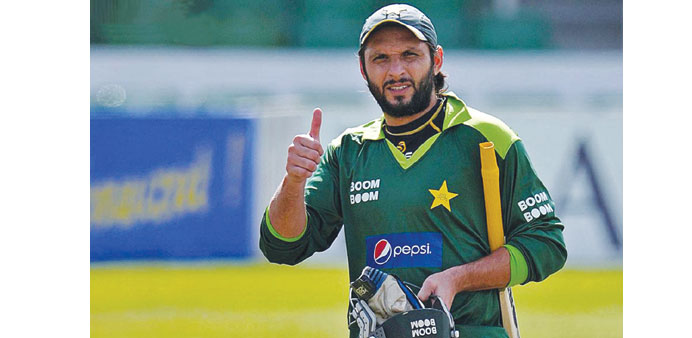
Shahid Afridi had criticised the Pakistan team’s ‘negative’ approach for their early exit from the World Twenty20, after the team’s return from Dhaka.
AFP/Islamabad
Pakistan cricket authorities yesterday demanded an explanation from star all-rounder Shahid Afridi after he criticised the team’s “negative” approach for their early exit from the World Twenty20.
Pakistan failed to reach the semi-finals of the tournament for the first time in five editions, prompting Afridi to take a swipe at the team’s batsmen who stumbled in their final match against the West Indies which they lost by 84 runs.
Sri Lanka won the title by beating India in the final in Dhaka on Sunday.
Subhan Ahmed, Pakistan Cricket Board’s (PCB) chief operating officer, confirmed Afridi had been served a notice, which can lead to a fine or reprimand.
“Yes, the PCB had served him with a show-cause notice on his interview,” Ahmed said. The PCB had forbidden the players from speaking to the media without prior permission.
Afridi, who is known for his hard hitting and plain speaking, had blasted the top order after they were bundled out for 82 runs chasing 167.
“It wasn’t a big total which couldn’t be achieved but the game slipped out of
our hands in the first six overs of our batting,” Afridi told reporters on team’s arrival last week.
“It was due to our negative approach in the first six overs, and that’s the reason we lost the match,” Afridi added.
A days after the team’s return, Twenty20 captain Mohamed Hafeez stepped down from his role, taking responsibility for the team’s failure.
Afridi, widely seen as the next Twenty20 captain, said he was ready to take the role. “I am ready to accept any challenge for the Pakistan team. As a player and as a captain I have no issues, but things should improve,” Afridi had said.
Sources close to Afridi said that he had replied to the notice, saying he spoke from his heart at the team’s failure.
Pakistani players have a history of paying fines and bans on violation of code of conduct, with former fast bowler Shoaib Akhtar fined 3.4 million rupees (around $34,000 in current conversion rates) and banned for 13 matches in 2007 over hitting teammate Mohamed Asif with a bat in an incident in South Africa.
Latif turns down Pak chief selector job
Pakistan cricket was hit by further controversy yesterday when former national team captain Rashid Latif changed his mind about becoming the chief selector despite having accepted the post last month.
“I don’t want to get into controversies and I don’t think this is the right time for me to accept this position,” Latif said.
Last month the Pakistan Cricket Board (PCB) issued a press release announcing that Latif would take over as chief selector from April 1. “I had got a contract from the board to sign it but I have declined and returned it to the board,” the 45-year-old Latif said, without giving any specific reasons.
However, sources close to the former wicketkeeper-batsman said he decided to step away because of differences with the board over the selection of the other members of the national selection committee and matters of authority.
“Rashid wanted former Test batsman Mohamed Yousuf as a selector but the board was reluctant to appoint him as he has been very critical of the PCB in recent times,” one source said.
Rashid has also been unhappy about the way the board reacted to the Pakistan team’s performance at this year’s World T20 tournament where they were knocked out before the semi-finals.
The former captain told the state-owned PTV sports channel it was not right for the board to allow Mohamed Hafeez to step down as T20 captain because the entire team had performed badly.
Yousuf said he supported Rashid’s decision to decline the offer if he was not getting a selection committee of his choice.
“If a designated chief selector can’t pick his members on the selection committee than how does the board expect him to deliver results,” Yousuf said.
Latif has remained an enigmatic figure in Pakistan cricket and been at odds with the establishment since he played a crusader role in exposing the match-fixing scandal in Pakistan cricket in the 1990s.