


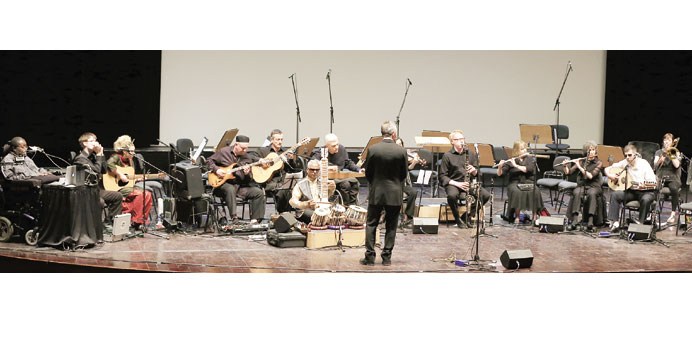
DEEPLY MOVING: Charles Hazlewood conducting the Paraorchestra. Photos by Jayan Orma
It took the Paraorchestra only the first few minutes of their half hour-long first performance to shun any doubts in anyone’s mind about their performing abilities, writes Umer Nangiana
Awesome is a much overused term, but one could genuinely ascribe it to this half-an-hour treat of inter-continental melodies woven in perfect orchestration. Disability? Where was it? The British Paraorchestra performing alongside Qatar Philharmonic Orchestra (QPO) for the first time ever in Doha were “definitely able”, more than just able, in fact.
Some of the members of the Paraorchestra were extraordinarily melodious. With a tweak provided by the QPO members sitting right behind them, it was mainly the Paraorchestra that set down the tone for the track ‘Madness’ and they seemed to take it to the height of insanely beautiful music.
A more than minute-long standing ovation from the house on their first performance was a tribute to how profoundly they touched a chord. This was undoubtedly one of the best musical performances the Doha audience would have ever experienced.
With their individual varieties in the world premiere of ‘Madness’, they truly took the listeners, as their founder and director, an internationally renowned conductor, Charles Hazlewood predicted, “to a journey of continent-hopping.”
Steph West came in with her harp, Guy Llewellyn and Chris Melling presented their French horn and trumpet respectively, Liz Hargest was on flute, Amelia-Rose Hamilton on piano and 17-year-old Oliver Cross chipped in with his harmonica to create a blend of music that touched every heart in the multi-cultural Doha throng.
Three musicians, however, stood out from others. It was not that the others were below par; it was only the instruments in the hands of these three maestros were different and unique. The mesmerising sounds came from Tom Doughty’s Lap Slide Guitar, Gemma Lunt’s viola and Baluji Shrivastav’s tabla, sitar and dilruba (classical musical instruments from sub-continent).
It took the Paraorchestra only the first few minutes of their half hour long first performance to shun any doubts in anyone’s mind about their performing abilities. The wheel-chairs and the dark glasses were no longer visible.
It has been “a helluva job” for Hazlewood, however, to convince the world that these men and women are equally able.
“Ladies and gentleman, this is just a beginning of a global mission and we are thankful for your trust,” said the director of the Paraorchestra. “Lack of trust among people has been the problem that we have been facing and we have to change people’s thinking,” Hazlewood emphasised while addressing the audience at the beginning of the next performance.
It was the American composer Charles Ives’s work called ‘The Unanswered Question’. Again, they paired with QPO here.
Scored for three groups; a string ensemble playing offstage, a solo trumpet, and a woodwind quartet, the composition was played in independent tempos and it sounded like three layers of music put over each other. It worked this way, as intended by the original composer, the trumpet asks the question which the quarter tries to answer six out of seven times while the strings play on, just to contribute background music.
It was as marvelous as Hazlewood promised it would be. QPO was performing strings in the part from one of the corridors, invisible to the audience; only a smooth melody reaching their ears.
It was in the next composition soon after a song performed by a Doha-based female singer that Doughty emerged from among the chorus with his lap slide guitar. No words can describe the beauty and the depth of the tunes he played on the guitar with his small fingers.
When he performed, even the ablest of the musicians from QPO looked on in awe. It was a next level guitar.
“It is a lap guitar and it is hollow — that is where the resonance comes from, it has no neck. They were originally made for the Hawaiian music release in the 1920s but they are coming back in fashion,” Doughty told Community. He has even invented his own techniques of playing the slide guitar.
“I have pitched rhythm sustained tone and even now I am using a glass tube on a finger, I can vary the tone so much by the way I attack the strings,” the great guitarist said. He has been playing slide guitar for 30 years.
Doughty became completely disabled following a tragic accident in 1974. His impairment also affected fingers and prevented him from playing music but his love and passion for the latter won in the end. He soon found ways around his restraints and invented techniques to suite his new style. He had to relearn his own style, he said.
About the collaboration of the Paraorchestra with QPO, Doughty was thrilled. “This was the first time I played with the orchestrations behind us and I was really moved by it, close to tears during the whole period. It really got me. Beautiful,” he said.
The other maestro sitting right in front of Doughty in the ensemble was Baluji Shrivastav from Agra, India. His sitar, dilruba and tabla were just ecstatic and full of feeling. At one point in a “drooping and melancholic” piece, a British folk song Greensleeves, Shrivastav cut in with his Raga (a melodic mode in Indian classical music) to take the entire arrangement to an all new high.
Permanently deprived of vision at the age of eight-month, Shrivastav has been an ardent student of classical music since childhood. Currently based in London, he has formed his own Jazz ensemble. Besides composing music for contemporary dancers and singers from India, Shrivastav has performed with renowned musicians and bands such as Stevie Wonder, Massive Attack, Annie Lennox, Madness, Andy Sheppard and Guy Barker. He was one of the early ones to be called to join the ensemble when Hazlewood decided to form the Paraorchestra.
“They invited me to join the group. I am one of the founding members,” he told Community in a post-performance talk. “God grants everyone some ability. Okay, blindness is one disability but we can do everything else. But these people with other disabilities are very patient. We do not have that level of patience and I am learning the same patience from this orchestra,” the maestro said of his passion for the orchestrations with his group.
“I was playing Banjo (a guitar-like stringed instrument) and suddenly, my hand went to this instrument and I asked my teacher to give it to me. He said you were too small for it. I insisted and when finally, he gave it to me, I started playing the same tunes on it that I was playing on the Banjo and he was amazed,” Shrivastav said of how he came to know a sitar at the blind school where music was a compulsory subject.
He can play every eastern musical instrument with authority. Every member of the Paraorchestra was a source of inspiration, and a story of courage.
“It is an orchestra of individuals, even though they do play beautifully together but every one of them is adding value, introducing fresh colour, perspectives, ideas,” Hazlewood, the Director, told Community.
“When I started to put the word out, musicians just started to emerge like angels. There were few people I had heard about because it is a very small network and there are not many musicians like this but in a matter of weeks more and more people started to come in,” Hazlewood said, explaining how he assembled the orchestra.
There were now 30 members at the orchestra in London. The multinational aspect of London life helped make the group multicultural. “If you form an orchestra and you are based in London, inevitably, you are going to get all people from different backgrounds,” Hazlewood added.
As the world’s first professional ensemble of disabled musicians, founded by Charles Hazlewood and television director Claire Whalley in January 2012, the British Paraorchestra is pioneering a global movement to recognise and showcase their extraordinary abilities. Their visit to Doha was part of Sasol’s ‘Definitely Able’ corporate social responsibility initiative.
Launched in 2012, the campaign raises awareness around public engagement and social acceptance for people with special needs and highlighting the possibilities that exist for disabled individuals. The initiative was launched with a focus on sport, in collaboration with the Qatar Olympic Committee and the Qatar Paralympic Committee and has now been expanded to demonstrate excellence in music and culture.
The big plan for the Paraorchestra is to grow the European Super Group to play at the next Olympic Games, Hazlewood said. “We have made some really good friends here and there seems to be real willingness to continue the friendship,” he said, and hoped to return to Doha sometime in the future.
BELOW:
1) MELANCHOLIC: Baluji Shrivastav on Dilruba (in the front) and Tom Doughty (first from right) with his Lap Slide Guitar in action.
2) THE CAST: Ziad Sinno (first from left) with his musical instrument Oud, Charlotte White (first from right) and Steph West on harp (middle first row).