


Reuters/London
A Faberge Imperial Easter Egg made for Emperor Alexander III of Russia and not seen in public for more than a century will go on show in London after being saved from the melting pot by an American scrap dealer who only accidentally realised its value.
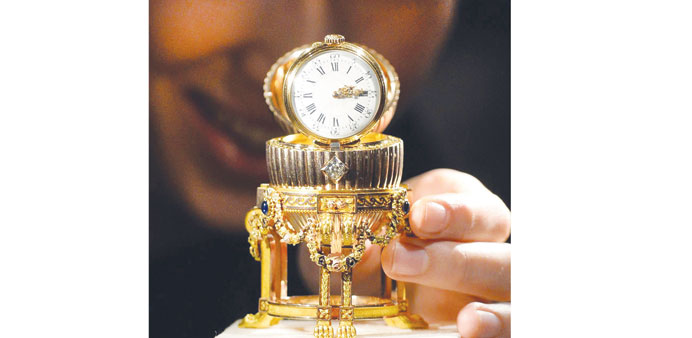
The Lost Third Imperial Easter Egg was made by Peter Carl Faberge as a gift for Empress Maria Feodorovna for Easter 1887. The 8.2cm tall egg, made from gold and studded with diamonds and sapphires, was last displayed in St Petersburg in 1902. It was seized by the Bolsheviks during the 1917 Russian Revolution and mysteriously made its way to the US.
By chance, an unidentified man bought it at a market in the US Midwest for $14,000, intending to sell it for scrap.
Unable to find a buyer, he searched the Internet and realised that he may have found Empress Maria Feodorovna’s lost Easter egg. London antiques dealer Wartski, which specialises in the work of Faberge, bought the egg for an unidentified private collector who has permitted it to go on show in its small showroom near London’s luxury shopping strip Bond Street.
“For the art historical community and for the Faberge world, I think we had to say that it was found. It’s like finding a missing Rembrandt and you didn’t tell anybody,” Kieran McCarthy, director of Wartski, said. “It may disappear again and may not be seen for, who knows - I would not be surprised if it didn’t come out for another 112 years,” he said.
Slightly taller than a cup cake, the ridged yellow gold egg sits on its original tripod with lion paw feet. It is encircled with gold flower garlands strung from cabochon blue sapphires topped with rose diamond-set bows. Like all Fabergé’s eggs, it contains a “surprise” - a lady’s watch by Vacheron Constantin with a white enamel face and diamond-set gold hands.
The watch has been taken from its case and mounted in the Egg so it can be displayed upright. The egg was made in the St Petersburg workshop of Faberge’s chief jeweller August Holmstrom between 1886 and 1887. “In the hierarchy of Faberge objects, the egg occupies the very, very highest level,” said McCarthy. “They each took a year to make from the original conception to the completion of it for delivery on Good Friday each Easter.”
Faberge eggs are considered masterpieces, affordable only by royalty or the very rich.