


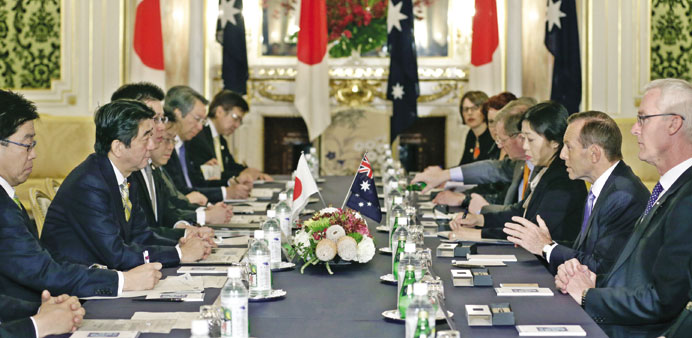
Australia’s Prime Minister Tony Abbott (2nd from right) talks with Japan’s Prime Minister Shinzo Abe (2nd from left) during their summit talks at the state guest house in Tokyo yesterday after announcing a free trade agreement between the two countries.
AFP/Tokyo
Japan and Australia said yesterday they had reached “substantive agreement” on a long-awaited free trade deal, in a rare opening of Japan’s protected markets.
The deal was announced as Japanese Prime Minister Shinzo Abe and visiting Australian Prime Minister Tony Abbott held a briefing.
Abbott said it was the first time Japan had negotiated a comprehensive economic partnership agreement or free trade deal with a major economy.
“We have reached a substantive agreement on our Japan-Australia EPA (Economic Partnership Agreement) negotiations that began in 2007,” Abe said.
“We intend to proceed with work to sign the agreement as early as possible.”
Japanese media reported Australia would drop its 5% duty on small and mid-sized Japanese cars, while Tokyo had agreed to cut its steep tariff of 38.5% on Australian beef by up to half for some varieties.
Abbott said the deal marked “truly an historic occasion for both of our countries”, with the pair also agreeing to boost cooperation in security, including joint development of defence equipment.
Kyodo news agency reported the deal would likely be signed in the summer and come into force in 2015.
It should give Australia a further edge over the US in the field of agriculture. In 2011, 64% of the beef imported into Japan was from Australia compared with 26% from the US, according to government data.
Under Abe, Tokyo has also entered into talks on the Trans-Pacific Partnership (TPP), a proposed free trade deal that would encompass 12 nations including the US and Japan.
The deal between Japan and Australia could help “break the stalemate” over the TPP, Kyodo said.
But there are major sticking points among various nations, including the opening of protected domestic markets such as agriculture and automobiles.
Japan has long been accused of protecting its domestic industries – including the politically powerful agricultural sector – with high trade and other non-tariff barriers, while many of its own exports, including vehicles and electronics, enjoy big sales overseas.
The US has expressed frustration with Japan over its stance on excluding certain sectors from the TPP, as talks continue.
Tokyo is also in separate free-trade negotiations with the European Union.
Today Australia is set to sign a free trade pact with South Korea after four years of negotiations. After Seoul, Abbott will head to China.
The agreement to boost security cooperation come as Japan last week loosened a self-imposed ban on weapons exports in a move which unnerved China.
“We decided to start talks towards an agreement on a co-operative framework in the areas of defence equipment and technology,” Abe said yesterday evening.
The Australian premier attended a national security council meeting in Tokyo earlier in the day, a first for a foreign leader, as he called for peace in the region.
“This will be the Asian century,” Abbott said.
“I think that’s true: The better Asia is, the better the world will be,” he added.
Regional tensions have soared as China and Japan lock horns over the ownership of islands in the East China Sea. Beijing is also embroiled in a dispute with several nations over islands in the South China Sea, which it claims almost in its entirety.
An unpredictable North Korea hangs over the regional power balance. Abbott’s visit came as Tokyo said last week it would cancel its annual Antarctic whaling hunt to abide by a UN court ruling.
Australia, backed by New Zealand, hauled Japan before the International Court of Justice in 2010 in a bid to end the annual Southern Ocean hunt.
The trade deal with South Korea calls for Canberra and Seoul to remove almost all tariffs on traded goods within 10 years of the agreement going into effect.
Australia will abolish a 5% import tariff on most South Korean-made cars while a five% tariff on other South Korean exports such as TVs, refrigerators and machinery would also be eliminated immediately.