


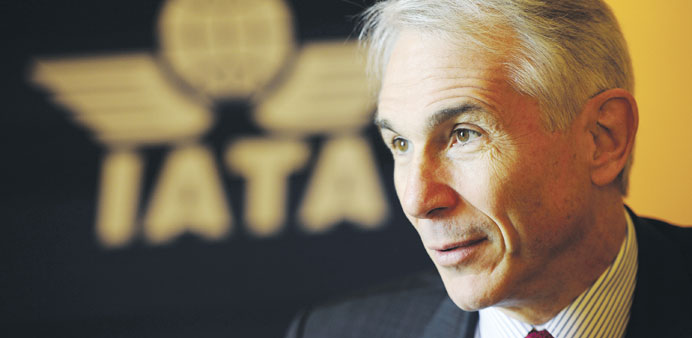
The International Air Transport Association (Iata) called for regional co-operation and global standards to support the continued success of aviation in the Gulf region.
“A strong vision for aviation’s future supported by co-operation and global standards has laid the foundation for a very successful air transport sector. That foundation becomes stronger the more we work together as partners. I am absolutely confident that the Gulf region will play an even more crucial role in aviation’s second century,” said Tony Tyler, Iata’s director general and CEO in a keynote address to the Global Aerospace Summit in Abu Dhabi.
The fast-growing Gulf area is at the centre of the success of Middle East aviation. Airlines in the Middle East are expected to contribute a record $2.2bn to the industry’s expected global profit of $18.7bn in 2014. Driven by the high-speed growth of airlines in the Gulf, the Middle East region’s share of global traffic increased from 4% to 9% in just over a decade.
Aviation has become a key contributor to local economies. In the UAE (UAE) over 430,000 jobs and 14.7% of the gross domestic product are linked to aviation and aviation-related tourism.
“Aviation in the Gulf is a great success story and air traffic gridlock should not become its Achilles’ heel. Airspace is finite. So capacity can only grow with efficiency. Each country has invested in impressive technology. But effective management needs regional and international teamwork. The players in the region urgently need to buy in to a vision for seamless airspace management in the region and then work together in a team effort to make it happen,” said Tyler.
“Airspace congestion is a real and rising problem. And it grows with each new aircraft that is delivered. Unless it is dealt with expeditiously, the efficient hub operations, which are supporting the region’s success will begin to unravel,” said Tyler.
Iata identified opportunities for progress in two areas. Firstly the flexible use of military airspace with between 40% and 60% of airspace in the Gulf is reserved for military use. “We are trying to squeeze the fast-growing civil aviation component into a fraction of the airspace. One solution is to develop partnerships and trust with the military to open more flexible use zones. That is happening progressively—but it is not keeping pace with demand for air travel,” said Tyler.
Second are is to focus seamless use of airspace. Historically, the Arabian Peninsula was operated as one flight information region (FIR) from Bahrain. “From the early 1980s it began to be fragmented and today there are six FIRs. For an airline, the important thing is to get from point A to point B as smoothly as possible. The challenge for the air navigation service providers is to work together to make that happen as seamlessly across six FIRs as if there were one,” said Tyler.
“Learn from the mistakes of Europe. The single aviation market created enormous demand for air connectivity. But this was not matched with a single European sky. The result is an inefficient and fragmented air traffic management system that is a burden on European competitiveness,” said Tyler.
Iata urged the region to continue to base its growth on global standards. “Global standards provide a common language for industry partners to work together. I would attribute a large part of the success of aviation in the Gulf to the importance that the stakeholders in the region—namely, governments and industry—have placed on them. Stay the course and resist the urge to fragment global standards with local variations,” said Tyler.