


By Al Jacinto/Manila Times
The UN is alarmed by the dismal conditions of tens of thousands of war refugees living in filthy evacuation centres and transition sites in Zamboanga City in southern Philippines.
More than 100 refugees died from diseases in the evacuation centres. The refugees were villagers affected and displaced by rebel attacks mounted in September by the Moro National Liberation Front under Nur Misuari. The attack sparked three weeks of street battles that killed and wounded over 400 people and displaced some 120,000 villagers.
“There is an urgent need to find shelter solutions for these IDPs,” said Jens Laerke, spokesperson for the Office for the Co-ordination for Humanitarian Affairs (OCHA), at a press briefing in Geneva, referring to internally displaced persons.
Laerke said in the immediate aftermath of the fighting, OCHA announced that the UN emergency relief fund will allocate $3mn to assist those affected by the violence. More than 10,000 homes were destroyed in and around Zamboanga City and, additionally, nearly 19,000 were displaced in Basilan province.
Citing current figures from the Department of Social Welfare and Development, Laerke said the remaining IDPs lack access to adequate and safe water and sanitation.
Overcrowding in the two biggest evacuation centres, including the Joaquin Enriquez Memorial Sports Complex, is feared to have triggered outbreaks of acute respiratory infections, diarrhoea and skin diseases.
“There is, for example, a need for 940 extra latrines to meet global standards. There is also a water shortage because of rationing imposed last month as reservoirs were low in the dry season,” Laerke said.
He added that food distribution to the affected region ended in December 2013. However, nearly 12,000 IDPs and returnees continued to benefit from food-for-work programmes, and 11,000 children had received emergency food in their schools.
Laerke said the Zamboanga City government had requested support from humanitarian agencies to assist the families still in evacuation centres and transition sites.
“Local authorities have begun implementing their recovery and rehabilitation plan looking at longer-term livelihoods programmes,” he said.
Just recently, hundreds of Muslims protested the government’s failure to facilitate the return of refugees to their villages.
The refugees, many of them Tausugs from Sulu; Yakan from Basilan; and indigenous Badjao tribe from Tawi-Tawi — engaged in fishing and other traditional livelihoods — were being relocated to the far-flung villages of Tulungatung and Taluksangay in the coastal villages of Rio Hondo and Mariki and other areas.
The government has built bunkhouses as temporary shelters for those affected by the violence, but has also warned that villagers who are not natives of Zamboanga will not be allowed to return to their homes unless they can provide certificates to show they are landowners.
Gammar Hassan, one of the refugee leaders, said more than 100 people had died from diseases in the past months in evacuation sites and the deaths are continuing due to poor health services and malnutrition and lack of medical and emergency facilities there.
Hassan said majority of the refugees oppose the government’s relocation plan to put them in other areas, saying it would be extremely difficult for them to rebuild their lives. He also urged the local government to allow the refugees to return to their places instead of holding them in evacuation centres.
“Build back better till we all die in pain. Who will enjoy the promised development and rehabilitation? Send us home now, not tomorrow,” Hassan said.
Just before Christmas last year, President Benigno Aquino flew to Zamboanga City and inspected the refugees’ temporary shelters. Aquino assured the refugees his administration is working closely with various agencies to rebuild houses destroyed during the war.
Aquino said the government already spent some P273.8mn in relief aid and cash-for-work programmes for displaced Zamboanga residents. He said P3.5bn more was allocated for the rehabilitation efforts, in addition to the millions of pesos that the provincial government of Sulu has sent to Zamboanga to help feed the refugees.
The provincial governments of Basilan and Tawi-Tawi and other
non-governmental organisations and private companies also donated cash and food aid to refugees in Zamboanga.
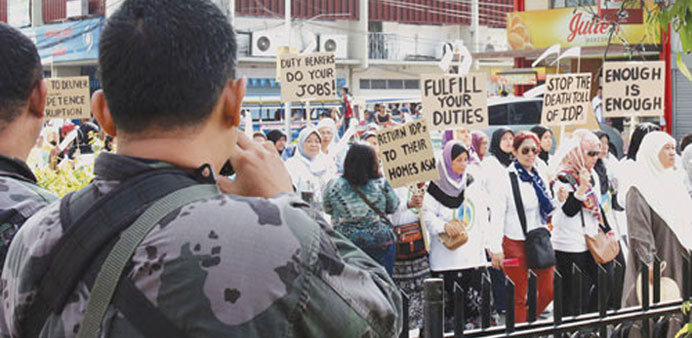
Zamboanga City residents who lost their homes during last year’s siege, protest the government’s failure to address dismal conditions in evacuation ce