


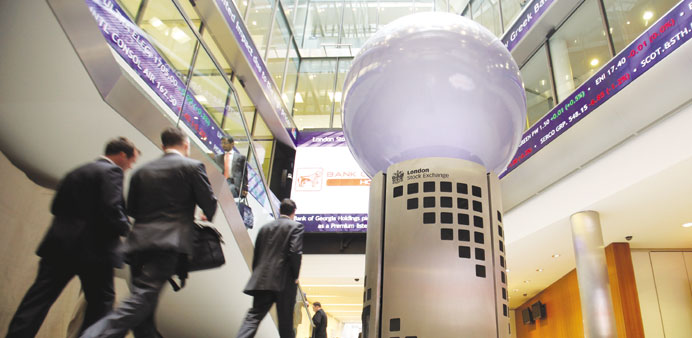
Visitors pass a sign inside the London Stock Exchange (LSE) headquarters in London. LSE said last month it was looking at introducing a ‘mid-session auction’ as a way of offering investors some of the advantages of anonymous trading.
The European Union’s plan to cap the number of shares that can be traded anonymously could give traditional stock exchanges such as Deutsche Boerse and the London Stock Exchange the chance to win back some of the ground they have lost to new rivals.
Anonymous dealing in private venues known as “dark pools” has been a major source of growth for new electronic share trading companies such as Chi-X Europe and Liquidnet.
But EU regulators are concerned such venues could be open to market manipulation and that they take away liquidity from public exchanges, potentially making them more volatile.
As a result, they have drafted a set of reforms that will limit the proportion of a company’s shares that can be traded anonymously to 8%.
That could give traditional exchanges an opportunity to win back business, which some are already exploring.
Last month, the London Stock Exchange (LSE) said it was looking at introducing a “mid-session auction,” as a way of offering investors some of the advantages of anonymous trading, while remaining within the new regulations. “Potentially, it would affect the way we do business if it became popular and provided significant liquidity,” said Christopher Hughes, equity dealer at Royal London Asset Management, of the LSE’s proposal.
Traditional exchanges were hit hard by a series of EU reforms in 2007 which sought to promote competition in equities trading. The reforms led to the rise of new dealing venues which offered a wide range of trading options, often at a lower cost for investors, including anonymous trading in “dark pools.”
These proved popular among investors who complain that when they execute a large order on a public exchange, other dealers can see what they are doing and so can move the price against them. In “dark pools,” investors place buy or sell orders anonymously, and are matched up automatically. Following the market liberalisation, the LSE has seen its share of European equities trading drop from a leading position of around 18% to 11.7%, according to Thomson Reuters EMSR data.
Meanwhile, Chi-X Europe has captured 16.8% of the market, with 16.9% of that due to “dark” orders. TABB Group, a consultancy, has estimated “dark pool” trading is equivalent to 11% of the European stock market. Traditional exchanges have tried to compete by creating their own anonymous trading venues or striking partnerships with those run by others. The LSE, for example, has its Turquoise platform, while Swiss stock exchange operator SIX Group has partnered with “dark pool” operator Liquidnet since 2011.
But now regulators are clamping down on anonymous trading, traditional exchanges are looking at new ways to win back customers wanting to execute big orders.
The LSE believes an intraday auction could be one such way.
During the auction, normal trade would be suspended and buyers and sellers would be able to place orders, with an algorithm used to determine the price.
This could offer an advantage over “dark pools,” where buyers and sellers submit the price at which they would like to trade, but may not be able to get the deal done if they cannot find a counterparty prepared to do business at that price.
“When you hit the 8% cap (for anonymous trading)... what are the alternatives for executing larger trades if you don’t have a dark pool, or access to one? An intraday auction is one option,” Brian Schwieger, LSE’s head of equities, said.
“This is how we’re offering an alternative to dark pools; this is how we’re responding to that.”