


|
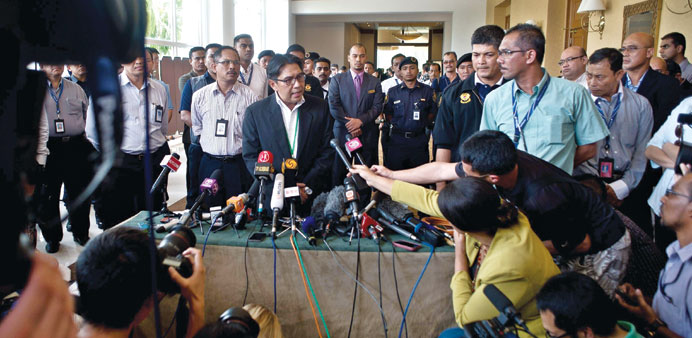
The ongoing mystery of what happened to flight MH370 continues to raise questions almost four weeks on about the aircraft’s bizarre disappearance. |
Everyone is looking for answers – the media, the families, the experts, the analysts and, not forgetting the travelling public.
Yet against on onslaught of criticism from different quarters about the timely and selective release of information to the public at large, Malaysia Airlines faces an uphill battle of a different kind.
How to rebuild its reputation and image as the saga continues to baffle the watching world.
Whether it has been deliberately withholding information, which is difficult to believe, or genuinely doesn’t have answers to the unfolding drama, one thing is clear. Internal confidence would have hit a low.
Malaysia’s national airline has to pick up the pieces and fast, while running a business that must go on. As they say in the corporate world, business continuity is a must in any crisis. How this is managed will be judged by the outside world. Either the corporate earns brownie points or faces the wrath of critics.
Image consultants would be hard at work in the background preparing strategies to help lift Malaysia Airlines out of its current gloom. The airline would inevitably be flooded with levels of support and advice from professionals around the world seeking, in part, to capitalise on the events of recent weeks.
But it has to tread carefully with the approach bearing in mind the huge sensitivities of unfolding events.
Flights must continue to operate; seats have to be sold; planes require filling; products need promoting; salaries need to be paid and, most of all, sales people must continue relationship building with the travel trade and corporates at this difficult time. Business cannot stop.
Any message disseminated, whether in a press release, advertisement or even through social media, will come under intense scrutiny. This has been evident with the information flow surrounding MH370 and the missing 239 passengers and crew feared doomed in the Indian Ocean.
Advertisements with images and phrases connected to oceans, luxury, paradise, comfort, Boeing 777, are a no, no.
Unfortunately, fake ads like the one doing the rounds on social media recently purporting to be from Malaysia Airlines will not help the cause.
‘Lose yourself on a journey of epic proportions, wherever you go, no one will ever know’ was a false campaign using an image of an Airbus A380 instead of a Boeing 777, the aircraft-type at the centre of the crisis.
The viral ad was a rehash of the airline’s marketing campaign two years ago yet the sick joke can only inflame rather than appease the current situation.
Airlines love talking about their cabin interiors, the spacious seats, those exquisite features, warmth hospitality and superb service.
All of the above are hallmarks of the Malaysia Airlines distinct offering.
But this is not the time to inject marketing dollars on promoting the above.
Malaysia Airlines has clearly put the brakes on promotional activities, and rightly so.
An airline website would typically promote an array of products and services, special fares and hype up new routes and frequency increases on existing ones.
Malaysia has stripped out the fluff and colour that once adorned its home page, replacing it with content related to the missing aircraft. Videos are posted featuring senior customer service staff and management led by the Group CEO Ahmed Jauhari Yahya with three-minute personal messages. The compassion, support and trauma felt within the Malaysia Airlines’ community for families and others involved in this extraordinary series of events.
Just over a year ago, I was in Kuala Lumpur attending the official launch of Malaysia Airlines (MAS) entry into the global airline marketing alliance oneworld.
MAS held an induction ceremony to welcome its new-look oneworld livery, hosted a lavish gala dinner and flew in a posse of international aviation and business journalists to cover the celebratory events that included a press conference with member airline CEOs and a cake-cutting send off for the first MAS/oneworld flight.
Coincidentally the first departure was from Malaysia to China, the country where MH370 was also bound with mainly Chinese nationals onboard.
Huge investment was pumped into marketing the alliance with full-page ads splashed across leading local and international newspapers.
How times have changed since then with the mood turning sombre 180 degrees in these times.
Malaysia Airlines will want to resurrect marketing activities but at the right time and with the right message. The right time is still far away but an action plans needs to be in place to address the issue.
If no wreckage of MH370 is found for weeks, months or, as it has been suggested, years, MAS has a tough time to find that right time to get back on track with promotional activities and messaging on the scale it has so been used to in the past, to continue operating as normal as possible as if nothing happened.
The airline will have to counter another problem. A drop in bookings from one of its key markets, China, where the airline is experiencing cancellations by agitated Chinese travellers responding to concern over lack of information about what happened to the aircraft.
Malaysia Airlines flies to six cities across China – Beijing, Shanghai, Guangzhou, Kunming, Xiamen and Hong Kong – so a drop in bookings has a significant impact.
In the first two weeks of the incident, China’s largest travel booking website Ctrip.com reported the number of Chinese clients heading to Malaysia down 50% on the same period last year, claiming this was as a direct result of the crisis surrounding the missing jet liner.
China’s popular film star Chen Kun, who has a staggering 72mn followers on the micro blogging site Weibo, has urged travellers to boycott Malaysia.
With 1.8mn Chinese travellers to Malaysia, China is the third largest source of visitors to the south-east Asian nation, in which tourism is the sixth biggest contributor to the gross domestic product. For sure, a drop in high-spending Chinese visitors will hurt the tourism industry in the short term.
Ironically, in a period designated Visit Malaysia Year 2014 and with an award-winning tourism campaign Malaysia Truly Asia aimed at boosting worldwide arrivals from 24mn to 28m, the country has its work cut out to get back on track.
The PR and marketing teams at Malaysia Airlines will have to go into overdrive alongside friends at the Malaysia Tourism Promotion Board at some stage soon to ramp up efforts with a commercially driven strategy for the next phase of this evolving crisis – rebuilding its image and reputation.