


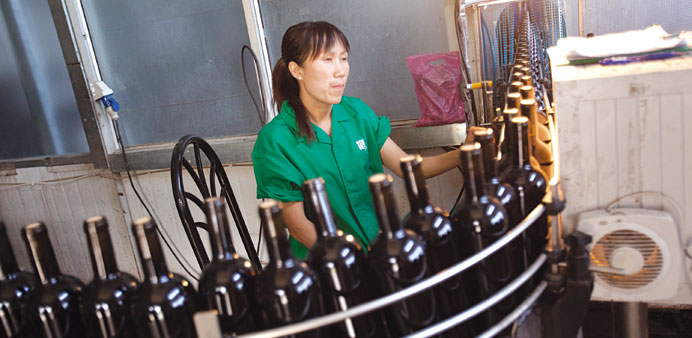
A worker is seen at the Cofco’s plant in Shacheng, Hebei province. China’s largest grain trader yesterday agreed to pay $1.5bn upfront for just over half of Noble’s agricultural trading unit.
Bloomberg/Beijing
Cofco Corp, China’s largest grain trader, agreed to pay $1.5bn upfront for just over half of Noble Group’s agricultural trading unit to broaden its access to food supplies.
The purchase highlights China’s push to secure more food overseas as it juggles insufficient farming resources at home against a dependence on imports. It’s the second such deal for Cofco this year after it agreed to buy a majority stake in Dutch grain trader Nidera BV in February.
“The transactions will strengthen Cofco’s strategic importance to the Chinese government,” as the “resultant access to Nidera’s and Noble’s agriculture assets overseas will allow China to better meet its increasing demand for agricultural products,” Kai Hu, a senior credit officer with Moody’s Investors Service, said in a note yesterday.
The deal creates a venture that will be Cofco’s main base for sourcing food materials internationally, according to a statement yesterday from Hong Kong-based Noble, Asia’s biggest commodity trader by sales. It will integrate with the food raw material processing assets owned by Cofco, Noble said.
Cofco will share the investment with an international group led by Hopu Investment, a private equity fund. Hopu was set up by Fang Fenglei, the chairman of Goldman Sachs Group’s Chinese securities venture. Noble’s chief executive officer Yusuf Alireza, who will head the operation on an interim basis, joined the Hong Kong trader from Goldman Sachs in 2012.
Noble rose 5% to S$1.255 at the close of trade in Singapore, the highest since November 2012. The benchmark Straits Times index fell 0.2%.
The initial payment of $1.5bn will be adjusted to equal 1.15 times of the audited book value for the 51% stake in the unit, Noble said. The unit has $2.5bn of debt and sales of about $14.9bn last year.
The transaction comes after a unit of Temasek Holdings Pte., Singapore’s state-owned investment company, last month offered to take over Olam International in a deal that values the company at S$5.3bn ($4.2bn). Olam, one of the world’s top three coffee and rice traders, had sales of $16.8bn last fiscal year ended June 30.
“Global demand for agricultural commodities is steadily rising, driven by population growth, increasing incomes and changes to a more protein-rich diet in key importing countries” led by China, Noble said. A deal with Cofco gives Noble greater access to capital and connects it directly with Chinese consumers, the company said. Noble’s agribusiness, the smallest of its three units, includes sugar mills in Brazil, grain elevators in Argentina, and oilseeds crushing plants in China, Ukraine, South Africa, and South America. The business, with 45 assets and more than 13,000 staff in 60 locations, had an audited book value of $2.8bn as of December 31, Noble said.
Weighed down by low sugar prices and weak oilseeds crushing margins, the agribusiness unit booked an operating loss in 2013, contributing to a 48% drop in Noble’s full-year profit. The company’s biggest division by operating income is its energy unit, followed by its metals business.
The deal valued Noble’s agricultural unit at more than double some market estimates and allows the company to take off its books its biggest drag on earnings, Credit Suisse Group AG analysts Gerald Wong and Louis Chua said in a report yesterday. “We view the disposal as a significant positive as our key concern for Noble has been earnings weakness in the agriculture division,” Wong and Chua said. They raised their recommendation on the stock to outperform, from underperform.
China is considering cutting the ratio of the nation’s total food crop relative to consumption to 80% from 95%, meaning it would allow more imports, two people with knowledge of the plan said in January. The annual agricultural policy statement is still under review, the people said at the time.