


Reuters/Washington
The European Central Bank should ease monetary policy to combat dangerously low inflation that could crimp eurozone output and consumer spending, the head of the International Monetary Fund said yesterday.
ECB policymakers meet today and are not expected to announce any new measures to fight weakness in Europe’s economy. But a drop in the region’s rate of inflation is putting pressure on European central bankers to take more action.
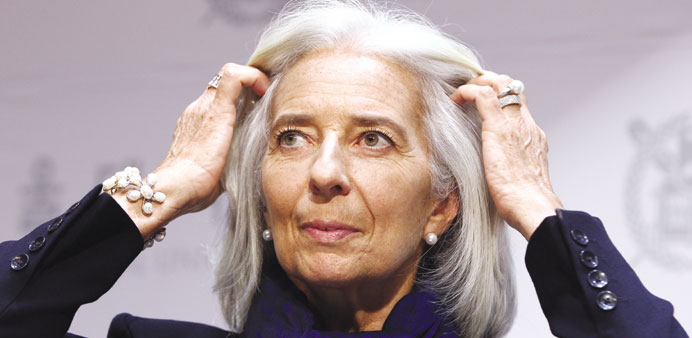
“More monetary easing, including through unconventional measures, is needed in the euro area,” IMF Managing Director Christine Lagarde said in a speech that outlined the Fund’s policy recommendations ahead of its spring meetings in Washington next week.
Lagarde said the world’s economy should pick up pace above 3% this year and next, but she warned the recovery from the global financial crisis remained weak. She cited slow price growth in the eurozone, geopolitical tensions in places like Ukraine, and market volatility as factors that could drag on growth in the short-term.
“In 2013, global growth was about 3%; we project modest improvements in 2014 and 2015, although still remaining below past trends,” Lagarde said at the Johns Hopkins School of Advanced International Studies. “The risk is that without sufficient policy ambition, the world could fall into a medium-term low-growth trap,” she said.
The eurozone’s inflation rate fell last month to the its lowest level since November 2009, according to data released on Monday. Prices rose 0.5% in the 12 months through March, down from 0.7% in the year through February.
Lagarde also urged the Japanese central bank to keep trying to stimulate that country’s economy.
“The Bank of Japan should also persist with its quantitative easing policy,” Lagarde added. She also warned that geopolitical tensions could hit growth if they got out of hand. Russia has been in a stand-off with Western nations over its annexation of the Crimea region, prompting economic sanctions from the US and the European Union. “The situation in Ukraine is one which, if not well managed, could have broader spillover implications.”
Spillovers are also a risk from the US Federal Reserve’s gradual winding down of its massive monetary easing program, which has hit emerging markets as investors bet on higher US interest rates.
Lagarde reiterated the IMF’s calls for greater cooperation among monetary policymakers to limit the impact of the Fed tapering of its monthly bond purchases, as the problem could also “spill back” to the US.
Meanwhile the number of conditions the International Monetary Fund attaches to its loans has grown in recent years, despite promises to limit what critics see as onerous requirements, according to a study released yesterday.
The Eurodad network of European development groups also said nations desperate for cash are at a disadvantage in their dealings with the IMF, likening them to negotiating “at the barrel of a gun.”
The IMF attached nearly 20 conditions on average to each loan it approved in the past two years, Eurodad found. That was more than the number the group had calculated in two prior reports.
Many of the conditions also focused on politically contentious areas, such as public sector wage cuts or private sector reform, according to the report. Eurodad looked at the period from October 2011 to August 2013, covering 23 loans.
In a 2011 review, the IMF promised to keep “conditionality parsimonious and focused on macro-critical issues.”
The Eurodad report said: “The IMF is going backwards - increasing the number of structural conditions that mandate policy changes per loan, and remaining heavily engaged in highly sensitive and political policy areas.”
The results were partly skewed by the biggest IMF loan programs during the period covered. Loans to Cyprus, Greece and Jamaica accounted for 87% of all funds approved, and had an average of 35 conditions each, Eurodad said.
In the case of Cyprus and Greece, they were shaped by the IMF’s European-dominated executive board, which demanded strict budget cuts in exchange for aid, said Eurodad’s director, Jesse Griffiths.