


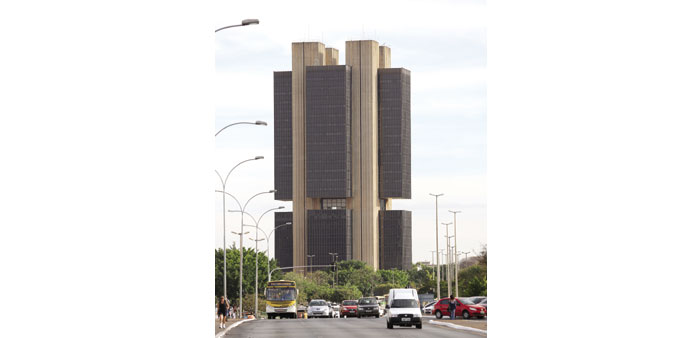
Cars drive past the headquarters of Brazil’s central bank in the business district of Brasilia. The central bank president Alexandre Tombini has warned that policymakers must act to limit the effects of the food inflation spike.
Reuters/Brasilia
Brazil will likely raise interest rates for the ninth straight time yesterday, aiming to tame a surge in food prices that threatens to push inflation through the official target ceiling in an electoral year.
All 62 economists polled by Reuters expect the central bank to raise its benchmark Selic rate by 25 basis points to 11% - what would be the highest level in more than two years.
After signaling at its last rate decision that monetary tightening was nearly done, the central bank’s monetary policy committee, known as Copom, changed tack and hinted of more hikes to ease rising inflation risks.
A severe drought in Brazil’s southeast has raised the prices of food items like meat and tomatoes, rekindling inflationary pressures that could hit the popularity of President Dilma Rousseff as she prepares to run for re-election in October.
“We expect tonight’s monetary policy meeting to end just like the February meeting did, with policymakers hiking the Selic by 25 basis points, to 11%, and maintaining the door open for additional hikes,” ING’s Latin America economist Gustavo Rangel said in a research note yesterday.
The yield curve of Brazil’s interest rate futures shows that an overwhelming majority of market traders are betting the central bank will opt for a 25 basis-points rate hike, according to Thomson Reuters data.
Most economists see the Selic ending the year at 11.25%, according to a weekly central bank poll.
The mix of low economic growth and high inflation was one reason behind Standard and Poor’s decision to cut Brazil’s rating closer to junk territory last week.
Brazilian Central Bank President Alexandre Tombini has warned that policymakers will act to limit the effects of the food inflation spike.
Higher food prices pushed inflation to 5.90% in the 12 months to mid-March, at the upper end of the official target range of between 2.5 to 6.5%.
That surge in food prices has overshadowed a moderate pick-up in activity at the start of the year, which briefly raised hopes the Brazilian economy may perform better than expected after three years of sub-par growth.
A more rapid increase in food prices could hit domestic consumption, which has been the country’s main engine of growth as investment has remained subdued in recent years.
Finance Minister Guido Mantega said yesterday that the increase in food prices should be temporary as weather conditions return to normal.
Other price pressures could come from an increase in the prices of fuel and electricity, which the government is trying to contain, but that economists believe will have to rise either this year or next.
The bank’s aggressive tightening cycle, which has added 350 basis points to the Selic since April 2013, has so far done little to ease inflation as well as expectations.
Inflation expectations for 2014 have risen from 5.86% in early February to 6.30% last week, according to a weekly central bank poll of economists.
The central bank itself raised its 2014 inflation forecast to 6.1% from 5.6% previously, highlighting the difficulties policymakers face to lower stubbornly high prices in Latin America’s top economy.
In its quarterly inflation report, the bank acknowledged there was a 40% chance that inflation could move above the target’s ceiling of 6.5%.
The market has speculated that the bank is allowing the Brazilian real to strengthen in recent weeks as a way to battle inflation. A stronger real, which has gained 4% against the US dollar this year, reduces the prices of imports.
“We still think a stronger real will be accepted as part of the battle against inflation, and that policymakers there will not try to prevent this,” economists with Brown Brothers Harriman & Co wrote in a research note yesterday.