


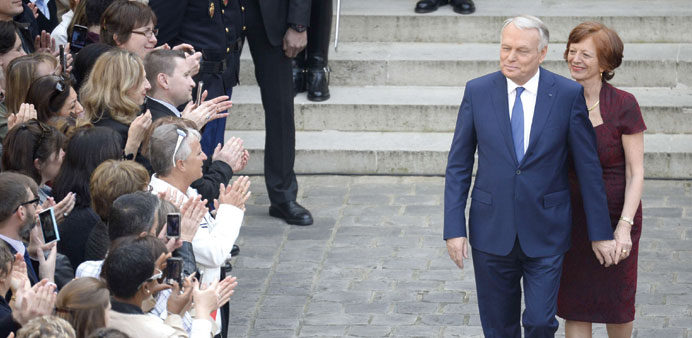
Ayrault and his wife Brigitte walk past those gathered at the Hotel Matignon – the prime minister’s official residence – to witness the handover ceremony.
DPA/AFP
France’s new Prime Minister Manuel Valls took office yesterday following the stinging defeat of the ruling Socialists in local elections, with the new premier promising to speed up reforms and ensure greater social justice.
President Francois Hollande on Monday appointed former interior minister Valls to replace Jean-Marc Ayrault after voters punished his party for the government’s poor economic record by voting out scores of Socialist mayors.
During a handover ceremony at the prime minister’s office, Valls acknowledged the task awaiting him was a “difficult” one.
Paying tribute to his predecessor, who was criticised for failing to rein in unruly, gaffe-prone ministers, he promised to “go farther and faster” in trying to turn around the ailing economy.
He also acknowledged the demand from left-wing voters for the reforms to place a greater emphasis on social justice.
Many long-time Socialist supporters did not bother voting or voted for opposition candidates in the municipal election, to express their discontent with Hollande’s shift to a more liberal, pro-business approach.
“This is a trying, demanding, round-the-clock task but at the same time it is exhilarating,” a visibly emotional Ayrault said as he made way for Valls at the handover ceremony, his former subordinates present, some with tears in their eyes.
On Monday Hollande sought to allay the criticism by announcing plans to cut income tax within the next three years.
However, he remained firm on the need to cut spending to fund tax relief for business, stressing that “it is companies that create jobs”.
“Governing is about choosing and the duty of telling the truth to our compatriots,” Valls said, quoting 1950s prime minister Pierre Mendes France.
Valls, who is one of France’s favourite politicians, is a pragmatist. As interior minister he took a firm line on illegal Roma settlements, earning him comparisons with ex-president Nicolas Sarkozy, who also once used the interior portfolio as a springboard to higher office.
On the economic front, the new premier is seen as reformer, in the mould of former British premier Tony Blair and former German chancellor Gerhard Schroeder.
He is expected to unveil his cabinet today or tomorrow.
Hollande has promised the new “fighting” team will be more “coherent”.
Valls was the popular choice to take over from Ayrault, two months before European elections in which the Socialists risk another drubbing.
Polls showed the French clamouring for a stronger hand at the helm.
On the Left, however, he is seen as a divisive figure.
A leftist Socialist faction had lobbied against him becoming premier.
Two ministers from the small Greens party, which was a part of the outgoing coalition, announced they would not be part of his team.
Valls met yesterday with a Greens delegation in an attempt to win their support.
He takes office amid renewed questions over France’s ability to meet its commitments to Europe on deficit reduction.
Statistics released on Monday showed the government missing its 2013 deficit target, prompting speculation Hollande would ask the EU to extend a 2015 deadline on getting the deficit, which stood at 4.3% last year, down to 3% of GDP.
Speaking in Athens, EU Economy Commissioner Olli Rehn called on France to act “decisively” to improve public finances and to address “well-known bottlenecks to competitiveness and growth, and thus employment”.
He also pointed out that the deficit correction deadline “has already been extended twice in recent years”.
Valls faces the challenge of “an economic context that has deteriorated sharply”, said Frederic Dabi of the Ifop polling institute, with unemployment and a public deficit that remain stubbornly high after 22 months of Socialist rule.
Growth, meanwhile, is almost non-existent and the exasperation of the French was reflected in Sunday’s municipal elections that saw the Socialists lose a whopping 155 towns and cities to the main opposition and far right.
In a televised address on Monday, Hollande tasked Valls with implementing a package of pro-business policies known as the Responsibility Pact, which cuts taxes on firms that are widely viewed as hampering employment and growth, and imposes spending cuts of 50bn euros ($69bn).
He also asked him to set in motion a new “Solidarity Pact” that would include steps to boost spending on education and health and reduce personal income taxes.
Economists say the critical question is whether the new government will continue to respect commitments to the European Union to reduce its public deficit from 4.3% to 3.0% of output, or put these targets aside and risk angering Brussels.
“I think France is well aware of its commitments. It’s been given two years and there is obviously work to be done,” Eurogroup chief Jeroen Dijsselbloem said yesterday, echoing comments made by EU economic affairs commissioner Rehn.
Exactly who will be included in Valls’s new government is unclear, but there is speculation that the mother of Hollande’s four children, Segolene Royal, will be recalled from the political wilderness to take part.
Dabi said the divisions should iron themselves out once a new government is formed, adding that Valls was likely to have more of a handle on his ministers than his predecessor.
“Jean-Marc Ayrault’s personal image is not too damaged,” Dabi said. “He appears pleasant, competent, serious, close to the people, but he had a leadership deficit on his ministers, there was the feeling that he didn’t really manage his government.”
He pointed to the widespread feeling among the French that the government flip-flopped on issues and did not lead the country with a firm hand at a challenging time.
“Through his personality, his dynamism ... Manuel Valls could bring more leadership over his ministers,” Dabi said.