


DPA/Reuters
Istanbul
Prime Minister Recep Tayyip Erdogan secured a firm win for his party in Turkey’s local elections, results showed yesterday as he promised that political enemies behind a series of leaks will be held to account.
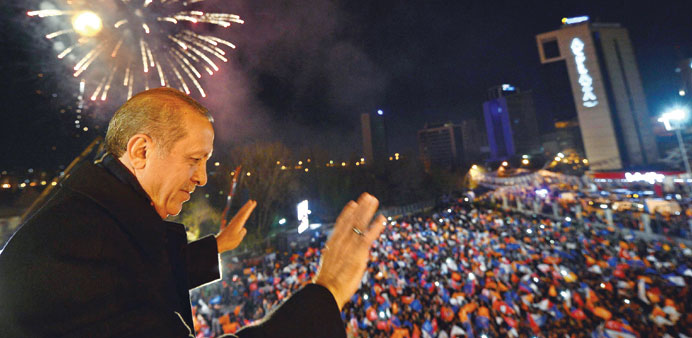
In a victory speech from the balcony of the headquarters of his Justice and Development Party (AKP) in Ankara late on Sunday, Erdogan said his fiercest opponents would “pay the price”.
“We will enter their lair,” he said, before a huge firework display lit up Ankara’s midnight sky. “They will be brought to account. How can you threaten national security?”
The harsh tone of his balcony address suggested he felt he now had a mandate for strong action against his enemies.
“From tomorrow, there may be some who flee,” he said.
His speech was a noted departure from past victories, when Erdogan sounded conciliatory after a win.
Maja Kocijancic, a spokeswoman for EU foreign policy chief Catherine Ashton, said there had been “worrying developments” in the country over the last three months and called for an effort to “reach out to all citizens, including those who are not part of the majority vote”
Turkey has been an EU candidate country since 1999, but talks have been stalled in recent years.
The election at the weekend took place with Twitter and YouTube banned in the country by the government.
Three main opposition news websites were down on election day, charging they were victims of a cyber attack.
Erdogan also pushed through a bill this year which critics say politicised the judiciary and passed a law giving the government greater powers to block websites and track users’ activities online.
The AKP has effectively won every election since its creation in 2001.
The campaign was marked by polarising rhetoric as Turkey’s political divisions become more pronounced ahead of presidential and parliamentary elections in the coming months.
A corruption scandal affected top figures in his party in December and a series of audio leaks in recent months have portrayed further graft charges and authoritarianism within government.
Neither appeared to weaken the long-serving premier in this election.
With results still not official, it appeared AKP received about 45.4% of the vote nationally and maintained control over Istanbul while squeaking out a victory in the capital Ankara, according to television station CNN Turk.
With about 98.9% of votes counted, the main opposition Republican People’s Party (CHP) polled at 27.9%, followed by smaller parties.
Kurdish party BDP swept the mostly Kurdish southeast.
AKP said it wanted to at least match its performance in the 2009 local elections when it received 38.8%.
Erdogan has charged that US based cleric Fethullah Gulen – a one-time AKP ally – is behind the leaked recordings, and the prime minister appeared likely to now target followers believed to be responsible for the spread of the audio recordings.
The recordings cannot be independently verified.
The crackdown on social media sites has earned Erdogan harsh criticism from his allies in the Nato alliance, including the US and Germany.
Presidential elections are due in August to be followed by parliamentary polls by early next year.
Analysts have cautioned that political instability may still lay ahead, as fresh campaigns heat up for the next election cycles.
AKP party rules currently ban Erdogan from running for a fourth term as premier, fueling speculation about whether he will seek to change the limits or run for president.
“Of course this has reinforced Erdogan’s bid for the presidential polls,” one source close to the government said of Sunday’s election result. “He was in need of a vote of confidence, both from the people and for those who have been critical of him within the party.”
A senior government official concurred, saying there were now “no obstacles before him” on the road to the presidency, although the official said rooting out Gulen’s influence within the state would remain Erdogan’s priority.
“Erdogan is certainly much closer to the presidency,” the official said. “But he makes his own agenda. Very soon he will begin his assessment of what needs to be done together with the party’s ruling echelons.”
Erdogan, lacking trained personnel loyal to himself, filled government departments with Gulen supporters when he first was elected in 2002.
Gulen, who runs a huge network of schools and businesses, is widely credited with having helped Erdogan break the political power of the armed forces using allies in the police and judiciary.
But in recent years friction has grown between the two men and came to a head when Erdogan moved to curb Gulen’s influence and close the schools that are a key source of income and influence.
He now seems likely to step up his drive against Gulen.
“Let me tell you, Erdogan’s response is coming,” said Tesev think-tank chairman Can Paker, seen as close to Erdogan. “He will harshly and fully clean up the police and judiciary. And he will purge the press that supported the leaks. He will most certainly do that. He will say ‘I was elected to eliminate them’. He is not going to soften.”
Investors, who have been unnerved by the turbulence, took solace in the election result, seeing it as a sign of political continuity. The lira rallied to its strongest in two months and stocks hit a three-month high.
“From a market perspective, the election result appears to be more or less what the doctor ordered: a solid win for the AKP which shores up the position of Turkey’s ruling party,” said Nicholas Spiro, head of Spiro Sovereign Strategy.