


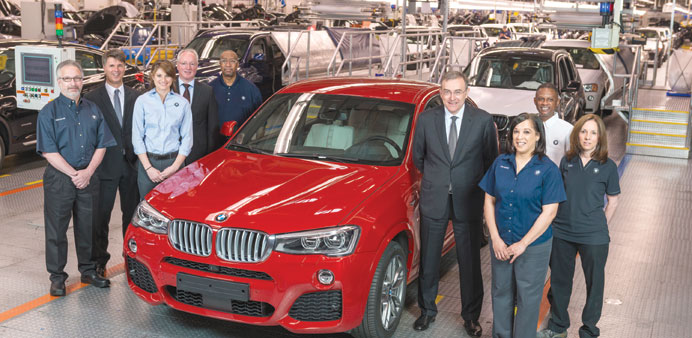
Top BMW officials stand with workers next to a BMW X4 sport utility vehicle at the factory in Spartanburg, South Carolina. Ramping up production capacity at Spartanburg to 450,000 cars by 2016 will make it BMW’s largest factory, the company said.
Reuters
BMW will expand production capacity in the US by 50% and introduce another new off road model, the German luxury carmaker said, in what amounts to a $1bn bet on sport utility vehicles (SUVs).
BMW said that as well as the new X4 SUV, its US factory would make a new X7 SUV. Ramping up production capacity at Spartanburg, South Carolina to 450,000 cars by 2016 will make it BMW’s largest factory, the company said.
The red X7, which was rolled out from a cloud of white smoke before a crowd of workers and dignitaries including US Commerce Secretary Penny Pritzker, is part of a strategy to help the German automaker cut its dependence on fragile European markets, which accounted for 44% of group sales in 2013.
Raising US production with new models and greater manufacturing capacity increases BMW’s bet on the US, a market which is fast recovering to levels seen before the 2007 financial crisis, helped by the popularity of SUVs.
“With the BMW X7, we are developing another, larger X model, which we will produce at our US plant,” Chief Executive Norbert Reithofer said, explaining that customers had demanded such a vehicle from BMW.
Reuters last week reported BMW planned to build the X7 in South Carolina.
“We think it will be a success in the US and China, we cannot just ignore the market,” Reithofer said.
During the financial crisis, BMW mothballed a previous generation X7 on the grounds that there was little demand for it and that it may not sit well with BMW’s image as a maker of low-emission cars.
But SUVs have grown more popular in recent years, accounting for 32% of total US vehicle sales last year, up from around 19% in 1999, statistics supplied by LMC Automotive show.
Spartanburg started out making BMW’s 3-series sedans but today makes mainly offroaders, producing 300,000 X3, X5 and X6 offroader vehicles in 2013 of which 70% were exported.
Gas-guzzling offroaders have proved particularly popular in the US, thanks in part to the low fuel prices that have resulted from its booming shale oil and gas industry, a trend that is expected to continue.
In 2019, US domestic production of crude oil will account for 63% of total supplies, according to the Energy Information Administration, a significant increase from 2011 when it barely covered 38% of the country’s needs.
By contrast the International Energy Agency has warned that Europe’s high energy prices risk driving away a big share of its energy-intensive industries.
With sales of its BMW, Mini and Rolls-Royce branded cars climbing to 375,000 units in 2013, the US has become the second-largest market for the company, accounting for 19% of its global sales.
China accounted for 20% of its sales while Germany, BMW’s home market, accounted for only 13%.
BMW said the US will be a key driver of group sales in 2014, expecting overall market to grow to 16mn cars, almost rebounding back to pre-crisis levels last seen in 2007.
By contrast it sees only a slight uptick in Europe.
This year BMW aims to achieve a significant rise in sales volume to 2mn or more, after it delivered a record 1.96mn cars in 2013.
The latest investment will see the number of people employed at the Spartanburg plant rise by about 800 to 8,800, BMW said, adding there were no plans to create a German-style works council.
BMW’s investment was welcomed by local dignitaries who were full of praise for Reithofer’s bet on America.
“He was on the ground floor of the decision making. If this plant had failed, he wouldn’t be chairman,” South Carolina Republican US Senator Lindsey Graham said on Friday.