


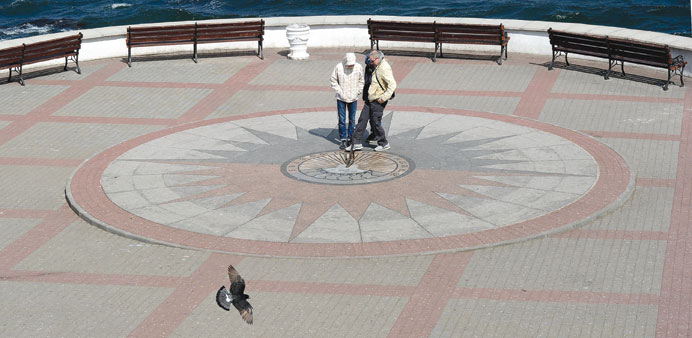
TIME WILL TELL: People look at a sundial on the seafront in Sevastopol, Crimea. Russia has pledged that it would not invade mainland Ukraine following its seizure of Crimea and said it favoured the ex-Soviet state becoming a federation as a way of defusing the crisis.
AFP/Reuters/Moscow
Russia has pledged that it would not invade mainland Ukraine following its seizure of Crimea, favouring a federal solution for the ex-Soviet state as diplomacy with the West gathered momentum.
Tensions have run high since Moscow’s lightning takeover of Crimea from Ukraine, with the United States accusing Russia of massing tens of thousands of troops on Ukraine’s eastern border.
But telephone talks between Russian President Vladimir Putin and US counterpart Barack Obama late on Friday and the possibility of a new meeting between the top Russian and American diplomats were the latest signs of progress in the search for a mutual solution in what remains the worst East-West crisis since the Cold War.
Foreign Minister Sergei Lavrov suggested Moscow’s main demands in the talks were that Ukraine should be made into a federation, commit to not joining Nato and restore order to cities after almost half a year of street protests.
Putin also told Obama that the problems surrounding the breakaway Moldovan region of Transdniestr – a Russian-speaking region seen by some as the Kremlin’s next target – should be solved not by force but by talks in the “5+2” format of Moldova, Transdniestr, the OSCE, Russia, and Ukraine, with the EU and US as observers.
Ukraine is now at a crossroads after the fall of pro-Kremlin president Viktor Yanukovych in February and the clock ticks down to May 25 presidential elections which are expected to cement Kiev’s pro-West course.
Ukrainians remain deeply divided over protests that led to Yanukovych’s ousting and many eastern Russian-speaking regions are sceptical about the policies of the new pro-Western government in Kiev.
Yanukovych called on Friday for each of the country’s regions to hold a referendum on their status within Ukraine, instead of the presidential election planned for May 25.
With boxing champion turned politician Vitali Klitschko bowing out of the race (see accompanying report), the overwhelming favourite to win the polls is pro-European confectionary tycoon Petro Poroshenko, although feisty former premier Yulia Tymoshenko is expected to mount an all-out campaign since declaring her candidacy this week.
Lavrov said that Moscow has no intention of ordering its armed forces to cross over the Ukrainian border and acknowledged the divisions between Moscow and the West on the crisis are narrowing.
Lavrov, speaking on Russian television, reinforced a message from President Vladimir Putin that Russia would settle – at least for now – for control over Crimea despite massing thousands of troops near Ukraine’s eastern border.
“We have absolutely no intention of – or interest in – crossing Ukraine’s borders,” Lavrov said.
“We (Russia and the West) are getting closer in our positions,” he added, saying recent contacts had shown the outlines of a “possible joint initiative which could be presented to our Ukrainian colleagues”.
Lavrov made clear Russia’s priorities for Ukraine were a federalisation which would allow the interests of everyone in Ukraine – including Russian speakers in the east and south – to be fully represented.
Each region, he said, would have jurisdiction over its economy, finances, culture, language, education and “external economic and cultural connections with neighbouring countries or regions”.
“Given the proportion of native Russians (in Ukraine) we propose this and we are sure there is no other way,” Lavrov said, and Russia had briefed Western powers and others on the proposal.
He said Ukraine should also commit to being non-aligned – with Ukrainian Nato membership clearly a red line for Moscow.
“There should be no ambiguity here. There is too much ‘not for the time being’ and ‘we don’t intend’ (to join Nato). Intentions change, but facts on the ground remain,” he said.
Lavrov said that the West was now “listening” to Russia’s idea of a federalised Ukraine and a federation (for Ukraine) “is far from being a forbidden word in our talks”, Lavrov said.
There was also a bid for regional devolution within Crimea. Its Tatar community, an indigenous minority who were persecuted under Soviet rule and largely boycotted last month’s referendum on joining Russia, want autonomy on the Black Sea peninsula, the Tatar leader said yesterday.
The United States and European Union clearly want Russia to de-escalate tensions by removing the troops said to be surrounding Ukraine’s eastern borders.
The Ukrainian government this week estimated there were now 100,000 Russian soldiers positioned around Ukraine – a figure neither confirmed nor denied by Moscow.
Nato Secretary General Anders Fogh Rasmussen, in an interview with Germany’s Focus magazine, said the alliance was “extremely worried”.
“We view it as a concrete threat to Ukraine and see the potential for further interventions,” said Rasmussen, who is due to leave the post in October.
“I fear that it is not yet enough for him (Putin). I am worried that we are not dealing with rational thinking as much as with emotions, the yearning to rebuild Russia’s old sphere of influence in its immediate neighbourhood,” he added.
Putin and Obama had earlier discussed ways to solve the crisis in Ukraine, both the White House and the Kremlin said in separate statements, although neither side gave precise details on the nature of the plan on the table.
However, in a sign both sides feel there is something to discuss, US Secretary of State John Kerry made a last-minute change of plans yesterday to fly to Paris from Riyadh with the aim of setting up talks with Lavrov.
The Russian foreign ministry said both men spoke by phone yesterday, adding only that they discussed a “timetable for future contacts”.
A foreign ministry source told the Itar-Tass news agency that the two men would meet “soon” and were in the process of finalising a time and place.
Russia is also feeling economic pressure, with the United States and European Union having already hit Moscow with sanctions against senior officials and markets worried about measures that could hurt the wider economy.
Moody’s put Russia’s credit rating on review for a possible downgrade on Friday, saying the current crisis “could significantly dampen investor sentiment for several years to come”.