


AFP
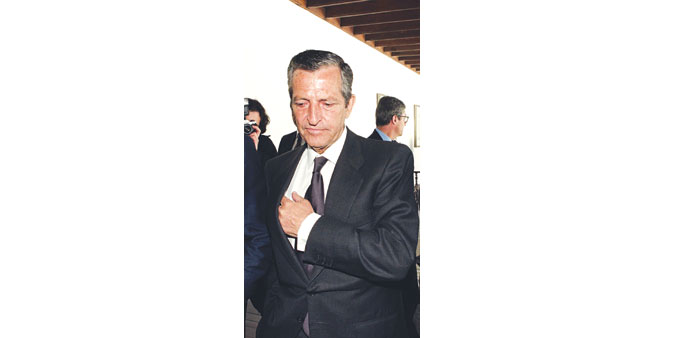
Tens of thousands of people bade farewell yesterday to Adolfo Suarez, the statesman who led Spain to democracy after the Franco dictatorship, as his coffin was borne through the streets of Madrid before his burial.
Mourners applauded and took pictures as a horse-drawn gun carriage transported the flag-draped casket from parliament where it had been lying in state to Cibeles Square to a solemn drum beat.
Suarez, Spain’s first elected premier after the death of dictator Francisco Franco in 1975, died in a Madrid hospital on Sunday aged 81.
He had been admitted on March 17 with pneumonia and had suffered from Alzheimer’s disease for the past decade.
Suarez was a leading player in the delicate dismantling of the dictatorship followed by democratic reforms that he and King Juan Carlos helped to achieve after Franco died – a process known by Spaniards as the “transition”.
Onlookers packed balconies to watch as Suarez’s children and top politicians, including Prime Minister Mariano Rajoy, walked slowly behind the carriage carrying the coffin.
At Cibeles Square eight uniformed soldiers wearing white gloves loaded the coffin into a black hearse which drove it to Avila, about 100km (60 miles) northwest of the capital, where Suarez was buried in the cloister of the city’s cathedral.
Saurez, who was born in the nearby town of Cebreros, was buried alongside his wife Amparo Illana who died in 2001. Her remains were exhumed on Monday and taken to Avila.
Admired as charismatic with a talent for conciliation, Suarez oversaw the legalisation of political parties, including the Communist Party which had been persecuted under Franco, sending thousands of left-wingers into exile.
He then helped them forge a consensus as they hammered out a constitution, approved in a referendum in 1978.
“He wanted to make a pact with everyone at a very difficult time so that there would not be tensions and divisions, so that Spain would be united, and he achieved this,” said retired teacher Mercedes Perez, 64, at the funeral procession in Madrid.
Some 30,000 people, including members of the royal family and government, filed past Suarez’s coffin in the lower house of parliament where it had been lying in state since Monday, according to the president of the assembly, Jesus Posada.
The queue stretched for up to 5km (three miles) from the doors of the lower house of parliament as mourners waited in the cold and rain for hours to bid farewell.
Many Spaniards hail Suarez as a national hero because of his democratic reforms and his unruffled stance during the attempted coup of February 23, 1981.
When soldiers firing their rifles in the air took members of parliament hostage that day, Suarez was one of only three lawmakers who did not hide under their benches.
The king, Franco’s successor as head of state, had named Suarez prime minister in a new government in 1976 when the lawyer and politician was 44.
The following year Suarez won Spain’s first democratic elections since Franco’s death. He governed until 1981.
A state funeral for Suarez will be held on March 31 in Madrid’s Almudena Cathedral.