


Reuters/London
Russian assets climbed yesterday in the absence of new sanctions by the Group of Seven, while Turkish debt insurance traded close to a seven-week high before local elections this weekend.
The G7 leaders had warned Russia on Monday of economic sanctions if President Vladimir Putin takes further action to destabilise Ukraine after seizing Crimea.
Russia’s deputy economy minister, Andrei Klepach, said on Monday the Economy Ministry forecasts net capital outflow during the first quarter at $65-70bn – and “closer to $70bn”.
That is close to the full-year figures for 2013.
But investors said the current visa bans and asset freezes aimed at individual Russians had little bite, and it was not in the west’s interests to impose harsher sanctions on Russia.
“They are teasing Russia with these visa issues,” said Slim Feriani, the chief executive of Advance Emerging Capital. “I struggle to see that these sanctions have major implications.”
Russian stocks rose 1 to 2%, credit default swaps fell and the rouble gained 1% against the dollar.
Turkish five-year credit default swaps dipped on Tuesday, according to Markit, after reaching their highest since early February at 265 bps in the previous session.
The swaps have risen 40 bps in the past three weeks, before local elections.
Turkey’s ruling AK party won about 40% of the municipal vote across the country in 2009. It hopes to at least to match those results. But Prime Minister Tayyip Erdogan has been fighting a corruption scandal and anti-government protests.
Turkish finance minister Mehmet Simsek told Reuters that Turkey’s 4% growth forecast for this year was at risk if the election results heightened uncertainty.
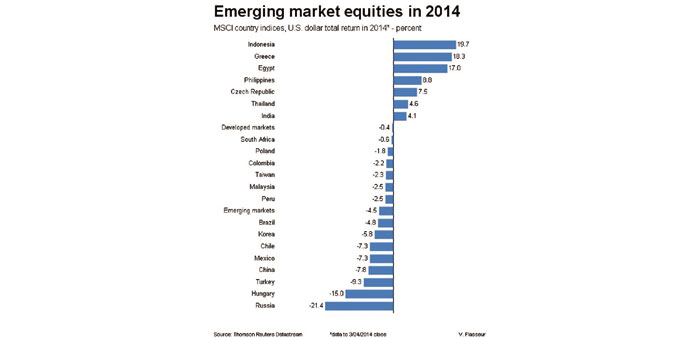
The MSCI emerging equities index was steady and most emerging European currencies were steady to firmer.
Hungary’s central bank is expected to cut rates by 10 bps on Tuesday, to 2.6%.
Ukraine’s hryvnia and bonds were steady but CDS rose, as investors await statements from the International Monetary Fund after its visit to Kiev.
Emerging sovereign debt spreads were unchanged at 342 basis points over US Treasuries.
Zambia plans investor meetings from this week for a potential Eurobond, one of the arrangers told Thomson Reuters news service IFR.
Zambia’s debut Eurobond, issued in 2012, has performed poorly, and the kwacha has been reaching record lows.