


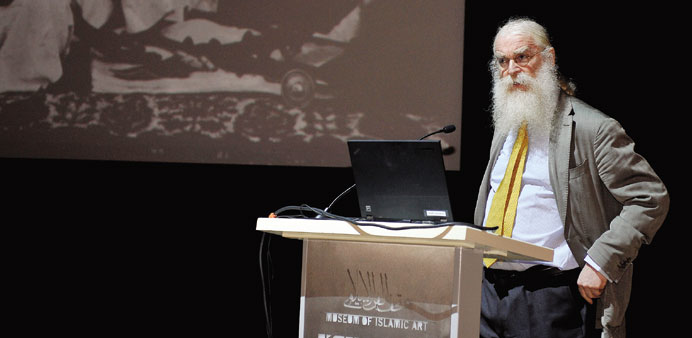
LECTURE: Dr Irving Finkel during his talk at the Museum of Islamic Art. Photos by Najeer Feroke
The British Museum’s Assistant Keeper of ancient Mesopotamian script, languages and cultures holds a treasure trove of knowledge on Pachisi, writes Anand Holla
Like most boys before the reign of handheld gaming, Dr Irving Finkel loved board games. His love was unusual because he found learning about the evolution of those games more exciting than playing them.
More than half a century later, Finkel’s grandfatherly eyes still twinkle with enthusiasm when he talks about antique board games and his first brush with them as a boy.
“I was 10 when I read a book about the games of the world. It was called The Board and Table Games of Many Civilisations, by R C Bell,” Finkel recalls.
After reading it many times, Finkel wrote a gushy letter to Bell, who asked Finkel to spend the weekend at his Newcastle home.
“So there I was with Bell’s family, and he showed me his collection of books. They were about games from Greece, Rome, Egypt, Europe, India and the Middle East. It was a memorable experience,” Finkel says, of what triggered his life-quest for collecting and researching on board games.
To add to the fascinating exhibition Kings and Pawns: Board Games from India to Spain, that opened at the Museum of Islamic Art last week and is on till June 21, Finkel was in Doha to give a talk — The Indian Game of Pachisi and What Became of it.
“In 1983, an old Indian man came to see me and gave me an old Pachisi board. I couldn’t believe in this wonderful thing,” he says, extending his hands and opening his palms.
Much like his free-flowing white beard or the mane of hair that is held back in a ponytail, Finkel’s passion for antiquated board games knows no bounds. “Not many are bothered about Pachisi. Those boards get eaten away by insects or are thrown away. I thought it would be worth trying to rescue these games and I got really interested.”
Despite being a solid authority on the history of board games, it’s not even his mainstay.
It wouldn’t be a conjecture to call Finkel one in a million. In fact, one in a billion would be a more appropriate estimate. The British Museum’s Assistant Keeper of ancient Mesopotamian script, languages and cultures — which includes the Sumerian, Babylonian, and Assyrian — happens to be one of the very few people in the world who reads cuneiform.
Written by Sumerians and Babylonians over more than 3,000 years, cuneiform is the world’s oldest and toughest writing. Finkel, in charge of 130,000 cuneiform clay tablets at the British Musuem, has described it as “a mix between hieroglyphic picture-symbols and a syllable-based system like Japanese.”
To understand the importance of what Finkel’s expertise can achieve, knowing why he has been in the news this year should help.
The 60-something genius made a spectacular discovery when he deciphered a 4,000-year-old clay tablet from ancient Mesopotamia that contained the story of Noah’s Ark and the flood.
While all biblical illustrations spoke of a large pointy-ended wooden boat, the 60 lines of cuneiform on the little pile of clay Finkel decoded turned out to be a unique piece of evidence. It had precise instructions on how to build the ark, and crucially, that the ark should be circular, not oblong.
Finkel calls the artefact, which is the size of a cell phone, as “one of the most important human documents ever discovered.” This January, he created waves across the world when he released his book on it, called The Ark Before Noah: Decoding the Story of the Flood.
His fascination for clay tablets and cuneiform also led him straight to his childhood fantasy — board games. “Around 1980, on a clay tablet, I found the rules for a very ancient Babylonian game called The Royal Game of Ur from Iraq. That revived my interest,” he recounts.
And most of all, Finkel was bowled over by Pachisi — which he calls “a very clever, quick-moving race game” — and even wrote a book, Round and Round the Houses: The Game of Pachisi. “So far, about eight people have written about the history of board games and about 12 people have read them,” he jokes.
Played on a board shaped like a symmetrical cross and made of embroidered cloth, Pachisi is derived from Pachees, the Hindi word for 25, the largest score that can be thrown.
“You can play it like a simpleton, or you can strategise your moves. The brighter you are, the more likely you are to be a winner,” says Finkel. A player’s pieces move around the board based upon a throw of six or seven cowrie
shells. Usually four play in two teams, and the team that moves all its pieces to the finish first, wins the game.
“Many aspects of culture in India are intellectually sparking, and Pachisi is a part of it. Pachisi is the only world-conquering, deep-seated game for four players that the world has seen,” Finkel says, while explaining its origins.
“The great court installation of Emperor Akbar, where he used to play outdoors with living persons, is the first real evidence of Pachisi,” he says.
In fact, Edward Falkener, in his 1892 book Games ancient and oriental and how to play them, describes how Emperor Akbar played it at the giant Pachisi court at Agra’s Fatehpur Sikri Palace.
Falkener wrote: “It was here that Akbar and his courtiers played this game; 16 young slaves from the harem wearing the player’s colours, represented the pieces, and moved to the squares according to the throw of the dice.”
Falkener further noted, “It is said that the Emperor took such a fancy to playing the game on this grand scale that he had a court for Pachisi constructed in all his palaces.”
During Finkel’s talk on Pachisi which he completed moments before he settled for a conversation with me, he spoke on everything from Falkener to Krishnaraja Wadiyar III, the Rajah of Mysore (between 1799-1868), “a die-hard board game fanatic” whose palace had rooms painted with traditional board games.
“It’s possible that Pachisi was ancient in India and the Muslims adopted it, or it came with (the Mughal Empire) in India,” Finkel says, and then pauses.
“My idea is that this game for four players on a cross originated as an abstract duel for two players, because in the history of the world’s games, board games for four players are very unusual,” he adds.
But why is Finkel fixated on this old, dying game? “I am interested in traditional things that disappear,” he says, “The age in which we live is so fast-changing that even people who live in remote villages play with digital devices. And when that happens, many things that have been carried on from thousands of years, start disappearing.”
To make his point, Finkel cites the tiger-sheep board game played in villages, where the tigers hunt sheep and the sheep block the tigers’ movements. “For centuries, this was played all over India. It was born out of a situation in which shepherds who looked after the sheep, scared the predators away,” he says.
“If you sit under a sun all day with the sheep, you are not going to think about football,” Finkel says, “These board games have to do with a timeless environment. It’s sad that they are all going to disappear.”
The death knell has come in the form of Gameboys and handheld gaming devices, Finkel feels. “In the 19th century, British historians often called Pachisi the National Game of India. I don’t think that would be a very common description in the 20th century. And in the 21st century, no-one would think like that at all,” Finkel says of its eroding glory.
Having stayed in India to chronicle Pachisi, Finkel feels Indians often play board games for what they call ‘timepass.’ He says, “Pachisi takes a lot of time and for most people, it’s perhaps not possible to spare so much time.”
However, there’s an upside in hunting for the game’s sporadic craze on a random Indian street corner. Finkel figured that people playing Pachisi made for terrific photographic matter.
“The truth is that when people play a game like Pachisi, they really concentrate. As a photographer, you get a lot of fantastic faces really thinking. It’s a shop of activity. It’s not people chewing betelnut,” Finkel says.
“It’s really quick, it’s like that,” he says, animatedly and repeatedly clicking his fingers.
You can almost sense a tinge of disappointment in Finkel’s voice when he talks about Pachisi being comprehensively overtaken by its much popular, watered-down version Ludo (Latin for I Play).
After the British left India, they dumbed down Pachisi and exported Ludo to the world. “Ludo must have come to India from Britain in 1950s. In India, you see people playing Ludo everywhere, with none perhaps knowing that they are playing a watered-down version of a most distinguished game played by King Akbar in his court,” Finkel points out.
After writing a book on Pachisi, Finkel isn’t done with it. “I am writing a much bigger book on it now,” he says.
“When I retire, I want to live in India for a year, and first see what can be done to get more things into museums, and secondly, collect more information and put it on the Internet.”
Finkel knows rescuing dated board games is an uphill task. “Usually, grandmothers teach their grandchildren to play these games, as the parents are busy, and the kids learn quickly. But this pattern is now under threat. Children today say this is rubbish and return to playing on devices,” he says.
Despite the odds against the traditional, Finkel prefers being an optimist. “I think Pachisi will survive. Possibly, its Internet versions might keep it alive,” he says and smiles.
And when he smiles, the twinkle in his eyes seem intact.
BELOW:
BOARD GAME: The famous Pachisi.