


|
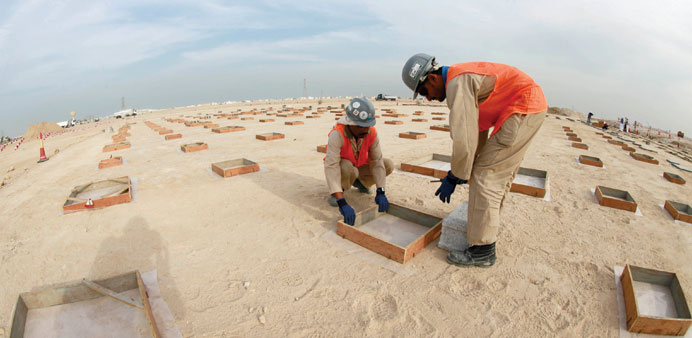
As Qatar prepares to host one of the biggest sporting events in world, the FIFA World Cup 2022, working conditions of expatriate workers are a priority. |
Human Development is one of the five pillars of Qatar’s National Vision 2030 and the targeted participation of Qatar’s expatriate workforce together with the recruitment of the right mix of that workforce, the protection of its rights, securing its safety and retaining those individuals who are outstanding is an integral part of the vision.
In order to provide a framework within which this workforce structure can be developed, a growing number of Qatari government and quasi-government entities have put, and are putting, in place expatriate worker employment charters with which all stakeholders and interested parties are obliged to comply.
In 2012 the Qatar Foundation (QF) adopted its comprehensive Migrant Workers’ Charter (MWC) and more recently the Qatari 2022 Supreme Committee, now renamed the Supreme Committee for Delivery and Legacy, issued a workers’ charter aimed at creating a safe working environment for the thousands of expatriate workers who are and will be employed on various World Cup projects.
The material objective of the MWC is the effective execution of a comprehensive set of standards that seeks to guarantee the rights of workers at all stages of the migration cycle, from the moment they are recruited until they are repatriated to their home countries or to any other country as may be agreed between the worker and his or her employer.
In addition and to augment the MWC, QF has issued Mandatory Welfare Standards (MWS) which set out the minimum mandatory requirements with respect to recruitment, living and working conditions and general treatment of workers.
Pursuant to the MWS, all construction and other activities under QF projects are to be carried out in line with the requirements set out in the Qatari laws and the MWS. The material Qatari laws include the Immigration Law and the Labour Law and their executive regulations which are listed and form an annex to the MWS.
The MWS is applicable to all workers of QF contractors and sub-contractors regardless of whether they were recruited for QF projects or not.
Further, the MWS constitutes an integral part of the main contract entered into with a contractor with effect from the date of the award and requires that all contractors subsequently ensure adherence to Qatari laws and the MWS by all their sub-contractors.
The MWS provides that QF contractors and the sub-contractors must adhere to ethical standards in the process of the recruitment and deployment of the workers in Qatar.
For example, workers shall not be charged with any recruitment or placement fees and shall be informed with the terms and conditions of their employment, safety and health risks of their work prior to their deployment to Qatar in a language they understand.
Further, the terms of the employment contracts workers sign upon their arrival in Qatar shall be identical to the terms of the original offer of employment which they received and shall clearly specify the rights and responsibilities of workers and employers, respectively, with regard to wages, hours of work, including regular hours and overtime requirements, days off and annual leave, rights and responsibilities, notice period and conditions for termination by each party, disciplinary procedures as well as dispute settlement procedures; all of which shall meet the minimum requirements set out in Qatari laws and the MWS.
The MWS also provides that the workers shall possess valid work and residence permits in accordance with Qatari law and shall retain possession of their passports and other personal documents throughout their employment.
In addition, an employer shall provide comprehensive medical insurance to the workers, appropriate accommodation and training on the necessary skills required to carry out their tasks.
Notably, the issuance of the MWC included the establishment of a fully functional Workers’ Welfare Department, which falls under the scope of QF Health, Safety, Security and Environment (HSSE) Directorate. The department is mandated, on behalf of QF, to act as a regulatory body within QF instituting fair employment standards and ensuring that all rules and protocols are being followed by respective parties, while pushing for continuous improvement and development.
The MWC is based upon a holistic and principled approach that combines Qatari Labour Law and international best practice in order to set an exemplary model for the ethical treatment of workers by guaranteeing that all contractors and sub-contractors, such as labour suppliers, labour agencies and other service providers, adhere to strict regulations and comply with guidelines as part of their contracts with QF.
By establishing a designated department, QF seeks to ensure that its rules and protocols are being followed by stakeholders and interested parties and that MWS is enforced from a practical standpoint.
♦Qatari Laws (save for those issued by the QFC to regulate internal business) are issued in Arabic and there are no official translations for the purpose of drafting this article, we have used our own translations and interpreted in the context of Qatari regulation and current market practice.
♦ If you would like further information please contact David Salt ([email protected]) and/or Yousef Fakhoury ([email protected]).