


AFP/Madrid
Adolfo Suarez, the prime minister who led post-Franco Spain to democracy, died yesterday at a Madrid hospital, his family and doctors said. He was 81.
Suarez, Spain’s first prime minister after the death of General Francisco Franco in 1975, had suffered from Alzheimer’s disease for the past decade.
“Adolfo Suarez has died,” the family spokesman Fermin Urbiola told reporters at the Cemtro hospital where the former premier was admitted last Monday with a respiratory infection.
His son Adolfo Suarez Illana told reporters on Friday that his father’s Alzheimer’s disease had progressed and his death was “imminent”.
Suarez was one of the last surviving players in Spain’s historic “transition” - the delicate dismantling of dictatorship followed by democratic reforms that he and King Juan Carlos helped achieve after Franco died.
Despite being born the son of a Republican, Suarez became a member of Franco’s regime, serving as head of the state broadcaster and a senior leader in the National Movement, a Francoist party with fascist roots.
The king, Franco’s successor as head of state, named Suarez prime minister in a new government in 1976 at the age of 44, and he was confirmed as leader in an election the following year.
A charismatic leader admired for his talent for conciliation, Suarez oversaw the legalisation of political parties and helped them forge a consensus as they hammered out a constitution, approved in a referendum in 1978.
Prime Minister Mariano Rajoy hailed Suarez as “one of the most important and positive figures in our history” and declared three days of national mourning.
“Suarez was the meeting point for the reconciliation between Spaniards,” Rajoy, who wore a black suit and tie, said in a televised address.
“His intuition, his skills and his courage were key in creating the freer and fairer country in which we live.”
King Juan Carlos praised Suarez as an “exceptional colleague and a loyal friend” in a televised address as he sat at his desk decorated with a picture of him with his arm around Suarez’s shoulder.
Suarez “was guided at every moment by his loyalty to the Crown and all that it represents: the defence of democracy, the rule of law, the unity and diversity of Spain”, he added.
In time Suarez became overwhelmed by various perils: splits within his party, Spain’s economic hardship, a dissenting military and regions, and armed attacks by the Basque separatist group ETA.
In 1981, two years after being elected for the second time, he resigned unexpectedly. Days later, soldiers took members of parliament hostage in an attempted coup that was defused with the help of Juan Carlos.
Suarez was one of only three members of parliament who did not hide under their benches. He remained in his seat even when coup leader Antonio Tejero seized parliament, gun in hand.
“They ordered us to get down on the floor,” he said in a television interview years later. “I was the prime minister and the prime minister should not do that.”
Despite his troubled departure from government, Suarez ran for leader again in 1982 at the head of a new centrist party, which later broke apart.
That election was won by Socialist Felipe Gonzalez, opening a new era of reforms.
Suarez withdrew from public life but received the Golden Fleece, Spain’s top civil honour, in 2008 from his old friend King Juan Carlos, who also bestowed on him the title Duke of Suarez.
Suarez’s death was “a natural progression” of his Alzheimer’s disease, his doctor Isabel de la Azuela, told a news conference at the Cemtro hospital.
“He was serene and surrounded by his family. He had a good quality of life until his final days which was always our goal,” she said.
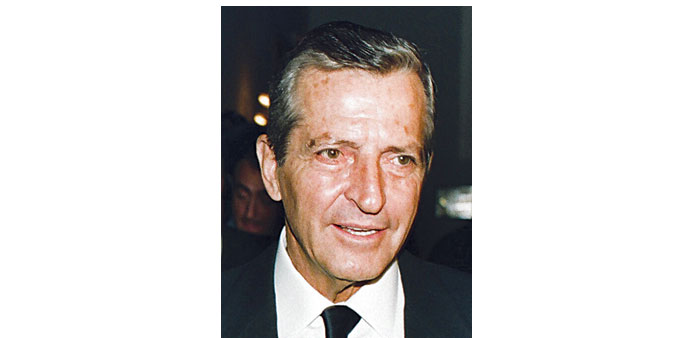
Suarez u2026 steered Spain to democracy.