


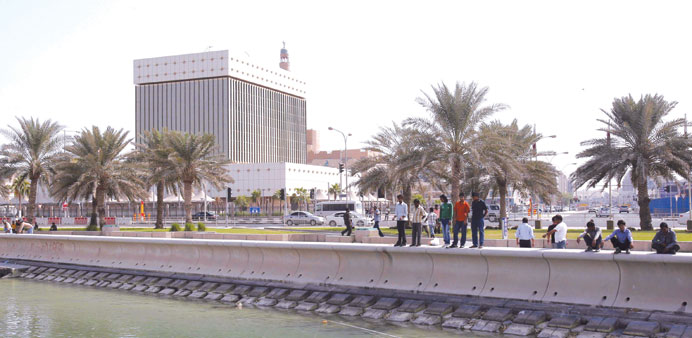
A general view of the Qatar Central Bank. Qatar has been making efforts to develop its domestic government securities market, but it will take time to reach sufficient depth and liquidity, the IMF said.
By Santhosh V Perumal
The Basel III criteria for high-quality liquid assets are “ill-suited” to the Gulf economies, where local debt markets are underdeveloped but new capital norms should give an impetus to develop the domestic debt market in the region, according to an International Monetary Fund (IMF) paper.
The GCC (Gulf Co-operation Council) regulators are expected to follow the new Basel III liquidity requirements, but there may be challenges in agreeing on definitions of liquid assets and in developing market liquidity, the IMF said in a staff discussion note ‘Macroprudential Policy in the GCC Countries’.
The main theme of the paper was that macroprudential policy needs to play a key role in the Gulf economies, supporting fiscal policy in managing financial cycles associated with oil prices.
“The Basel III criteria for high-quality liquid assets are ill-suited to the GCC, where domestic debt markets are underdeveloped. Moreover, the net stable funding requirement means that banks need to match the maturity of their funding more closely with the maturity of their assets,” it said.
In the GCC context, this could mean more retail deposits, issuing long-term liabilities or cutting back on long-duration assets, it said, adding “this creates a tension, given the absence of domestic term funding markets and the demand for longer-term lending for mortgages, infrastructure, and small and medium enterprises investment.”
Finding that the Basel III liquidity requirements should give an impetus to domestic debt market development in the GCC, the discussion paper said “it has to be noted, however, that developing liquid debt markets in fiscal surplus countries is challenging.”
In this regard, the note said Qatar has been making efforts to develop its domestic government securities market, but it will take time to reach sufficient depth and liquidity. The other GCC countries have yet to make concerted efforts at domestic debt market development, it added.
It said shallow domestic money and debt markets, passive liquidity management frameworks and persistent structural liquidity surpluses in the financial system make liquidity management challenging for GCC banks. Highlighting the scope to expand the range of macroprudential instruments in the region; the note said GCC regulators should continue to ensure that banks maintain higher capital than required by minimum international standards.
Although most GCC banks are currently highly capitalised and over the past few years they have aimed at capital levels between 15% and 20%; the paper said “the Gulf banks could somewhat reduce the need for the extra capital through improved corporate governance and disclosure as well as by requiring that their large borrowers receive credit ratings.”
The countercyclical capital buffer, an important component of the Basel III framework, is a pre-emptive measure that requires banks to build up capital gradually as “imbalances” surface in the credit market, to provide additional loss-absorbing capacity in downturns, it observed.
“Regulators will need to develop a set of indicators to guide the activation and deactivation of this buffer, either on a broad basis or to target specific segments of the credit market. Tailoring to specific country circumstances and supervisory judgment will both be a key for appropriate calibration,” the IMF note said.
Asserting that certain provisioning rules can also serve macroprudential purposes, it said some of the GCC countries - notably Kuwait, Qatar, and the UAE - have raised general provisions to increase banks’ resiliency against the possibility of losses not yet identified.
Moreover, the paper suggested that rules on limiting dividend payments in good times can help build capital buffers for use in bad times.