


By Xiao Xi and Cer Jianan/Kashgar
The “matang” nut cake and skewered “kawap” (mutton), an ancient kingdom reduced to ruins in a desert, and the simple imagery of folk singing and dancing: These are the stereotypes most Han Chinese people have of the Uighur people.
It made sense for me to travel to find out more in their native land, in the Xinjiang Autonomous Region, China’s farthest province from the ocean.
So I went there, to its southern reaches, where I walked in the labyrinth of the old town of Kashgar and witnessed the beauty and the desolation of the ancient Buddhist Kucha kingdom in Kuqa city.
But in those same old-town alleys glowing in gold, there are also Kashgar women who pull their headscarves over their faces when they unexpectedly come across strangers. This helped me understand that behind this region of multiple ethnicities - labelled by Han Chinese people with simple images of festive dancing - there lies an old culture and a different recognition of the world with its own beliefs.
Yusufu Kadir, an ethnic Uighur, grew up in the midwestern border city of Aksu where he went to a Han Chinese school. Today, he speaks a mixture of Uighur and Mandarin with his family.
The proportion of Uighur children in Han Chinese schools is gradually rising from a past when only well-to-do Uighurs could afford to go to those schools. And today even Han Chinese schools are adopting bilingual teaching curriculum.
“For me to go to a Han Chinese school feels less strange than sending a Chinese child to study abroad today,” Yusufu notes. “As long as people communicate and exchange their ideas, people of different races mingle easily.”
Still, Yusufu says the split communities weighed on him in his youth. “I gradually became an alien to my Uighur friends, relatives and neighbours’ children. Today most of my friends and colleagues are Han Chinese.”
He believes the Xinjiang schools’ implementation of bilingual teaching these days will help other Uighur students avoid repeating his personal experience of feeling estranged from his own people.
While in Xinjiang’s southern border towns women wear veils, it is rare to see such clothing in a big city like Urumqi. “Since ancient times, Uighur people have embraced many kinds of religions. Each brought different dress codes of which wearing a headscarf is a leftover,” Yusufu explains.
“The veil came from Arabian, Iranian and Persian culture. It’s a religious item rather than ethnic clothing. Traditionally, Uighur men wear long gowns whereas women wear long skirts and a headscarf covering half of their face. It’s totally different from the hijab or niqab.”
It used to be relatively common to see mixed marriages between Uighurs and Hans in the 1970s and 1980s. But things have changed.
A non-Muslim who agrees to marry a Muslim will not only have to convert to the religion, but will also undergo a “purification ritual”. And in any case, objections from both families usually lead to an increasingly volatile relationship for the couple in the long term, and eventually to separation.
Could such social discord reverse itself again? “No rules dictate that a mixed marriage shouldn’t exist,” laments Yusufu. “However, the heaviest burden that weighs on these couples comes from their own families.”
Ayiguli is a Uighur girl who went to study in a Beijing college before returning to Xinjiang to work. It was then that she started speaking her native language again - and eventually she had a traditional Uighur wedding.
Talking about the night market in Urumqi that she loves so much, Ayiguli suddenly speaks in a serious tone. “People like to exaggerate the Uighur taboos. But in a night market here, a halal and a nonhalal store can coexist face to face without any problem. They have always been a harmonious part of the street scene here.”
I was indeed a bit surprised to hear this. After all, people told me that a non-Muslim is not to touch the meat on a halal counter, otherwise one is obliged to buy it because the meat is “polluted”.
“This is true. You are to avoid mentioning pigs and or eating nonhalal food in front of a Uighur,” she said. “After washing hands, one should dry them so that water is not splashed around. It is absolutely forbidden to blow one’s nose or pick it in front of other people. These things should be done in the toilet. These are the basic rules. A lot of people aren’t really so strict. However Xinjiang has always been supposed to be a peaceful place as long as other people respect their customs.”
In Yusufu’s opinion, a Han Chinese person is more sophisticated whereas Uighurs don’t “look around the corner”. It is a point where careful handling is required when the two ethnicities interact.
After travelling around the southern border and arriving in Urumqi, a lot of tourists might think that the city doesn’t look much different from any other major Chinese city.
However, if you cross those bustling streets and go into the little lanes behind them, you can still see that the city retains a lot of customs of Xinjiang’s various ethnic groups.
Like other Xinjiang minorities, Yusufu lives around the Erdaoqiao district, just a few hundred metres from the Islamic-style and always very lively Grand Bazaar. This is where there were a series of deadly riots pitting Uighurs against Hans and the Chinese police in July 2009. But Yusufu is convinced that “no matter what ethnic groups they belong to, people here have a strong desire to live peacefully”.
As a teacher these days, Yusufu is responsible for the Xinjiang students’ scholarship programme for studying abroad. But he’s just as focused on exchanges in his home city. “I sincerely hope that one day my Han Chinese friends will feel they no longer need my company to feel safe shopping in the Grand Bazaar.”- Worldcrunch/Economic Observer
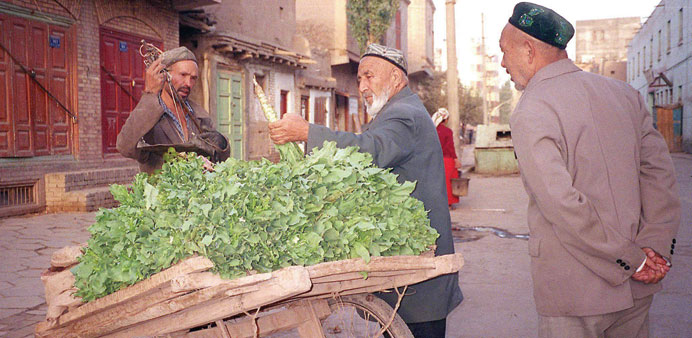
A vendor in Kashgar, in western China. PICTURE: Elisabeth Rosenthal/The New York Times