


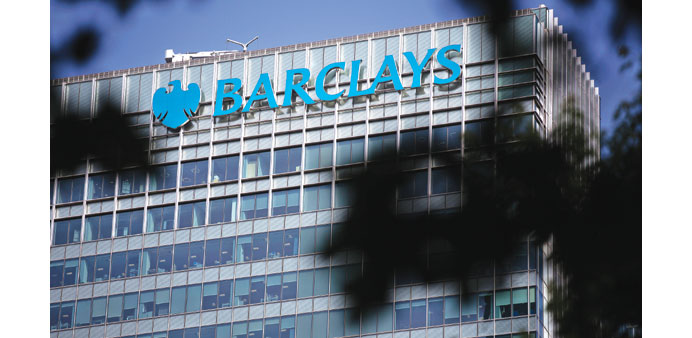
The logo of Barclays is displayed outside the company’s headquarters in London. The investment bank lost the chance to be among firms sharing hundreds of millions of dollars in fees from Alibaba’s initial public offering.
Bloomberg
Beijing
The investment bank Barclays lost the chance to be among firms sharing hundreds of millions of dollars in fees from Alibaba Group Holding’s initial public offering when it advised and financed Charlie Ergen’s failed effort to buy Sprint Corp last year, several people with knowledge of the matter said.
Ergen’s bid was a challenge to SoftBank Corp, which eventually acquired Sprint for $21.6bn, and upset the Japanese company’s founder Masayoshi Son so much that he pressed Alibaba to stop working with Barclays, the people said, asking not to be identified discussing private information. SoftBank owns about 37% of Alibaba and Son took his request directly to the company’s founder Jack Ma, the people said.
The decision to back Ergen highlights the risk of working with competing clients. To pick sides, larger banks use a process called “business selection” in situations where they may alienate another company, with the decision typically based on which client will bring in more fees over the long term. Still, Son’s decision to punish Barclays is against the interests of Alibaba’s other shareholders, said Erik Gordon, a professor at the University of Michigan’s Ross School of Business.
“It is counter to the interest of a company to cut out a globally important underwriter simply because a major stockholder wants to punish it,” he wrote in an e-mail. “Powerful people who want revenge should not use third parties to wreak it.” Son called Ma last spring, in the midst of the struggle over Sprint, and asked that Ma keep Barclays off of an $8bn loan that Alibaba was seeking, one person said.
Aware of Son’s anger, Barclays turned its attention later in the year to other Chinese Internet companies that could go public, another person said. The bank ended up working with Tencent Holdings Ltd, Asia’s largest Internet company by market value, on its recent purchase of a 15% stake in Alibaba rival JD.com Inc, and is pitching for a role on JD.com’s own IPO, this person said.
Barclays ranks ninth among IPO underwriters this year, data compiled by Bloomberg show.
The decision to work for rivals was seen as a flagrant shot at Alibaba, one person said, and London-based Barclays will now be one of the few global banks not to land a spot on Alibaba’s share sale, said the people.
Spokesmen for SoftBank, Barclays and Alibaba declined to comment on the relationship.
The Alibaba sale, which will be managed by banks including Credit Suisse Group AG, Morgan Stanley and Deutsche Bank AG, according to a person familiar with the matter, could be bigger than Facebook Inc’s $16bn offering in May 2012. Other banks working on the sale include Goldman Sachs Group, JPMorgan Chase & Co and Citigroup, that person said.
Alibaba said on March 16 it had decided to start the process for an IPO in the US. The sale may be equivalent to about a 12% stake in the company, a person familiar with the matter said earlier. Based on the average $153bn valuation in a Bloomberg News survey of analysts, that would make it an $18.4bn offering.
Banks on Facebook’s sale earned fees of 1.1% of the sum it raised. Assuming a similar percentage for Alibaba, underwriters would get about $200mn.
“This shows the power of reputation and the dangers of backing a losing horse,” said Tim Loughran, a finance professor at the University of Notre Dame in Indiana. “I don’t find it too surprising that Masayoshi Son is still annoyed with Barclays. Big inside owners of IPOs only want to deal with investment banks they trust.”
Barclays has worked with Hangzhou, China-based Alibaba before. It contributed $200mn as part of the $3bn loan package Alibaba put together to privatise its Hong Kong-listed unit and buy about 20% of itself from Yahoo! Inc in 2012, a person familiar with the matter said then.
Most of the major banks who lent to Alibaba in 2012 will win roles on its IPO, according to a person with direct knowledge of the matter. Credit Suisse, Citigroup, Deutsche Bank and Morgan Stanley each contributed $200mn to the loan package. HSBC Holdings, Australia & New Zealand Banking Group, Mizuho Financial Group and DBS Group Holdings, which were also among lenders, could get hired for the IPO, the person said.
After Son objected, Barclays didn’t participate in Alibaba’s $8bn syndicated loan in June 2013, which consisted of 13 banks. JPMorgan and Goldman Sachs, which will have lead roles on Alibaba’s IPO, were among lenders then.
Son and SoftBank eventually won the competition for Sprint in June 2013, though not before they were forced to raise their offer by $1.5bn to fend off the competing bid from Ergen and his Dish Network Corp.
SoftBank told banks that financing the Dish offer would hurt their chances of working on Alibaba’s IPO, one of the people said. Financed by Barclays and working with some of the bank’s most senior advisers, Ergen made an unsolicited bid for Sprint, trying to top a $20.1bn offer from SoftBank. For several weeks, Barclays was the only lender aligned with Ergen, though Jefferies Group later agreed to help finance an acquisition, people with knowledge of the matter said earlier.
After more than two months of back and forth between the two billionaires, which included Son disputing Ergen’s financial projections and calling them “wishful,” SoftBank bumped its bid to win.