


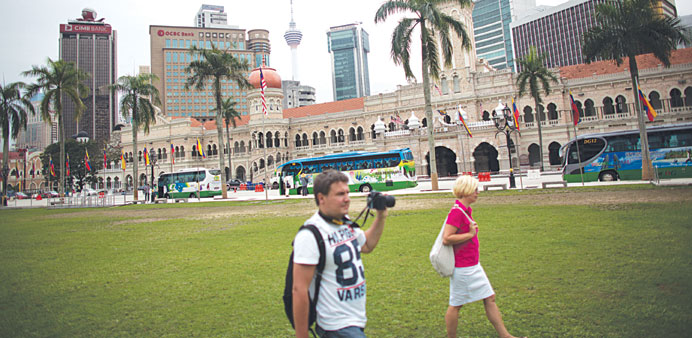
Pedestrians walk through Merdeka Square past the Sultan Abdul Samad building in Kuala Lumpur. Malaysia’s tourism authority made much effort to promote 2014 as “Visit Malaysia Year” in order to lure more tourists, especially from China and the Middle East, into the country.
By Arno Maierbrugger/Gulf Times Correspondent /Bangkok
Tourism, the sixth-largest contributor to the Malaysia’s economy and the second-largest foreign exchange earner, is likely to take a hit this year as the tragedy around the missing flight Malaysia Airlines MH370 unfolds. Originally, Malaysia’s tourism authority made much effort to promote 2014 as “Visit Malaysia Year” in order to lure more tourists, especially from China and the Middle East, into the country, pointing at hundreds of planned events and festivals and the country’s reputation as the preferred halal tourism destination in the world and one of Southeast Asia’s health tourism hubs.
However, the MH370 incident and the way Malaysian officials are handling the crisis are presumably dampening some tourists’ desire to visit Malaysia in the near-term, observers say. The government’s controversial handling of the search for the plane has soured feelings about Malaysia, particularly among Chinese, which normally make a large number of visitors to Malaysia.
The official webpage of the “Visit Malaysia Year” (www.vmy2014.com), where all the events and festivals, as well as popular tourism destinations are listed, has now been overlaid with a banner showing the missing plane and asking for prayers for the passengers. Once clicked, the banner leads to a statement by Hishammuddin Hussein, Malaysia’s defence minister and acting transport minister, about the incident, written in both English and Chinese.
Ironically, the incident is being downplayed by some of the country’s tourism officials.
“We all know accidents happen but that does not mean everything stops. Business must go on and we are here to communicate. The show must go on,” Malaysia Tourism director general Dato’ Mirza Mohammad Taiyab said.
Malaysia has seen its tourist numbers swell over the past 12 years from just 5.5mn visitors in 1998 to 23.6mn in 2013, bringing in $16.4bn in that year. Of this, Malaysia drew some 295,000 Middle East arrivals in 2013 and was planning to welcome 332,000 this year, a target that now seems harder to achieve.
The ongoing neck-on-neck race with Thailand over the lead in Southeast Asia’s tourism numbers (which Malaysia used to hold over the past years) is also likely to be disrupted. Even though Malaysia somehow lacks much of the appeal of neighbouring Thailand with its great beaches and entertainment options, it used to point at its position as a safe and politically stable regional alternative to a Thailand in month-long turmoil.
However, the MH 370 incident in tandem with obvious loopholes in the country’s immigration system that allows people to use fake passports, deteriorating public security and growing tensions over a racially motivated policy of the government have raised eyebrows among tourists and travel industry representatives.
Thus it was not surprising that the MH370 crisis was topic of much of the talk between exhibitors and visitors at the important annual travel exhibition of the Malaysian Association of Tour & Travel Agents, MATTA Fair, which was held from March 14 to 16, 2014, in Kuala Lumpur.
“The tragedy that is MH370 looms over us all, and its impact on this nation will resonate for many years to come,” said Hamzah Rahmat, the association’s president, in his opening speech.