


Agencies/New Delhi
Khushwant Singh, one of India’s best known writers who won fame for a searing book on partition of the subcontinent as well as his once-daring descriptions of sex, died yesterday aged 99.
Singh died at his Delhi residence, his son Rahul Singh said.
“He was having some breathing problems. He hadn’t been too unwell in his last few days and had only stopped writing recently. He was still reading newspapers and books... was mentally alert, and led a full life,” Rahul told NDTV.
The country’s most prolific author, nicknamed King Leer for his legendary roving eye, was a household name who wrote more than 100 books and countless newspaper columns, including one called With Malice Towards One And All.
In an interview in 2005, Singh described his passion for writing as “compulsive.”
“I don’t know what to do with myself if I don’t write, I have lost the art of relaxation,” he said.
Singh, born on February 2, 1915 in what is now Pakistan, occupied India’s literary centre-stage for half a century with his novels - some in his early decades scandalised India with their sexually explicit scenes.
He is best remembered for his historical novel Train to Pakistan, which recounts the tragedy and bloodshed of the partition of the subcontinent in 1947.
Singh, who penned his books and columns on yellow legal pads, became a writer relatively late.
Born into a well-off family, he initially practised law in Lahore. But partition was the trigger for him to change professions.
“I loathed the law. I thought I can’t waste my entire life living off other people’s quarrels,” he said.
After coming to New Delhi, where his father became a prosperous property developer, he entered the diplomatic service in 1947 but soon tired of this and became a journalist and writer.
His philandering fame was mainly self-cultivated and he looked after his wife devotedly until she died of Alzheimer’s disease in her mid-80s.
But a rakish reputation could still get him into trouble even late in life.
In 2001 he triggered diplomatic uproar when he pecked the Pakistani High Commissioner’s teenage daughter on the cheek at a New Delhi party when tensions between India and Pakistan were high.
The high commissioner was recalled to Islamabad to explain what was seen in some Pakistani circles as a lapse in propriety.
Singh, famous for his insouciance, had penned his epitaph before his death.
“Here lies one who spared neither man nor God/Waste not your tears on him, he was a sod/Writing nasty things he regarded as great fun/Thank the Lord he is dead, this son of a gun.”
Singh was a member of parliament in the 1980s and was given the Padma Vibhushan, India’s second highest civilian honour.
He was close to former prime minister Indira Gandhi but then fell out with her over her imposition of press censorship during her emergency rule 1975-77. The relationship further soured after he became close to Gandhi’s estranged daughter-in-law Maneka Gandhi, whom he mentored for some time.
In 1974, he was awarded the Padma Bhushan, the third highest civilian award, but he returned the award in 1984 in protest against the army siege of the Golden Temple of the Sikhs in Amritsar.
President Pranab Mukherjee expressed sadness at the death and said his works had delighted generations of readers.
“A prolific writer who made his mark in literature as well as in journalism, Khushwant Singh will be remembered for his sharp insight and unique wit, as well as sense of humour,” Mukherjee said.
Vice President M Hamid Ansari said: “Khushwant Singh had a long, prolific and illustrious literary career spanning several decades during which he wrote on subjects varying from politics to poetry to issues of social concern.
“He was particularly admired for being fearless in expressing his views in his writing and speech.”
Singh was cremated in Delhi later yesterday. He is survived by his son, daughter and a niece.
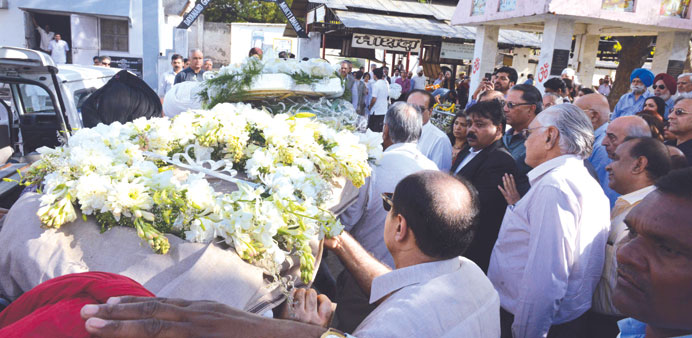
The body of Khushwant Singh is brought to a cremation centre in New Delhi yesterday.