


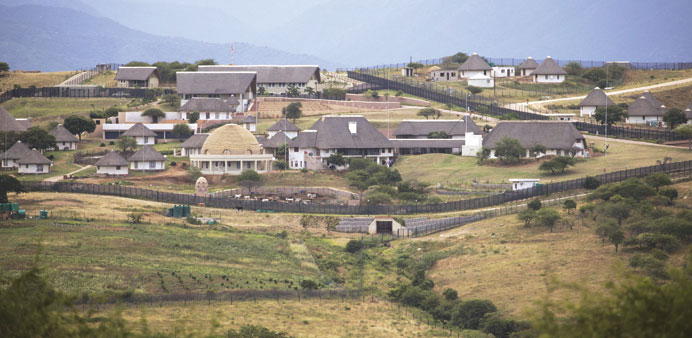
This picture taken on January 21 shows the controversial homestead of South African President Zuma in Nkandla. South Africa’s public ombudsman has said that some of the $23mn taxpayer-funded refurbishments at Zuma’s luxurious residence were unlawful and ordered him to repay part of the cost.
Reuters/AFP/DPA/Pretoria
President Jacob Zuma benefitted “unduly” from a $23mn state-funded security upgrade to his home that included a cattle enclosure and an amphitheatre, South Africa’s corruption watchdog said yesterday in a damning report six weeks before an election.
Public Protector Thuli Madonsela accused Zuma of conduct “inconsistent with his office” and said that he should repay a reasonable part of the unnecessary renovations, which also included a chicken run and a swimming pool that had been justified as “fire-fighting equipment”.
However the exact amount to be reimbursed was not disclosed and Madonsela said it would be up to the Treasury to determine a figure.
The findings were likely to further hurt the image of the scandal-plagued Zuma and his ruling African National Congress (ANC) in May elections, although the former liberation movement that has ruled since the 1994 end of apartheid is still expected to win.
The ANC, which has staunchly supported the president over several previous allegations of corruption, was due to hold a news conference later
“The president tacitly accepted the implementation of all measures at his residence and has unduly benefitted from the enormous capital investment in the non-security installations at his private residence,” Madonsela said in her report.
The 444-page summary of the two-year investigation into the renovations at Zuma’s sprawling homestead at Nkandla in rural KwaZulu-Natal province painted a picture of systemic government incompetence and flouting of normal tender procedures.
Madonsela, a soft-spoken lawyer who has become famous in South Africa for exhaustive investigations into government graft, described the cost overruns as “exponential” and said ministers had handled the project in an “appalling manner”.
When news of the security upgrade first broke in late 2009 in the media, the cost was estimated at 65mn rand ($6.1mn).
However, despite intense public scrutiny, the bill ballooned to 246mn rand ($23mn) as the project and its costs spiralled out of control.
The total spending amounted to eight times the estimated present-day value of securing the home of Nelson Mandela, South Africa’s first black president, who died in December aged 95.
Madonsela also ordered Zuma to “reprimand the ministers involved for the appalling manner in which the Nkandla project was handled and state funds were abused”.
“Our president needs to learn to be responsible, so I think it is fair for him to take that responsibility to pay what he did not spend fairly,” said Fundzo Mundalalo, an unemployed 21-year-old heading to the taxi rank near Johannesburg’s financial district of Sandton.
“This is negative for the ANC,” said Nic Borain, an independent political analyst. “They will lose votes as a result of this.”
However, some other analysts saw it having little electoral impact because of the blanket publicity the case had already received.
“This is unlikely to seriously shift people’s voting habits or make Zuma appear in a new light,” said Peter Attard Montalto, an emerging markets analyst at Nomura International.
Madonsela’s report, entitled Secure in Comfort, said public works funds had to be diverted from inner-city regeneration projects to carry out the upgrade on Zuma’s home.
It added that at no point did Zuma express misgivings at its scale or opulence even though the construction would have raised the eyebrows of a “reasonable person”.
“A substantial amount of public money would have been saved had the president raised his concerns in time,” the report said.
It detailed how a swimming pool was justified in official documents as “fire-fighting” equipment, and how Zuma personally requested changes to the design of bullet-proof windows.
It also criticised the placing of a medical clinic and police facilities inside the gated compound, saying that they could have been moved outside for the benefit of the public in what is one of the poorest regions of Africa’s wealthiest country.
“The manner in which the Nkandla project was administered and implemented gave me the impression of a toxic concoction of a lack of leadership, a lack of control and focused self-interest,” said Madonsela.
But Zuma did not wilfully mislead parliament in its knowledge and approval of the upgrades, the public protector said.
The home, which Zuma rarely visits as he has official residences in Pretoria, Cape Town and Durban – also has a helipad.
The Presidency meanwhile said in a statement that Zuma had been “consistently concerned about the allegations of impropriety” that have swirled around the upgrade.
He would study the report and give his response “in due course”, the statement added.
Despite voter concerns about graft and shoddy public services, the ANC is almost certain to win the May 7 election, handing the 71-year-old Zuma another five years at the helm.
The extent of his unpopularity in urban areas was highlighted by the boos that greeted him at a memorial to Nelson Mandela at Johannesburg’s Soccer City stadium in December, although he still enjoys huge support in the countryside.
The government had previously gone to court to try to prevent Madonsela releasing her findings on the grounds that they might jeopardise Zuma’s security.
The challenge was dropped after Madonsela made clear there was no threat.
Zuma, a polygamous Zulu traditionalist, has been beset by scandal throughout his political career.
He only became president after corruption charges against him were dropped on a technicality days before the 2009 polls, and while in office fathered a child with the daughter of a close friend.
The leading opposition Democratic Alliance has said that in light of the “damning findings”, it will urgently initiate impeachment proceedings against Zuma.
On average a South African worker earns roughly $11,000 a year.
In contrast to Zuma’s luxury lifestyle, some of his neighbours do without electricity or running water. Nearby residents collect water from communal taps and streams which often run dry.