


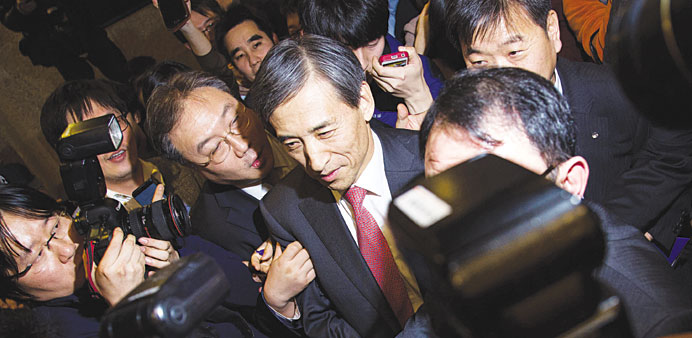
Lee Ju Yeol, incoming governor of the Bank of Korea, stands surrounded by members of the media as he leaves a news conference in Seoul. A South Korean parliamentary committee yesterday endorsed the former central bank deputy chief to become the next Bank of Korea governor.
Reuters/Seoul
A South Korean parliamentary committee yesterday endorsed Lee Ju-yeol, a former central bank deputy chief, to become the next Bank of Korea governor and help steer Asia’s fourth-biggest economy towards a durable recovery.
In his confirmation hearings the same day, Lee stressed the need for strengthened independence from the government and clear communication with markets as the central bank sets the country’s interest rate policy.
“It is an important goal (that the central bank) keep its neutrality from (government bureaus) involved in financial policies,” said Lee, 61, who has had 35 years of experience at the Bank of Korea.
“The central bank lost its trust from markets once market participants felt the Bank of Korea was not acting on its promises,” he added.
Outgoing governor Kim Choong-soo, who was a close aide of former President Lee Myung-bak and had no previous work experience at the central bank, was criticised for giving in too easily to pressure from the government.
Under Kim, the Bank of Korea raised the policy interest rate by 125 basis points between July 2010 and June 2011, while cutting it by 75 basis points between July 2012 and May 2013. He was criticised for being too slow when raising it and too slow when cutting it.
The committee members agreed to adopt a statement endorsing Lee as early as today morning, a committee official said, clearing President Park Geun-hye to formally appoint Lee to the governor’s post.
Lee is expected to start his four-year term from April 1. He would chair his first monthly policy review on April 10, and investors will be closely following his post-meeting news conference for more insight into his policy stance.
Yesterday, Lee showed his commitment to an orthodox central bank policy stance of taking a balanced approach between guiding inflation and fostering economic growth, but did not provide more clues on his immediate policy inclination.
The Bank of Korea last week kept its policy rate steady at 2.50% for a 10th straight month.
A Reuters poll conducted ahead of that meeting showed that analysts, since Lee’s nomination on March 3, have priced in a slightly higher chance of an interest rate increase this year.
South Korea’s economy has been on a solid recovery track and inflation is expected to pick up later this year, suggesting interest rates will be raised rather than cut when the Bank of Korea next changes its policy.
Although annual inflation in South Korea has remained in the 1% range, Lee said there was no need now to change the central bank’s current target band of 2.5 to 3.5%, as it was on par with the central bank’s forecasts.
“Changing the target band could lead to trust issues,” said Lee.
Still, consumer inflation may stay tame for the time being, with central bank data released yesterday showing the producer price index falling on an annual basis for a 17th consecutive month.