


By Reina Tolentino/Manila Times
A recent study by women’s advocates has prompted them to call on the Supreme Court to uphold the Reproductive Health Law of 2012, kept from implementation by a temporary restraining order (TRO), saying that there is an urgent need for maternal health programmes.
The study showed that women “widely accept” the use of non-traditional family planning methods such as contraceptives to control the number of their offspring. However, “lack of basic needs” kept families from practicing their knowledge on reproductive health (RH).
“The big majority of women want to plan their families and depend on government sources for commodities. However, because of the erratic supply of contraceptives, they are unable to do this correctly,” said Democratic Socialist Women of the Philippines (DSWP) national chairperson Elizabeth Angsioco.
The Supreme Court issued a TRO in 2013 on Republic Act 10354 or the Responsible Parenthood and Reproductive Health Act of 2012, answering to petitions claiming that the law offends religious belief and encourages abortion.
The law requires the national government to provide reproductive healthcare, information and supplies while prioritising marginalised beneficiaries.
The baseline survey conducted by the DSWP found a mismatch between beliefs and practices among women of reproductive age in what is considered the poorest barangay (village) in Quezon City. The right age for pregnancy is 22-years-old, according to almost 80% of 621 respondents from Payatas B aged 15-49 years and representing 10% of households. But the same study showed that more than 46% of them got pregnant at 16-20-years old, 38% at 21-25 years old and 4% at 13-15-years-old.
“Rising teenage pregnancy is a problem,” said Quezon City health office head Dr Antonieta Inumerable. Angsioco said this is because of “early sexual initiation and their lack of RH education.”
Quezon City is the most populous city in the Philippines, with a young population of 3mn residents at 2.92% annual growth rate (15.23% in Payatas). It comprises one-fourth of Metro Manila and houses 15 government and 32 private hospitals. Maternity clinics total 19.
Most respondents believed that births must be in a clinic or hospital (94%) and attended by a doctor (84%) or midwife (51.5%). But less than 1% of all their births were attended by medical doctors, 61% were attended by midwives and 46% by nurses, while 4.3% by their relatives or neighbours. Half of them gave birth at home and the rest at public hospitals or clinics.
“Death is a reality in Payatas,” said Angsioco, citing 422 cases of complications during childbirth and 298 cases of maternal deaths in the community.
To address this, Inumerable said the city is building lie-in clinics in various areas. Quezon City allotted P450mn for health projects, from which P14mn is given to reproductive health programmes. Currently, it needs about P200mn for most services, which cater to women and youth.
Since 2008, Quezon City has been enforcing a Population and Reproductive Health Management ordinance to fund family planning programmes but Inumerable said that “funds are not enough for a growing population.”
Angsioco said: “The implementation of the RH law at the national level is critical. LGUs will not be able to do much without the national government.”
Inumerable added that the RH Law would still be of help to local governments even with an existing RH ordinance. She said that it increases funds for maternal health services.
The study also showed that people have a limited understanding of reproductive health. A validation workshop disproved the 64% to 93% respondents who said that they have enough knowledge on the reproductive system. Half of the respondents said that they have adequate knowledge of health vital during and after pregnancy, while the other half said that they need more information on unhealthy behaviour and high-risk pregnancy.
“Respondents get their RH information from sources they are close with and trust at home—parents, family members and partners; in school—teachers; in the community—barangay officials, friends.”
By contrast members of the religious hierarchy have “virtually no influence” on the respondents, the study said.
This is likewise for social media platforms, to which they do not have access, except for television.
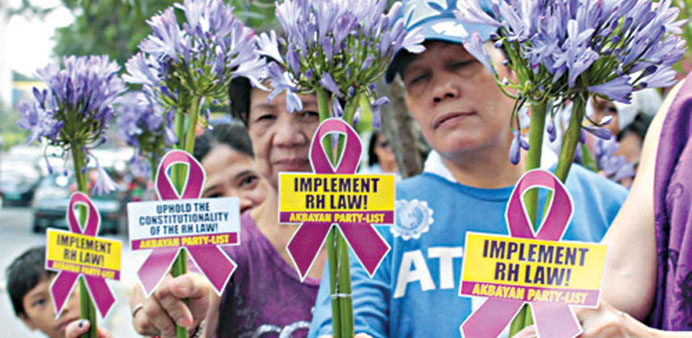
Supporters of the Reproductive Health Law hold flowers during a rally outside the Supreme Court yesterday, as they called on the judges to vote for th