


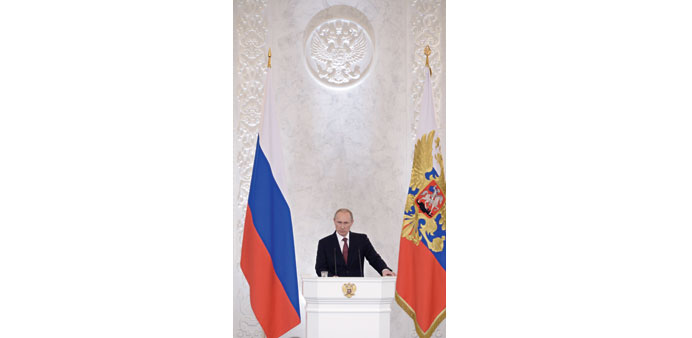
Putin addressing a joint session of Russian parliament on Crimea in the Kremlin. Yesterday he pushed every emotional button of the collective Russian psyche as he justified the incorporation of Crimea, citing everything from ancient history to Russia’s demand for respect to Western double standards.
Reuters/AFP
Defying Ukrainian protests and Western sanctions, Russian President Vladimir Putin signed a treaty yesterday making Crimea part of Russia again but said he did not plan to seize any other regions of Ukraine.
In a fiercely patriotic address to a joint session of parliament in the Kremlin, punctuated by standing ovations, cheers and tears, Putin said that Crimea’s disputed referendum vote on Sunday, held under Russian military occupation, had shown the overwhelming will of the people to be reunited with Russia.
As the Russian national anthem played, Putin and Crimean leaders signed a treaty to make Crimea part of the Russian Federation, declaring: “In the hearts and minds of people, Crimea has always been and remains an inseparable part of Russia.”
Parliament is expected to begin ratifying the treaty within days.
“The Republic of Crimea is considered to be part of Russia from the date of the signing of the treaty,” the Kremlin said.
Crimea and the city of Sevastopol – the home of the Russian Black Sea fleet which has special status – are being incorporated as new constituent parts of the Russian Federation.
Putin later told a flag-waving rally in Red Square beneath the walls of the Kremlin, near where Soviet politburo leaders once took the salute at communist May Day parades, that Crimea has returned to “home port”.
“In the hearts and minds of people, Crimea has always been and remains an inseparable part of Russia,” Putin said.
Putin said that Crimea belonged with Russia and he slammed the Soviet-era decision by Nikita Khrushchev to gift the peninsula to the Ukrainian Soviet republic as riddled with “violations”.
“When Crimea suddenly ended up being in another state, Russia felt it was not simply robbed – it was plundered,” he said.
He added that Russia was tired of being pushed into a corner by the West and said it had been repeatedly deceived on issues like Nato, missile defence and visa-free travel.
“On Ukraine the West crossed a line,” he said, warning it against provoking Russia.
Russian forces took control of the Black Sea peninsula in late February following the toppling of Moscow-backed Ukrainian president Viktor Yanukovych by a protest movement sparked by his decision to spurn a far-reaching trade deal with the European Union last November and seek closer ties with Russia.
Putin’s speech drew immediate hostile reaction in Kiev and the West.
Ukrainian Prime Minister Arseniy Yatsenyuk said the conflict in Crimea had moved from a political to a military stage and he had asked his defence minister to call an urgent meeting with his Russian, US and British counterparts.
“Today Russian soldiers began shooting at Ukrainian servicemen. This is a war crime,” he said.
He was referring to an incident at a compound near the Crimean capital Simferopol in which a military spokesman said a Ukrainian officer was shot dead and another injured when “unknown forces, fully equipped and their faces covered” attacked the base (
Witnesses said that there was no immediate evidence that Russian soldiers were involved in the shooting.
A Russian defence ministry spokesman declined immediate comment.
Interim President Oleksandr Turchynov has accused Russia of acting like “Nazi Germany”.
US Vice-President Joe Biden called Moscow’s action a “land grab” and stressed on a visit to Poland Washington’s commitment to defending the security of Nato allies on Russian borders.
Polish Prime Minister Donald Tusk said Russia’s move was unacceptable to the international community, while Britain suspended military co-operation with Russia.
“It is completely unacceptable for Russia to use force to change borders, on the basis of a sham referendum held at the barrel of a Russian gun,” British Prime Minister David Cameron said, threatening Putin with “more serious consequences”.
In his speech, the Russian leader lambasted Western nations for what he called hypocrisy, saying they had endorsed Kosovo’s right to self-determination and independence from Serbia but now denied Crimeans the same rights, he said.
“You cannot call the same thing black today and white tomorrow,” Putin declared to stormy applause, saying that while he did not seek conflict with the West, Western partners had “crossed the line” over Ukraine and behaved “irresponsibly”.
He said that Ukraine’s new leaders, in power since the overthrow of pro-Moscow Yanukovych last month, included “neo-Nazis, Russophobes and anti-Semites”.
Putin thanked China for what he called its support, even though Beijing abstained on a UN resolution on Crimea that Moscow had to veto on its own.
He said he was sure Germans would understand the Russian people’s quest for reunification, just as Russia had supported German reunification in 1990.
And he sought to reassure Ukrainians that Moscow did not seek any further division of their country.
Fears have been expressed in Kiev that Russia might move on the Russian-speaking eastern parts of Ukraine, where there has been tension between some Russian-speakers and the new authorities.
“Don’t believe those who try to frighten you with Russia and who scream that other regions will follow after Crimea,” Putin said. “We do not want a partition of Ukraine.”
Putin said Russian forces in Crimea had taken great care to avoid any bloodshed, contrasting it with Nato’s 1999 campaign to drive Serbian forces out of Kosovo.
Reinforcements had remained within the treaty limit of 25,000 troops in the area, he said.
Setting out Moscow’s view of the events that led to the overthrow of Yanukovych last month, Putin said the “so-called authorities” in Kiev had stolen power in a coup, opening the way for extremists who would stop at nothing.
Making clear Russia’s concern at the possibility of the US-led Nato military alliance expanding into Ukraine, he declared: “I do not want to be welcomed in Sevastopol (Crimean home of Russia’s Black Sea fleet) by Nato sailors.”
Moscow’s seizure of Crimea has caused the most serious East-West crisis since the end of the Cold War and Putin showed no sign of backing down despite the threat of tougher sanctions.
In Crimea, where his speech and the signing ceremony were broadcast live, his words caused rapture for some.
“Putin’s done what our hearts were longing for,” said Natalia, a pensioner who sells snacks in a kiosk in the centre of Simferopol. “This finally brings things back to what they should be after all those years. For me, for my family, there can be no bigger joy, for us this is sacred.”
Feride Kurtbedinova, a high school student and a member of Crimea’s Muslim ethnic Tatar minority, said: “After Putin met with the Tatar leaders, that made it for me. He showed respect, gave us security guarantees, for Tatars that is important.”
Ukraine’s Yatsenyuk earlier sought to reassure Moscow on two of its key concerns, saying in a televised address delivered in Russian that Kiev was not seeking to join Nato and would disarm Ukrainian nationalist militias.
On Monday, the US and the EU imposed sanctions on a handful of officials from Russia and Ukraine accused of involvement in Moscow’s seizure of the Black Sea peninsula, most of whose 2mn residents are ethnic Russians.
Russian politicians scoffed at the sanctions.
The State Duma, or lower house, adopted a statement urging Washington and Brussels to extend the visa ban and asset freeze to all its members. The foreign ministry in Moscow said it would retaliate (
The White House said leaders of the world’s seven leading industrial democracies will hold a Group of Seven summit without Russia on the sidelines of a nuclear security summit in The Hague next week to consider further responses to the crisis.
Despite strongly-worded condemnations, Western nations have been cautious in taking their first practical steps against Moscow, both to leave the door open for a diplomatic solution and out of reluctance to endanger the world economic recovery.
Russian stocks gained another 2% after rallying strongly on Monday and the rouble rose after Putin said Russia would not seek to further divide Ukraine. Investors noted the initial sanctions did not target businesses or executives.
But Russia said its long-delayed privatisation programme could be postponed again, adding to a deepening economic crisis over Ukraine.
Washington and Brussels have said future punitive measures could affect the economy, energy and arms contracts as well as the private wealth of magnates close to Putin.
The EU also said its leaders would sign the political part of an association agreement with Ukraine on Friday, in a gesture of support for the fragile coalition in Kiev.
In a symbolic gesture, Crimean Prime Minister Sergei Aksyonov announced that Crimea would switch to Moscow time from March 30.
In the Crimean capital Simferopol, Banks scrambled to introduce the rouble as an official currency alongside the Ukrainian hryvnia.