


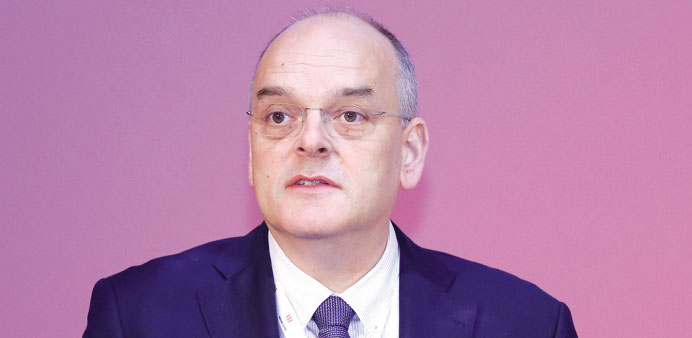
Working very closely with Muntajat, Qatar’s Al Karaana petrochemical project has set eyes on Asian markets for its 2mn tonnes-per-year products, says Els.
The new Al Karaana petrochemicals project - a 80:20 joint venture of Qatar Petroleum and Shell - is eyeing Asian markets to a great extent for its 2mn tonnes-per-year products.
The estimated $6.5bn project, which is now in the midst of FEED phase, will now embark on the next stage of engineering, procurement and construction (EPC) and is considering a mix of conventional bank loans and Islamic financing, its CEO designate Stijn van Els told media on the sidelines of a project conference organised by MEED.
In March last year, Qatar had awarded front-end engineering and design (FEED) contract for the plant to Fluor, a global engineering construction company. The project is slated for completion by 2018.
Upon commissioning, the project is expected to contribute an additional 25% to Qatar’s petrochemicals production capacity.
In December 2010, QP and Shell had signed a memorandum of understanding to jointly study the development of a major petrochemicals complex in Ras Laffan. One year later, both signed a heads of agreement setting the scope and commercial principles for project development.
Al-Karaana, which takes its name from an ancient Qatari village and refers to a “water well”, comprise a steam cracker, a mono ethylene glycol plant, a linear alpha olefin unit and an oxo alcohol unit.
The total production capacity would be 2mn tonnes per year of petrochemicals, Els said, adding the project has been designed to have a total of 1.5mn tonnes of mono ethylene glycol, 300mn tonnes of linear alpha olefin and another 250mn tonnes of oxo alcohol.
The steam cracker at the petrochemical complex would have feedstock coming from natural gas projects in Qatar. “We will be fully integrating with the other projects,” he said.
Both the mono-ethylene glycol plant, the world’s largest of its kind, and linear alpha olefin unit would use Shell’s proprietary MEGA and higher olefins process technologies respectively; whereas oxo alcohol uses Mitsubishi Chemical Corp’s OXO T-Process technology.
Asked about the markets, he said most of the products would be exported and some domestically consumed.
“The main exports markets will be Asia. We are working very closely with Muntajat to define the optimum market mix as we go about,” Els said.
Muntajat, which recently decided to set up its international marketing company at The Hague in The Netherlands, has now entered a new phase of expansion with it currently implementing its supply chain programme and building a global network of offices and warehouses.