


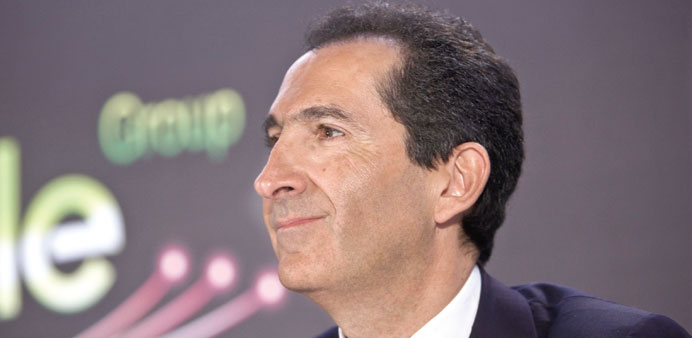
“We will create a French and European champion by marrying two companies with very different histories and strengths”
Reuters/Paris
The billionaire founder of Numericable believes he can create a French “national champion” by combining fixed-line and mobile telecoms services following his cable firm’s purchase of Vivendi’s SFR unit.
Speaking for the first time since winning a takeover battle for SFR against Bouygues Telecom, Patrick Drahi said yesterday the deal was a sign of “convergence” between fixed and mobile telecoms operators.
“Convergence of networks and of usage by consumers is happening everywhere in the world,” said Drahi, whose holding company Altice also owns cable and mobile assets from Israel to the Dominican Republic.
“We will create a French and European champion by marrying two companies with very different histories and strengths,” he told a news conference.
In a saturated and cut-throat competitive European telecoms market, firms are increasingly looking to offer a range of services to customers to benefit from economies of scale.
Drahi, a little-known entrepreneur who has made his wealth building European cable networks since the 1990s, emerged as the underdog winner on Friday of a bidding war for SFR, despite the fact that Numericable has annual revenue ten times lower than the business it is buying.
Combining Numericable and SFR will create France’s second-largest player in both fixed-line telecoms and mobile, behind Orange. Numericable believes its bundled offer will have an edge over rivals because its cable broadband tends to be faster than the ASDL connections used by most competitors.
Numericable won the battle for SFR despite opposition from France’s industry minister, who had openly favoured Bouygues and criticised Drahi for skirting French taxes by residing in Switzerland and basing his Altice holding company in Amsterdam.
Industry Minister Arnaud Montebourg said Bouygues’ bid would reduce the number of players in the French mobile market to three from four and calm what he called “destructive competition” that had sent prices down 20% in the past two years and hammered profitability in the industry.
Vivendi picked Numericable’s bid — which would give it €11.75bn in cash and 32% in the resulting company — because it offered more cash, posed fewer competition problems, and provided a quicker exit from telecoms than Bouygues’ bid.
As he laid out his plan for the new Numericable-SFR, Drahi sought to reassure the government with pledges on jobs, keeping prices stable, and using French vendors.
“We’re here to create value for our company, and by doing so create jobs and growth,” he said.
On the financial side, Drahi laid out a strategy for the new group that consists of using SFR’s marketing muscle to sell more high-speed broadband services over Numericable’s network and developing its business with corporate clients.
In the process, the combined group’s average revenue per user — Numericable’s stood €8 higher than SFR’s last year — should climb, driving higher profits, he said.
Numericable-SFR, which would have 7mn broadband and 21.4mn mobile customers, would in the medium-term achieve 2 to 5% annual revenue growth, he forecast.
Drahi said he would be chairman of the new company, adding it remained to be seen how many seats on the board Vivendi representatives would be given. He also said it remained to be seen whether SFR’s current chief executive would have a role alongside Numericable CEO Eric Denoyer.
Numericable also confirmed earlier reports the deal would create cost savings of more than €1bn per year by 2017. Synergies would come in part from migrating SFR broadband customers to Numericable lines into the home, lower costs for carrying mobile traffic on fixed lines known as backhaul, as well as marketing and software systems.
It aims for 40% operating profit margins, compared with SFR’s 27% and Numericable’s 47% last year.
Over time, the Numericable brand will be phased out in favour of the SFR brand, Drahi added. “I see big growth in top and bottom-line for this new company,” he said.
Drahi said he had not set a dividend policy for the new company and did not pledge to pay one.
The combined entity will remain based in Paris and will be listed on the Paris stock exchange.