


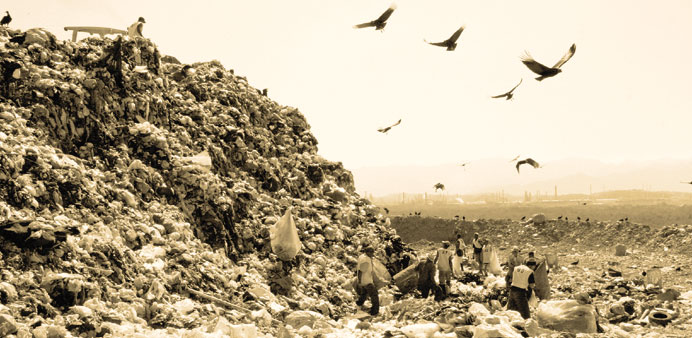
POIGNANT: A scene from the documentary Waste Land.
Brazilian artist Vik Muniz captures recreated images in the form of portraits. The result is: stunningly beautiful human portraits. The artwork surprised even the catadores themselves, writes Umer Nangiana
He is the son of the soil. He knows his native land like the palm of his hand, fully aware how entrenched is classicism and the divide on the basis of social status, race and colour.
One ‘unfortunate’ incident in his life landed him in the United States and changed his fortunes, enabling him to come out of a life of poverty. Today, he is one of the best-selling artists in the world.
After achieving all that he once dreamed of, renowned Brazilian artist Vik Muniz decided to give something back to his country, his people. Putting his thought into motion, the artist in him took him to a journey that eventually practically changed many lives.
From the comfort of his luxurious studio in Brooklyn, he sets off to Jardim Gramacho, the world’s largest garbage dump located in his native city of Rio de Janeiro, to photograph ‘catadores’, the garbage-pickers or the recyclable-material pickers — as they are preferred to be called.
The documentary Waste Land is all about Muniz’s journey to Gramacho, the stories of the people he met there and how his work changed their lives. It was screened at Museum of Islamic Art by Doha Film Institute recently.
He would sell portraits of garbage-pickers and the revenue would go to the catadores. This was his idea in words. Only he knew what was in his mind about the portraits but the extraordinarily unconventional artist in Muniz was convinced that garbage can also be beautiful.
It was not easy to photograph the people at the landfill, the ‘garbage city’, which was a world unto itself.
“These are probably the roughest people you can think of. They’re all drug addicts. Check out the geography of this thing. It’s like the end of the line. It’s where everything not good goes, including the people,” Muniz describes the place to his viewers in his own words.
Accompanied by his friend and co-worker Fabio, he lands at Gramacho. He was soon to discover some incredible stories but first he needed to win over the confidence of the subjects for his photographs. This is how he introduced himself and his idea to Tiao, President of the Garbage-Pickers’ Association, who later goes on to become one of the several subjects of his photography.
“I am the Brazilian artist who, I hate to say this, but who sells and is the most popular overseas.
Tiao: Congratulations, man!
Muniz: I grew up very poor, but now I have reached a point where I want to give back.”
Representing more than 3,000 pickers, Young Tiao had formed the association for his fraternity’s wellbeing with his own initiative. Initially, nobody, not even his own colleagues, believed in him but he persisted. He was uneducated but a ‘learned’ man.
Muniz discovered Tiao and a group of pickers discussing Italian Philosopher Nicolo Machiavelli’s The Prince, for instance, and other great books. They used to find books from the garbage and preserve it in the form of their library.
Zumbi was their ‘librarian’. “We have to think about the future because I don’t want my son to be a picker. Although if he is, I’d be very proud. But I’d rather want that he be a lawyer to represent the pickers, you know,” Zumbi tells Muniz.
Meeting these ‘ordinary’ people with extraordinary stories and personalities, Muniz knew he was up for a great project. It was fate or uneven circumstances in their respective lives that landed them at this place, the artist discovers. But they, too, had an attitude towards life. They were not ashamed or embarrassed in doing the ‘dirty work.’
“It’s better (in the night) than during the day, there are less people. It’s better than being out there, like a lot of people, prostituting yourself. We are working honestly,” a female garbage-picker tells Muniz. She, at the age of 18, had two children and her husband was a drug dealer who was not supporting the family.
Besides children, she had to feed her mother, who was also a garbage-picker, and other siblings living in a shanty town. Their job was to pick recyclable material from the garbage and collect it to be carried away by dealers in the trucks from the landfill.
The business works like a stock-exchange. The pickers pick only the material that is in demand on a particular day and they get their wages right there. Normally, they would easily manage to earn $30-40 a day. But then, the job requires frisking through dumps of garbage and dirt with your hands.
There were wise men among the pickers, who were fully aware of the importance of the recyclable material and thus were proud doing their job. For instance, the old man Valter, the vice-president of the association, would always advise his colleagues not to leave even the smallest of the things behind.
“People sometimes say, “But one single can?” One single can is of great importance. Because 99 is not 100, and that single one will make the difference,” he tells Muniz at one point.
The Brazilian artist, fully aware of the transformative power of art, photographs a group of catadores individually at the site. He returns to a warehouse nearby with the pictures and there he projects them on the floor. Involving his subject pickers, Muniz collects recyclable material from the garbage and uses it to recreate images on the floor.
He then captured these recreated images in the form of portraits. The result was stunningly beautiful human portraits. The artwork stunned even the catadores themselves. It was only at this point that they fully realised the importance and greatness of Muniz’s work.
After a lot of discussion with his wife and friend Fabio, Muniz decided to take some of the pickers abroad to accompany him on the auction of the portraits. Unlike many artists who would first go to a gallery, the Brazilian decided to go straight to auction. So Tiao accompanied him to London. His portrait was sold for $50,000.
Tiao broke down in tears. “The most important thing is what you’re going to do with this (money),” Muniz asks Tiao after the auction. “It was all worth it. Everything I did up until now was really worth it,” replies Tiao, in tears.
“Why do you think you are here?” Muniz goes on. “Because once a friend and I had a dream of creating an association. We created the association. It was a crazy dream. Nobody believed in us. Not even my family. Nobody believed in me,” Tiao replies, wiping away tears with the back of his hands.
“This is only the beginning, Tiao. This is only the beginning,” the Brazilian artist tells him. “I am so happy. God was so good to me, so wonderful,” Tiao finally, smiles. Muniz hugs him. “You’re the strong one. You’re the one who is doing everything,” he tells him.
For himself, out of this masterpiece of a work, Muniz tells the audience, he wanted nothing. It was all for the people of his country.
“I’d rather want everything and have nothing, than have everything and want nothing. Because at least when you want something your life has a meaning. It is worthwhile. From the moment you think you have everything, you have to search for meaning in other things. I spent half my life wanting everything and having nothing; and now I have everything and I don’t want anything,” you hear him saying at one point before starting his project.
“These days I am starting to see things in a simpler way. I don’t have as much material ambition as I used to. When I was poor I only wanted material things. I just wanted to have things. I had to buy a lot of crap to get rid of that complex,” he continues.
From the earnings of the portraits, all pickers in general and his subject ones, in particular, were able to substantially change their respective lives. Most of them managed to start new lives with new businesses. At least one of them went back to the landfill but not because she needed to, she was just missing her former colleagues.
Filmed over nearly three years and released in 2010, Lucy Walker’s Waste Land won over 50 prizes and a nomination for Oscars in the category of best documentary feature. It received unanimously positive reviews from almost all film critics and viewers.
BELOW:
1) FLOORED! Vik Muniz and the catadore, drawn to critical acclaim. Even the catadores were stunned.