


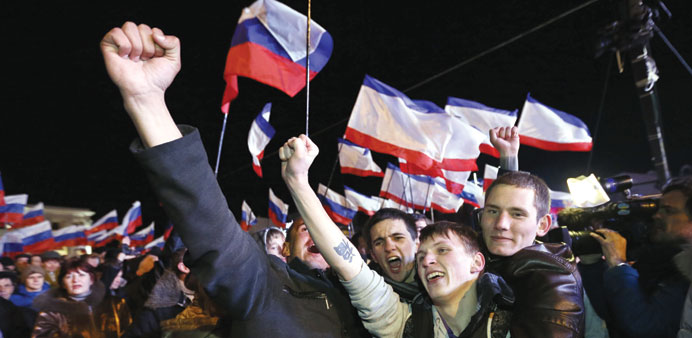
People react on Lenin Square after the end of a referendum in Simferopol. More than 90% of Crimeans voted for the Ukrainian region’s accession to Russia, according to an exit poll published after the referendum ended.
Reuters/AFP
Russian state media said that Crimeans voted overwhelmingly yesterday to break with Ukraine and join Russia, as Kiev accused Moscow of pouring forces into the peninsula and warned separatist leaders “the ground will burn under their feet”.
RIA news agency said 93% backed annexation, citing an exit poll released as voting ended at 8pm (1800 GMT). Another Russian agency said turnout was over 80%.
“This is a historic moment,” Crimea’s self-declared premier Sergiy Aksyonov told reporters after casting his ballot in the regional capital Simferopol.
Caught in an East-West crisis reminiscent of the Cold War, Kiev said that Russia’s build-up of forces in the Black Sea region was in “crude violation” of an international treaty, and announced plans to arm and train 20,000 members of a newly-created National Guard to defend the nation.
US Secretary of State John Kerry told Moscow that Washington would not accept the outcome of the vote, which is likely to favour union with Russia for a region which has a Russian-speaking majority.
The White House also warned Moscow to expect sanctions while foreign ministers from the European Union, which has major trade ties with Russia, will decided on possible similar action in Brussels today.
But Russian President Vladimir Putin rejected Western accusations that the referendum was illegal, saying that it respected the will of the Crimean people, while his foreign ministry said it had agreed with the US to seek a solution to the crisis through constitutional reform.
In Kiev, Prime Minister Arseniy Yatsenyuk threatened dire consequences for the Crimean politicians who had called the vote, saying that separatist “ringleaders” wanted to destroy Ukrainian independence “under the cover of Russian troops”.
“We will find all of them – if it takes one year, two years – and bring them to justice and try them in Ukrainian and international courts. The ground will burn under their feet,” he told a cabinet meeting.
Yatsenyuk had just returned from a US trip where he won expressions of moral support but no offers of weapons.
Kiev’s pro-European rulers, who took power after last month’s fall of Moscow-backed president Viktor Yanukovych to popular unrest, have been as powerless as Western governments to prevent the referendum or build-up of Russian forces on Ukrainian territory.
At a polling booth at a school in Simferopol, the Crimean regional capital, dozens of people lined up outside to cast their ballots early.
“I have voted for Russia,” said Svetlana Vasilyeva, 27, a veterinary nurse. “This is what we have been waiting for. We are one family and we want to live with our brothers.”
Vasilyeva voiced fears common among some of Ukraine’s native Russian-speakers about the consequences of Yanukovych’s downfall after protests in which over 100 people were killed.
“We want to leave Ukraine because Ukrainians told us that we are people of a lower kind. How can you stay in such a country?” she said.
But ethnic Tatars – Sunni Muslims who make up 12% of Crimea’s population – said that they would boycott the vote despite promises by the regional authorities to give them financial aid and proper land rights.
“This is my land. This is the land of my ancestors. Who asked me if I want it or not? Who asked me?” said Shevkaye Assanova, a Crimean Tatar in her 40s. “For the rest of my life I will be cursing those who brought these people here. I don’t recognise this at all. I curse all of them.”
Crimea’s 1.5mn voters have two options: union with Russia or giving their region, which is controlled by pro-Kremlin politicians, the broad right to determine its own path and choose relations with whom it wants – including Moscow.
Provisional results were due to be released later and the final tally expected a day or two later.
A local Tatar television channel broadcast the count at one small polling station. It took just a few minutes for officials to stack up the papers, virtually in a single pile.
One gave the result as: “166 for, 2 against, 1 spoiled”.
By “for” she clearly meant the first option on the paper, for union with Russia.
Russia has the right to keep forces on the Black Sea peninsula, including at its naval base in the port of Sevastopol, under a treaty signed after Ukraine gained independence from the wreckage of the Soviet Union in 1991.
But Ukrainian acting defence minister Ihor Tenyukh accused Moscow of going far beyond an agreed limit on servicemen – which he said was 12,500 for 2014.
“Unfortunately, in a very short period of time, this 12,500 has grown to 22,000. This is a crude violation of the bilateral agreements and is proof that Russia has unlawfully brought its troops onto the territory of Crimea,” he said.
This figure had risen from 18,400 on Friday.
“Let me say once again that this is our land and we will not be leaving it,” he told Interfax news agency.
Tenyukh later said that the defence ministries in Kiev and Moscow had declared a truce until March 21 during which Russian forces, who have been arriving by boat and helicopter, would leave Ukrainian military facilities untouched.
But AFP reporters saw no sign of the agreement being implemented at the Perevalnoye base outside Simferopol as Russian forces stood rooted in place.
Three people have died in clashes between nationalists and Russian supporters in Ukraine’s southeast since Thursday – the first fatalities since nearly died in a week of carnage in Kiev last month – and the region remained fraught with tensions as Crimeans voted to join Kremlin rule.
Around 4,000 pro-Moscow activists rallied in Donetsk to support Crimea’s referendum and 6,000 turned out in Kharkiv with a large Russian flag and a sign reading “Our Homeland is the USSR”.
Many Crimeans hope union with Russia will bring better pay and make them citizens of a country capable of asserting itself on the world stage. But others see the referendum as a land grab by the Kremlin from Ukraine, whose new rulers want to move the country towards the European Union and away from Russia’s sway.
Putin defended the vote in a phone call yesterday with German Chancellor Angela Merkel, saying it complied with international law, including Article 1 of the UN Charter which states the principle of self-determination of peoples.
“It was emphasised that Russia will respect the choice of the Crimean people,” a Kremlin statement said.
Putin has said he must protect the Russian-speaking population in Ukraine from “fascists” in Kiev who ousted Yanukovych.
Western powers largely dismiss his characterisation of the new authorities as successors of Nazi-allied Ukrainian forces which fought the Red Army in World War II.
Russian Foreign Minister Sergei Lavrov urged Kerry yesterday to encourage authorities in Kiev to stop what he called “massive lawlessness” against the Russian-speaking population.
In their second phone conversation in two days, Lavrov and Kerry agreed to seek a solution to the crisis by pushing for constitutional reforms in Ukraine, Russia’s foreign ministry said in a statement.
However, Kerry told Lavrov that the US would not accept the referendum result and said Russia must pull back its forces to their bases, a senior State Department official said.
The White House also warned Putin that he faces international isolation that will hurt Russia’s economy.
“You can expect sanctions designations in the coming days,” White House senior adviser Dan Pfeiffer told NBC’s Meet the Press.