


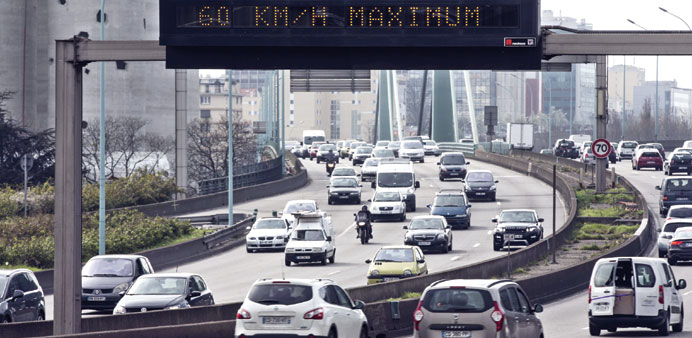
This picture taken on Saturday shows a sign informing drivers that the speed limit of the highway belt around Paris has been reduced to 60kph due to the peaks of pollution experienced since a few days in the city of Paris.
AFP/Reuters/DPA
Paris
Today Paris launches alternate driving days for the first time in nearly 20 years to tackle dangerous air pollution levels amid controversy on whether the ban is warranted or will yield results.
The restrictions in the French capital and 22 surrounding areas will come into force from 5.30am (0430 GMT) and could be extended until tomorrow, officials said.
About 700 police officers will be deployed to man 60 checkpoints to ensure that only cars and motorcycles with number plates ending in odd digits are on the roads.
Electric and hybrid cars will be exempted from the ban as well as any vehicle carrying three people or more.
Parking will be free today for vehicles with even number plates, the Paris city hall said, calling on residents to consult carpooling or car-sharing sites to work out their commutes and rides.
The restrictions will be reviewed on a daily basis to determine if an extension is necessary. The ban means that drivers can only use their cars or motorcycles every other day.
It is only the first time since 1997 that the French authorities have ever resorted to such a drastic measure.
The government made the announcement on Saturday after pollution particulates in the air exceeded safe levels for five straight days in Paris and its environs.
All public transport was made free over the weekend to persuade residents to leave their cars at home. It will remain free as long as the alternate driving days remain in force.
Political opponents and car associations criticised the decision, saying it would be tough to police, and accused the Socialist government of conceding to pressure from its coalition Green partners ahead of local elections in late March.
“This is impossible to enforce, stupid and an attempt to win votes,” Pierre Chasseray, president of drivers’ lobby 40 Millions d’Autombolistes, told French television and newspapers.
Opposition UMP chief Jean-Francois Cope and mayor of Meaux in the suburbs of Paris, said there was a lot of confusion about the scheme.
“The ecologists have applied a lot of pressure on the government and the decision was rushed. It lacks coherence, explanation and – on the ground, as a mayor from one of Paris’s suburbs – it’s panic,” he told Europe 1 radio.
France’s Automobile Club Association (ACA), which counts some 760,000 members, denounced the move as has “hasty, ineffective” and “bound to lead to chaos”.
“This measure had no effect in any country where it was introduced,” said ACA head Didier Bollecker. “Once drivers are being targeted even when heating is even more polluting, but no one is asking for heating to be used on alternate days.”
By Saturday the number of pollution particulates in the air had fallen slightly after hitting a high of 180 microgrammes per cubic metre – well over double the safe limit – on Friday.
These so-called PM10 particulates are created by vehicles, heating and heavy industry, with the safe limit set at 80 per cubic metre.
Last week European Environment Agency (EEA) figures for Thursday showed there was 147 microgrammes of particulate matter (PM) per cubic metre of air in Paris – compared with 114 in Brussels, 104 in Amsterdam, 81 in Berlin, and 79.7 in London.
Prime Minister Jean-Marc Ayrault said he was “aware of the difficulties” that the alternate driving plan would cause for commuters. “But this extra measure is necessary,” he said in a statement, calling on motorists to show a “spirit of responsibility and civic-mindedness”.
Ecology Minister Philippe Martin said he understood the “difficulties, the irritation and even anger” over the move, adding: “But we just had to take this decision.”
“Our core objective is to ensure public safety because we want to end this pollution,” he said yesterday, warning that the air quality was likely to worsen today.
Martin said similar measures in 1997 “had yielded results”, adding that he hoped that the number of vehicles on the roads would be “significantly lower” today, without giving a figure.
The measure in October 1997 lasted one day and was highly unpopular.
The smoggy conditions have been caused by a combination of cold nights and warm days, which have prevented pollution from dispersing.
The pollution particulates in the air can cause asthma attacks as well as respiratory and heart problems.
The World Health Organisation has said finer particulates – known as PM2.5 – are cancer-causing.
Paris is more prone to smog than other European capitals because of France’s diesel subsidies and its high number of private car drivers.
A week-long spell of unseasonably warm, sunny weather has recently exacerbated the problem.
Motorists took to news websites and social networks to voice their disapproval of the measure.
“To think that the Paris public transport system, which is heaving at peak hours, can absorb the flow of those who, one day out of two, have the wrong plate, is a rare (kind of) stupidity,” one reader remarked on the website of Le Nouvel Observateur.