


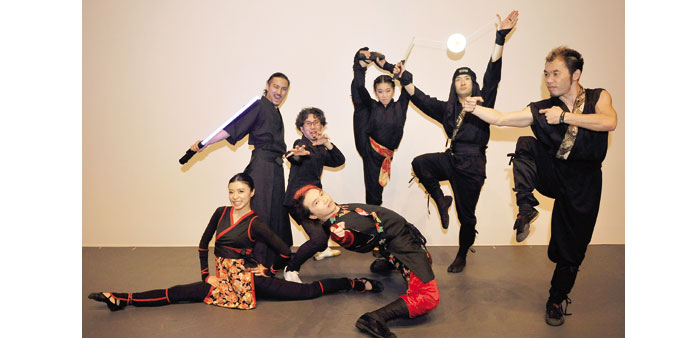
SPECIAL POSER: Enra strike a pose after the show for Community. Photos by Najeer Feroke
The dancers battled giant geometrical shapes, grooved against colour bubbles, ran in the mountains and played with light, Anand Holla writes
In the dark of the hall, they came alive in multi-dimensional hues. Jumping, dancing, fighting and falling, six artistes moved in and out of an illusion so seamless that one wondered where the real ends and the unreal begins.
The Japanese entertainment powerhouse known as Enra had turned the Katara Drama Theatre into some sort of a live visual effects studio over the weekend.
Before them was a spellbound audience, and behind them a big white screen on which images were constantly projected to the beats of electronica and dance music. Clad in cool black outfits, the dancers with their painstakingly synchronised steps, interacted with the visuals behind them as if they existed.
The outcome of this one-of-a-kind fusion of live-action dance, imagery, light, music, motion graphics and technology was a live show unlike anything you’d have seen before.
The dancers battled giant geometrical shapes, grooved against colour bubbles, ran in the mountains and played with light. Basically, they could do whatever their director Nobuyuki Hanabusa’s imagination talked him into.
After the show, Hanabusa walked away from a swarm of Doha’s new Enra fans eager to shake hands and click pictures, and spoke with Community.
“This is not drawn from video games or movies,” he said, searching for words, “This is like my experience of life. This is the only imagination I can have. The performers and their capabilities inspire me to conceptualise it.”
Hanabusa’s career trajectory explains how his multi-layered experiment took shape. Although he studied automobile design, Hanabusa took to visual arts after his graduation. In the late ’90s, he began working at a computer graphics firm and his work was featured in TV programmes and commercials.
Around 10 years ago, Hanabusa as a live performance VJ, honed his command over creating striking digital images. Apart from graphics, he spun images in analog styles as well. Soon, he was handling image production for Japanese fashion brand Somarta, and even weaving visuals for a dance troupe Orientarhythm and a performance group Kagemu.
Two years back, Hanabusa decided to give wings to his imagination, just the way he wanted. A gruelling audition later, he chose six versatile artistes. “I always wanted to be a performance artiste. But I can’t dance or perform myself. So I created Enra,” he said.
Hanabusa maintains that his purpose was to challenge different ways of expression and create complex work that offers a different outlook on the world. This is why he creates eye-popping imagery that marries the clockwork choreography of his group.
“Apart from Japan, we have performed in Hong Kong, China, USA, Romania, Indonesia, France, and now Qatar. But our most nervous show was when we performed before the International Olympic Committee last March in Tokyo. It was held at a palace and there were a lot of important people there,” he said.
This though is the first time that Enra pushed its act to 45 minutes. “We were wondering whether the audience would get bored with the onslaught of graphic projections,” Hanabusa said, laughing.
Tsuyoshi Kaseda, the most seasoned of the six, stood next to him and nodded along. “We are all martial artistes, jugglers, dancers, ballet artistes, acrobats,” Kaseda said, pointing at his friends who pulled off some mind-boggling feats in the show using props like a diabolo (Chinese Yo Yo) and ribbons.
Each one of them is not just multi-talented but has nurtured a long-standing passion for performance arts. And it shows.
Kaseda is as proficient in hip hop, street style and break dance as he is in Chinese martial arts. He is also the founder of the popular dance-martial arts unit Spinnin Ronin.
Maki Yokoyama, who is also part of Spinnin Ronin, has been doing rhythmic gymnastics since she was eight. She then learnt acting, martial arts, and dances like jazz, tap, and modern.
Saya was three when she started doing ballet. Later, she studied acting, Nichibu (Japanese traditional dance), Kyougen (Japanese comic theatre), and majored in theatre.
Self-taught in a performance style based on animation fused with pop and pantomime, Tachun’s dance is free-flowing and genre-less.
Arts student Yusaku Mochizuki, who is majoring in inter-media art, is an ace juggler and a street performer.
Kazz is a dancing genius, too, specialising in club, house, salsa, hip hop, and tap dance.
Despite their curriculum vitae speaking aloud for their abilities, the group can’t afford to miss practice. “Back in Tokyo, we practice four days a week, and every day for weeks before a show,” Kaseda said.
That is because every performance is a test in achieving stellar co-ordination with a near-zero margin of error. Throughout, the artistes have to be in complete sync with the graphics on the screen behind them, calculating each move and adjusting the position of their bodies with every beat.
Kaseda walked to that part on the stage where the screen is erected. He then pointed at a series of tiny markers stuck on the podium floor, and said, “Now you can see them. But during the show, we can barely see anything. So we use these markers to get a rough idea of where we stand, move to, and return to.”
While some marks are set to a few feet, some are half that size. “One stretch of our legs covers that portion, a half stretch covers half of it, and so on. What helps as much in measuring our moves is the sound of the beats,” Kaseda said.
It wouldn’t be a stretch to liken the Enra experience to witnessing a live-action animated movie being created right before you. All through the show, the audience didn’t get tired of bursting into claps every few seconds.
Has Hanabusa taken a few notes of inspiration from any other such artiste or group? “I am the first to do this,” he said. So unpretentious is his personality that he doesn’t sound one bit arrogant to instantly make such a claim.
With so many facets to this experiment, it’s clearly not a “dance group.” What does he call Enra? How does Hanabusa define it? “We haven’t yet decided,” he said and laughed.
BELOW:
1) GOING WITH THE FLOW: The dancers perform at the Katara Drama Theatre. Right: The artistes show their prowess.
2) STRIKING FORM: A member of the group is “hit” by a giant geometrical object.