


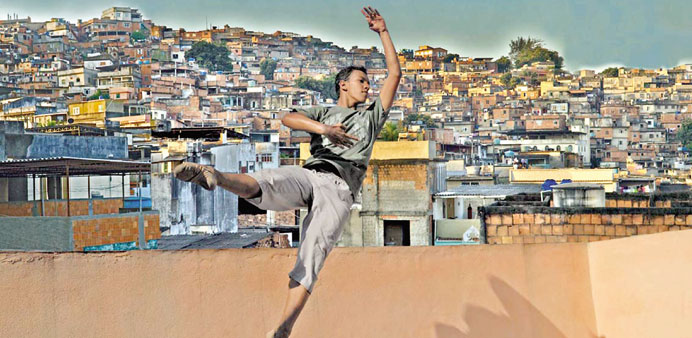
Beadie Finzi’s documentary Only When I Dance screened to a packed hall by Doha Film Institute
By Umer Nangiana
No matter how patchy the circumstances and how hard the way, an unshakeable determination would eventually take you to greater heights. Just put faith into what you love doing in life, set your goals and keep trying. All things extraordinary in the world often have humble beginnings and ordinary origins.
Knitted around such ideas is Beadie Finzi’s documentary film Only When I Dance featuring two ballet dancers from Brazil. Screened to a packed hall by Doha Film Institute (DFI) at Museum of Islamic Art (MIA) Auditorium last Friday, this 2009 flick tells the story of two teenagers from Rio de Janeiro’s slums (favela), who against all odds, go on to follow their dreams.
The awe-inspiring stories of Irlan Santos da Silva and Isabela Coralcy, the two ballet dancers, did inspire and involve the Doha audience. “You know, I felt like doing this. I felt I too could do this,” a young girl from a group of film’s audience while jumping in air trying to form a ballet dance posture told her excited friends right outside the auditorium at the movie’s climax.
With its factual, devoid of artificial sentimentality settings, Finzi’s movie successfully won over the audience for Irlan and Isabela, who not just challenged their own miseries, but also confronted centuries-old social taboos and stereotypes.
The story is told by the real people in their own words. The filmmaker follows them around, capturing “moments” in their lives and putting them on the reel in the form of an affective, eye-catching account.
The two teenagers belong to poor black families, struggling to meet ends in the shanty neighbourhoods of Janeiro, notorious for gang wars and violence. Amidst this battle for survival, the two protagonists find love for one of the most elitist forms of dance, the ballet. They are learning at Centro de Danca Rio, a local dance school run by a compassionate lady, Mariza Estrella.
Irlan is a particularly gifted dancer who is focused on one thing only — attaining excellence in the art of ballet dancing. He is shown nicely floating on the floor with an ease of a naturally gifted talent bearing a smile on his face.
Unlike his colleagues at the training school, he has no time for friendship or gossip. He is clear in his head about making a career in ballet dancing and he is determined to earn himself a place at the highest level in the world.
His loving father and mother have complete confidence in his abilities and despite all their financial constraints they are committed to support him.
Isabella’s family, on the other hand, is little deeper in financial woes. The girl has abilities and dances beautifully. Seeing her commitment, skills and love for the art form, Isabella’s father decides to support his kid to pursue her dream and achieve in life what he could not in his own for himself.
Estrella, however, at the very outset clearly tells the parents that it would not be easy for the girl to win the hearts of judges in the competitions ahead. Ballet is a dance form which has attached to it a centuries-old notion that it is a dance by and for the rich white people. She advises the girl to practice hard and show to the world that she too can do it.
The real test for the two families begin after their children qualify to perform in Lausanne, Switzerland and New York, a “make or break” chance for them where they, if they pass, can earn themselves scholarships to learn ballet at the world’s top most schools besides getting a placement at a leading company.
But Isabela’s family finds it hard to bear the expenses of her travel to New York. They do not have 2,000 dollars. Her father is not willing to give up. The entire family joins in to make it possible for their girl. Her mother goes back to work after four years to earn extra bucks. Her grandmother gives in her savings.
Due to his already bad credit history, her father is rejected for loan by the banks. Meanwhile, at Lausanne, Irlan, a gifted dancer, impresses the judges with his stark tribute to one of the ballet greats, Nijinsky, and wins a scholarship to the prestigious American School of Ballet in New York. “I was in tears,” says one of the judges after seeing him perform.
Next, he is flying to New York with Isabela and others to represent his country and win the scholarship.
Despite talent and hours of practice behind her performance, Isabela has disadvantages. She is little too dark and a bit “overweight” for an ideal ballet dancer. The girl is anything but fat with a lovely fashion-model like figure, but the ballet rules, according to Estrella, are strict on weight.
Estrella has already warned her parents about the weight and the taboos attached with her skin colour. But they cannot help either of them. She gives a charming performance, but fails.
Her dreams of becoming a ballet star shatter then and there. Tears and frustration follow. In the troupe competition, she however manages to win a third prize. Irlan, on the other hand, impresses the judges again and wins. They return home, one happy and the other dejected.
Estrella tells Isabela’s parents, “One of the judges told me she was overweight and I had warned you about it.” Despite failure, Isabela’s father wants her to give it another shot. However, the wise dance trainer Estrella advises against it. The girl stands minimal chances of making it at the stage in New York despite another attempt with no major achievement in “weight reduction”.
She observes that there are alternatives to stardom. Next, Isabella is seen coaching young dancers at Estrella’s school and looks somewhat content and fulfilled.
Irlan’s family, who have worked so hard to provide for his trips abroad, were now both happy and sad that he was going to leave them for a year. He is finally off to New York to pursue his scholarship at the company he selects.
Estrella throws him a surprise farewell party where all her friends gathered to see him off. Filmmaker Finzi’s success lies in the selection of stories for her films and the careful selection of the cast. It took the producers of the movie three years to find the two teenagers in Brazil and another 10 months to complete the film.
It premiered at the Tribeca Film Festival in April 2009. It was subsequently shown at several other major film festivals, including the Edinburgh International Film Festival, the San Francisco International DocFest, the Rio Film Festival, Guadalajara Film Festival and Sheffield Documentary Fest. It was broadcast on television in the United Kingdom on Christmas Day 2009. It was released in USA in the summer of 2010.