


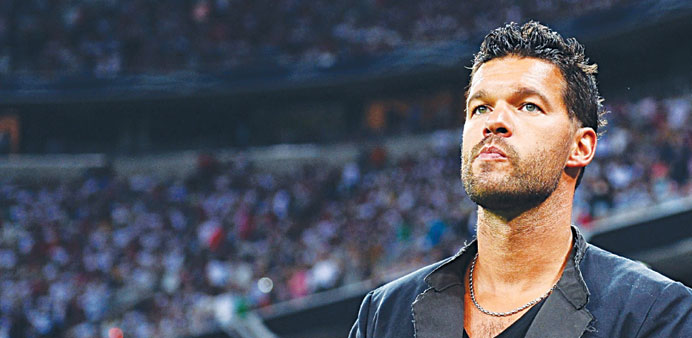
There is a great photograph of a distressed Michael Ballack during the penalty shoot-out in the Champions League final in 2008. Taken just after John Terry had squandered the chance to win it for Chelsea, Ballack is caught slumping to the floor, his legs turning to jelly, his hands holding on to Frank Lampard and Juliano Belletti for support, his eyes closed and his face a picture of sheer anguish. In a single moment, the photographer has managed to capture exactly how much winning means to those competing at the highest level and what it means to lose.
Ballack is by no means a failure. Ballack won the Bundesliga four times, once with Kaiserslauten and three times with Bayern Munich. He won the German Cup three times with Bayern. At Chelsea, he won the Premier League in 2010, the FA Cup in 2007, 2009 and 2010 and the League Cup in 2007. He was the German Footballer of the Year three times. There are footballers who would trade in their gold card at Nando’s for a fraction of that success.
Yet Ballack was so often the bridesmaid in the biggest games. The year 2002 was the most infamous of his career. The treble was within touching distance for Ballack. Managed by Klaus Toppmller, Bayer had the power of Ballack, the skill of Z Roberto, the creativity of Yildiray Basturk and the underrated efficiency of Bernd Schneider. But they won nothing. They contrived to throw away the title to Borussia Dortmund in the run-in. They lost the cup final to Schalke. Zinedine Zidane then did his Zinedine Zidane thing for Real Madrid in the Champions League final and that was the end of Neverkusen.
Ballack still had to absorb a few more punches, though. No one expected anything from a fairly average Germany side at the 2002 World Cup but in a tournament in which most of the best sides crashed out early, they went about their business quietly enough, forgettable but savvy.
Ballack was their only player of any genuine class and he scored the only goal in the quarter-final against USA. The semi-final was against South Korea, the co-hosts, and with the game goalless after 71 minutes, Ballack received a booking that would rule him out of the final for rather cynically stopping a counter-attack. Having taken one for the team, he then Roy Keaned the winner four minutes later, but Germany stood no chance without him against Brazil and lost to two Ronaldo goals.
On it went. Germany, riding a wave of national euphoria, reached the semi-final of their World Cup in 2006 but lost one of the finest games of the modern era 2-0 to Italy. They settled for bronze. Two years later, Ballack dragged them to the final of Euro 2008. They lost 1-0 to Spain.
There was Chelsea’s defeat in the 2008 Champions League final to Manchester United. Ballack scored both goals in a crucial 2-1 league win over United in April. But United won the league on the final day.
A year later, Chelsea lost to Barcelona in their Champions League semi-final.
Ballack’s final game for Chelsea was the FA Cup final against Portsmouth in May 2010. He was due to captain Germany at the World Cup a month later. After 44 minutes, Kevin-Prince Boateng went flying in and Ballack’s international career was over.
Ballack was a serial winner and a great player, but he never found a way to lessen the significance of surrounding incompetence, misfortune and the maliciousness of fate.
Andy Roddick
After Roddick beat Juan Carlos Ferrero at Flushing Meadows in 2003, he ended the year as the world No1 and was expected to add more titles in the coming years. Roger Federer had other ideas.
Roddick was the favourite to win Wimbledon in 2003. Then he met Federer in the semi-final. Here was someone who could not only return the Roddick serve, but hit mind-boggling winners off it. Roddick lost in three sets and Federer beat Mark Philippoussis in the final.
Roddick was Federer’s opponent in the final a year later. Roddick took the first set 6-4, only to lose the second set 7-5. But Roddick was not deterred. He broke early in the third set for a 2-1 lead and then came the rain, halting his momentum. With the English weather conspiring against Roddick, Federer found a second wind once they returned and eventually won 4-6, 7-5, 7-6, 6-4. “I threw the kitchen sink at him but he went to the bathroom and got his tub,” Roddick said.
Even though he must have felt like flooding Centre Court with his tears, he could still deliver a dry line.
The final was far more one-sided the following year, Federer winning 6-2, 7-6, 6-4, before he beat Roddick in four sets at the US Open final in 2006.
None of those defeats compared to the agony of the 2009 Wimbledon final, though. By then, many thought that Roddick’s time had gone, that he was too one-dimensional to be a serious threat to the best players, but he played a wonderfully intelligent game in the semi-final to beat Andy Murray and set up a fourth final against Federer, who was looking to break Pete Sampras’s record of 14 grand slams.
Roddick won a tight first set but he will always wonder what might have been if he had not squandered four set points in the second set tie-break. Leading 6-2, Roddick was unable to take the first three points, but the set was on his racket on the fourth. Federer was stranded and Roddick just needed to put a high backhand volley away, only to send it wide.
The advantage gone, Federer fought back to level the match and eventually won 5-7, 7-6, 7-6, 3-6, 16-14. Roddick was resilient and one careless game from Federer in the fifth set would have given the American the title. In the end, Roddick cracked. He had the greatest player of all time on the run but it was not to be. Roddick never got that close to him again.
Frankie Fredericks
Frankie Fredericks is the only Namibian who has won a medal at the Olympics. He came from a country with no sporting history to become one of the greatest sprinters ever and, in fact, he won four medals at the Olympics. Namibia have won four and Fredericks won them all. Four silvers, to be precise. Four silvers and no golds.
Given his upbringing, Fredericks has said in the past that not winning gold at the Games did not massively bother him. “It [the Olympics] was no big deal to me,” he told Observer Sport Monthly in 2002. “I’ve heard from many athletes how they dreamt of running in the Olympics from when they were kids. But me living under apartheid when Namibia was part of South Africa, I never even thought about the Games. I never dreamt about them as a kid, so the Olympics weren’t a big goal when I became an athlete. Winning the South African title was a much higher accomplishment.”
Fredericks did win a lot, 200m gold at the World Championships in 1993, the World Indoor Championships in 1999 and the Commonwealth Games in 1994 and 2002. His time of 19.97sec in Victoria remains a Commonwealth record, although he thinks Usain Bolt will break it in Glasgow this year.
But Fredericks never towered above his rivals on the podium at the Olympics. In Barcelona in 1992, he finished second to Linford Christie in the 100m and Michael Marsh in the 200m; in Atlanta in 1996, it was Donovan Bailey in the 100m and Michael Johnson in the 200m. “No matter how good you are at something, there’s always about a million people better than you,” Homer Simpson told his children once. In Fredericks’ case, there were only four.
He did not mind. Fredericks proves that, contrary to popular opinion, second can be somewhere.
Michelle Wie
While her class-mates in Punahou High School were studying hard, she was breaking amateur records like twigs under an overweight elephant’s foot. While they were taking tests, she was teeing off at the 2004 Sony Open, thus becoming the youngest person ever to play in a men’s PGA tour event. A year later and a week before she turned 16, Wie went professional and the million-dollar contracts and the press conferences with Bill Clinton came rolling in.
Unfortunately for her, it has not quite turned out as planned. Since becoming a pro, she won only two titles the Lorena Ochoa Invitational in 2009 and the CN Canadian Women’s Open in 2010. The closest she has come to claiming a major was finishing second in the LPGA Championship, three shots behind Sweden’s Annika Srenstam, but that was nine years ago. With the exception of 2006 when she had two joint-third place finishes her best result since then was sixth in the Kraft Nabisco Championship in 2011. In 2012, her annus horribilis, she missed 10 of 23 cuts, had one top-10 finish and finished miles down the LPGA rankings. The next year was better but still she missed seven cuts at 26 events. Aged just 24, it seems a little harsh to write Wie off as one of those who nearly made it but she has done precious little over the last few years to suggest otherwise.
Paula Radcliffe
Endurance is not infinite, however, as Paula Radcliffe discovered. The body can only take so much and while it is possible to ignore an injury for a while, eventually the pain becomes too loud and you have to stop and listen to it.
Radcliffe is an excellent runner, of that there is no doubt. She won World Championship gold in the marathon in 2005 and she won the London Marathon three times. She won the 5,000m at the Commonwealth Games in 2002 and the 10,000m at the European Championships in the same year. She is better at her job than most people are at theirs.
Yet she only experienced heartbreak at the Olympics. She finished fourth in the marathon in 2000, failed to finish in 2004 when she was one of the favourites, cramped in 2008 and finished 23rd and could not compete in London in 2012 because of a foot injury. There was no hiding place and she was often criticised, especially in 2004. But marathons are hard. Running 26.1 miles with an injury is nobody’s idea of fun.
Did Radcliffe care? Given that she relieved herself on the side of the road during the London Marathon in 2005, she probably doesn’t pay much attention to what people think of her, which is the best way to be.
Michael Ballack