


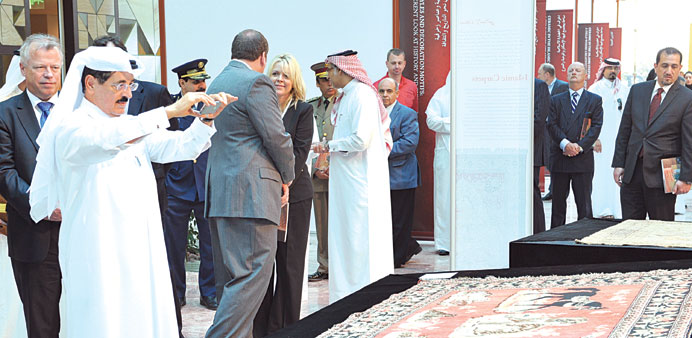
The Minister of Culture, Arts and Heritage HE Dr Hamad bin Abdul Aziz al-Kuwari using his mobile phone to take a photo of an exhibit after the event’s opening on Thursday.
By Joseph Varghese
Staff Reporter
A visit to the ‘Travelling Through Arts and Times’ exhibition, currently on at the Carnegie Mellon University in Qatar (CMUQ), is like a journey back in time.
An ornate set of solid gold jewellery from the 1920s; a wooden model of a Jalbut – the most common type of pearl fishing vessel in the Qatari waters; coins, carpets and ceramics from as early as 7th century and vintage cars are among the exquisite items on show.
The exhibition, which was opened on Thursday, is a collaboration between Sheikh Faisal bin Qassim Al Thani’s Museum and CMUQ, to mark the 10th anniversary of CMU campus in Qatar. More than 160 artefacts from the museum, including many shown for the first time outside the museum, are on
display.
Dr Haiko Kallwiet, curator of Sheikh Faisal bin Qassim Al Thani’s Museum, said the exhibition was focusing on Arabic and Qatari culture. “Most of the pieces depict typical Arabic culture and traditions while some of them ooze distinct Qatari
culture and way of life.”
“The jewellery collections are mostly from 1920s. Some of these are family property and a few others were bought from others. As gold was not traded much in Qatar in those times, the gold jewellery was brought from Bahrain and India and silver from Yemen and Saudi
Arabia.”
One of the highlights of the ‘Aspects of Qatari heritage’ collection is an ornate set of solid gold jewellery from the 1920s, which was locally made and belonged to a Qatari noble woman. The set of a necklace, belt, earrings and bracelets is on public display for the first time.
Also on display is a unique, 7m long wooden model of a Jalbut (dhow), commissioned by a Sheikha and at half-real size, is one of its kind.
The section of the Islamic Art Collection features 64 objects of ceramic and metal, carpets and rare Islamic coins, all dating from the very early Islamic period of 7th century through to the early 20th century and which have never before been publicly displayed.
A mid-7th Century golden dinar coin with three standing imperial figures, representing the Byzantine emperor Heraclius and his two sons Heraclius Constantine and Heraklonas, is one of the highlights of this
collection.
The high level of creativity and competence of the Islamic artists, whose craftsmanship displays sophisticated techniques and elaborate styles, are evident in this collection.
The collection of manuscripts, under the theme ‘Manuscripts: Reflecting the Past, illuminating the Future’, features items from across the Arab and Islamic world. In addition to religious manuscripts, the collection also displays manuscripts on science, philosophy and
spiritual matters.
An 18th century Sufi work by Al-Asharani entitled Albaher almawroud, is very special as it is extremely advanced for its time in terms of the paper and elegant calligraphy.