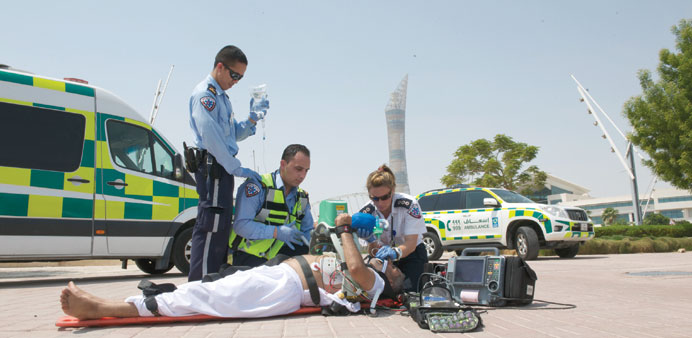
The main duties of a CCP are to provide a very high level of critical care before a patient arrives at a hospital.
The general public can learn about Critical Care Paramedics (CCPs) and all other aspects of the Hamad Medical Corporation Ambulance Service (HMCAS) at a fun day being held at Aspire Park from 10am to 5pm tomorrow (March 15).
Visitors will be able to speak to the paramedics, have a closer look at the emergency response vehicles, including the new LifeFlight helicopter, and take part in fun activities.
The aim of the fun day is to spread awareness among the public to know what to do in an emergency. It is also part of an ongoing campaign, ‘Know the five to save a life’, which comprise five simple ways in which the public can help when there is a medical emergency: dial 999, know your location, answer all questions, follow all instructions and give way to ambulances.
With a response record of over 130,000 ambulance calls last year, CCPs working with the HMCAS not only need to have a passion for their work, but are also required to administer the best care possible within a critical time-frame.
For Sunil Ramsumar, it was a combination of the satisfaction he got from helping the community and wanting to be involved in the delivery of emergency care that drove him into becoming a CCP.
The main duties of a CCP are to provide a very high level of critical care before a patient arrives at a hospital. They are able to perform advanced life-saving techniques and administer potentially life-saving medications, normally only available on arrival at a hospital emergency department. According to Sunil, it is important for a CCP to be compassionate, self-motivated and have the ability to swiftly troubleshoot complex situations while remaining calm and in control.
Having worked as a CCP with the HMCAS for two years, Sunil’s day starts at 4am as his work shift begins at 5.30am. He and his assistant are then allocated a response vehicle, which contains highly specialised advanced life-support equipment.
Once the vehicle has been thoroughly checked, the hi-tech communications centre allocates a geographical standby point so that they can respond as quickly as possible to emergencies. When a call comes through, they respond immediately and administer the best possible care. After administering care and transporting the patient to the appropriate hospital, they are ready to tackle the next call.
A CCP’s job requires him to be responsible and accountable for making complex and life-saving decisions while ensuring that he is delivering the highest quality of clinical care. But while CCPs are clinically trained, they also often rely on co-operation from the general public to do their job. A major challenge faced by paramedics is that sometimes other vehicles do not make way for ambulances to pass through the traffic easily. This can cause a delay in getting to the scene of a medical emergency to help someone whose life could be at risk.