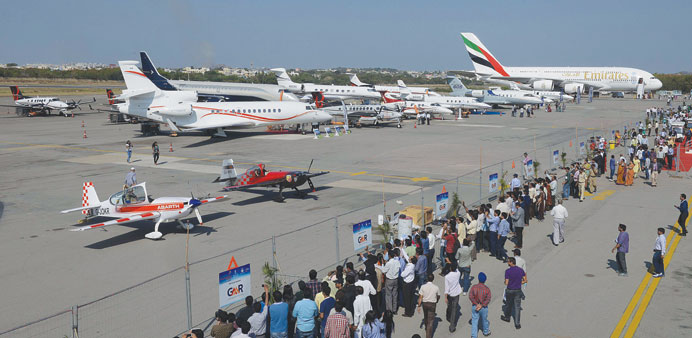
Various aircraft are seen on static display at the India Aviation 2014 airshow at Begumpet airport in Hyderabad yesterday. India’s fast-growing $16bn civil aviation sector, already among the top 10 globally, could be number one worldwide by 2030, said a report by global consultancy KPMG.
AFP/Hyderabad
India’s fast-growing civil aviation sector, already among the top 10 globally, could be number one worldwide by 2030, said a report yesterday by global consultancy KPMG.
Even though most Indian airlines face hefty losses this year and huge debts in the face of fierce competition and a sharply slowing economy, in the longer term the $16bn sector is on a high-growth track thanks to large untapped potential, experts say.
“We’ve just touched the tip of the aviation iceberg,” said Amber Dubey, KPMG’s India aerospace head said, noting “access to aviation is still a dream for nearly 99.5%” of India’s 1.2bn population.
The report was released to coincide with a five-day air show in the southern city of Hyderabad which winds up this weekend.
Chicago-based Boeing separately yesterday, in a similarly bullish mode, projected demand for over 1,600 new airplanes in India over the next 20 years, valued at $205bn. “India’s demographics are highly favourable to growth of air transportation” while “the share of India’s large population entering the workforce is growing,” said Dinesh Keskar, a Boeing senior vice president. Boeing on Wednesday clinched a $4.4bn order from India’s fourth-place no-frills carrier SpiceJet for 42 of its top-selling single-aisle 737 MAX jets.
Low-cost carriers, foreign investment in domestic airlines, modern airlines and a new drive for regional connectivity are propelling a new expansion wave, the KPMG report said.
Many states, especially in eastern India, have begun promoting air connectivity including by lowering aviation fuel sales tax and developing no-frills airports, the report noted.
But a lot more needs to be done, such as allowing domestic code-sharing and developing infrastructure, said the report prepared with the Federation of Indian Chambers of Commerce and Industry (FICCI). “India is blessed with a great geographic location, a large upwardly mobile middle class and immense tourism opportunities,” Dubey said, adding, “the beauty is our challenges primarily relate to policies, procedures, regulations and taxes”.
“These are all man-made problems and hence surmountable.”
The number of Indian airline passengers has grown by around 13% a year over the last decade, according to the Airports Authority of India, to 159mn in 2013.
The most significant development in the domestic market is growing dominance of low-cost carriers which now account for almost 70% of
capacity.
Boeing projects passenger airlines in India will rely primarily on single-aisle airplanes such as the Next-Generation 737 and the 737 MAX, a more fuel efficient variant of the widely used 737, to connect passengers.