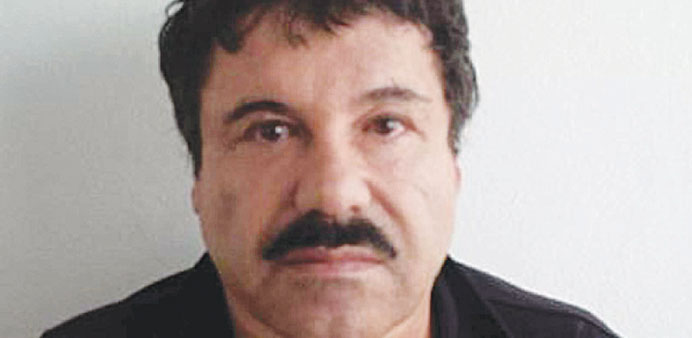
Mexican drug lord’s legend sparks tours, ballads
DPA/Mexico City
The party started at dusk with a band playing and people dancing in a carnival atmosphere. On the streets of the north-western Mexican state of Sinaloa, men, women and children demonstrated to demand the release of Joaquin Guzman, known as “El Chapo,” considered the world’s most powerful drug lord, days after his February 22 arrest.
Guzman is a mythic figure in Mexico, reminiscent of legendary cocaine kingpin Pablo Escobar, who was killed in 1993 in Colombia, has generated tours as people have their pictures taken outside the building where he was arrested in Mazatlan, Sinaloa.
Guzman, 56, had been on the run since escaping from prison 13 years ago.
The Mexican Navy finally captured him in the resort city of Mazatlan on the Pacific Coast. He had eluded authorities just five days earlier through a network of tunnels that linked seven houses through the sewer system below Culiacan, the Sinaloan state capital.
The Miramar building in Mazatlan, where Guzman was arrested in Apartment 401, has become an object of curiosity and even pilgrimage for tourists.
The drug lord’s story has for years been romanticised in “narcocorridos” songs, telling of his impoverished childhood and rise to power, his partners in crime or his Hollywood-style escape from Puente Grande prison in 2001, inside a laundry trolley.
His arrest has renewed focus on a so-called “narcoculture” in cartel-dominated regions. There were demonstrations to demand Guzman’s release in the Sinaloan cities of Culiacan and Guamuchil.
The rallies are symptoms of a society “sick with drug trafficking” and the Sinaloa drug cartel’s deep social influence has on its home turf, journalist and writer Javier Valdez told the radio station MVS last week.
People in the region have become accustomed to “daily” exposure to so-called “narcos,” or drug traffickers. “The ‘narco’ is your neighbour, he is the father of the children who go to school with your kids, the narco is your relative, the owner of the business, of the auto repair shop,” said Valdez, a Sinaloan who has written several books on the subject.
Even from jail, Guzman’s presence can still be felt.
On Twitter, two accounts allegedly belonging to his children voiced gratitude for the support he got on the streets. “I don’t know how to thank everyone in Sinaloa and in the whole of Mexico,” a purported Ivan Archivaldo Guzman wrote. “I assure you that prison bars are not eternal. Thank you.”
Another son, Alfredo, appeared to tweet both a defence of El Chapo and a threat to his enemies. “My father is better than any government. He created jobs, ended it for kidnappers, thieves and rapists. He never fought the people,” the message read. “Those people who dared do what they did (to arrest Guzman) should have thought things out better. They don’t know the kind of people they unleashed upon themselves.”
Narcocorrido composer Gonzalo Pena, author of the latest ballad updating Guzman’s tale, La captura del Chapo (The Capture of Chapo), says many people back the accused criminal. “They say he helped people. They loved him, and they don’t talk ill of him,” said Pena, the illiterate composor of 400 songs.