


ExxonMobil Qatar’s Tamayoz training programme engaged nearly 70 learners in Doha during January and February.
Four courses were held on Environmental Monitoring, Operations Logistics Best Practices, Economic Analysis and Negotiation Fundamentals for attendees from Qatar Petroleum, Qatargas and RasGas.
“The Tamayoz training programme is an important element of ExxonMobil’s commitment to developing Qatar’s local workforce and supporting Qatar National Vision 2030,” said Bart Cahir, president and general manager of ExxonMobil Qatar Inc. “Individual training courses cover a vast range of subject matters, featuring ExxonMobil experts sharing technical, commercial and operational expertise with Qatari partners and joint ventures.”
The Tamayoz 2014 programme kicked off with the Economic Analysis course held in January for more than 20 attendees from the joint ventures. This course was designed to impart principles and general procedures in profitability analysis. Upon completion, participants were able to classify funds, schedule revenues, calculate depreciation schedules and taxes, compare net cash flow, incorporate risk in project evaluation and select better alternative investments.
In late January, a four-day training course on Operations Logistics Best Practices was held in Doha. Covering marine and aviation logistics functions as they relate to offshore production and operations activities, the in-depth course was attended by approximately 20 participants. A team of three ExxonMobil subject-matter experts provided an overview of the HSE processes and management system, cost management principles, logistics optimisation techniques and practices and interfaces between logistics and stakeholders.
Early February saw the three-day Environmental Monitoring course led by ExxonMobil’s chief environmental scientist. The course included interactive instruction beginning with an overview of Environmental Aspect Assessment, followed by planning and implementation steps for representative upstream monitoring activities, including baseline surveys, impact assessment studies and compliance monitoring for indicators such as produced water and air emissions. The course included hands-on experience collecting and processing a range of environmental samples such as soil, sediment, surface water, air and biological material.
Finally, the Negotiation Fundamentals course was offered in late February for more than 20 local participants. The course prepared attendees, as employees of their respective organisations, with the tools to negotiate successfully every day. Whether it’s co-ordinating timelines with co-workers or managing the development of large-scale capital projects, this course employed interactive presentations, demonstrations, modelling and facilitated discussions to introduce a systematic process and framework for negotiation that organises thinking and defines skilful behaviour.
Participants actively worked with the concepts through role-plays, simulations and partner exercises, and had many opportunities to reflect both individually and through small and large group discussions.
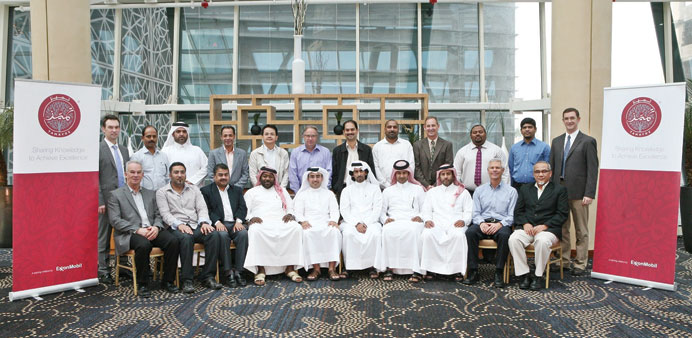
Officials and Tamayoz participants.