


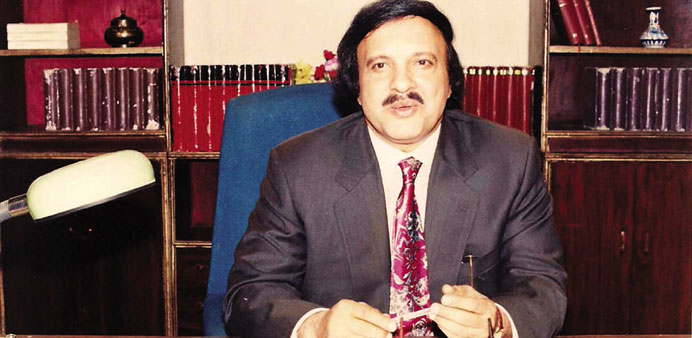
STAYING THE COURSE: “I identify my profession as engineering; side by side, I managed my musical ambition to compete with professionals who were doing it full-time,” says Dr Parvez.
By Umer Nangiana
It is not uncommon to find people with multiple talents. Most of them acknowledge and realise much of their God-gifted qualities. There are poets who can also sing and compose music. Still others are capable of acting skills, too. All such traits are mostly found within a single field of interest.
However, it becomes exceedingly difficult to passionately follow two fields as diverse as mechanical engineering and classical music and attain a professional level in both of them.
If one is the art of learning and practising the ‘Raga and Saga’ of music, the other involves the science of mechanics. One has to be ‘exceptional’ to reconcile the two, before going on to conquer them.
Dr Amjad Parvez, a Pakistani national, is just one of them. Having a doctorate in Engineering Production, Parvez has been heading many premier engineering institutes in his country over the past four decades.
At the same time, he is an accomplished, award-winning, professional classical singer who has rendered his melodious voice to many a raag (a melodic mode in sub-continent’s classical music), ghazals (a poetic form consisting of rhyming couplets and a refrain, with each line sharing the same meter) and songs.
“I can sing a raag in front of any great Ustaad (a maestro) and I have been doing it in Lahore and abroad. I can sing raags of morning like Mian ki todi, Gujri todi and evening like Raag Darbari or Kalyan, Champa Kali or name any,” Pervez told Community.
To the Pakistani community, especially the engineering community’s delight, he was in Doha recently. Community had a tete-a-tete with him at a reception organised by his Nespak (National Engineering Services Pakistan Limited) colleagues.
Parvez is a recipient of the prestigious President of Pakistan’s Gold Medal for writing best technical paper for Institute of Engineers, Pakistan in 1976. He also received Dr A Q Khan Lifetime Achievement Award from the Institute of Engineers, Pakistan in 2010 and a Pride of Performance in 2000 for best music works.
How did he manage two full-time jobs — music and engineering — simultaneously?
“Simple. Engineering is my profession and music and literature is my passion,” said Parvez without batting an eyelid.
“I identify my profession as engineering; side by side, I managed my musical ambition to compete with professionals who were doing it full-time.”
Born in 1945, Parvez comes from a family of educationists. His grandfather Khawaja Dil Muhammad was the principal of the famous Islamia College Lahore. He wrote books in Mathematics, Algebra and Arithmetic. His father Sheikh Abdul Karim was into chemistry. His book Karim’s Chemistry was taught at schools both before and after Partition.
After obtaining his engineering degree from Engineering University Lahore, Parvez joined the University of Engineering and Technology (UET) Lahore as professor and served there for 7-8 years. He did his masters in Quality and Reliability Engineering in 1969 and Doctorate in Engineering Production from UK in 1972. Upon his return, he moved to Nespak, the more practical form of engineering in those days.
After serving the company for three decades, Parvez retired from Nespak in 2005 as its president and managing director. His hallmark was setting up overseas offices in Saudi Arabia and Gulf countries and acquiring and implementing colossal projects within Pakistan and abroad in all branches of engineering. Recently, he was appointed as consultant to Nespak.
The veteran engineer and a legendary singer is a living inspiration for all those who possess talents in music but are reluctant to pursue that path. Parvez believes if one is passionate enough, nothing can stop him or her from finding time, resource and opportunity to pursue a career in music.
“If you are willing to learn, you will find somebody to teach you. It takes time and, yes, it is hard work. You cannot become popular overnight,” said Parvez. “I love music. My family supports it. So I have sizeable evening hours and the weekend available for it,” he said to explain how he manages time between his profession and his passion.
Parvez started his career in music as a child star in Radio Pakistan’s programme Honayhaar as early as 1954. He obtained professional training in classical music from the maestros of famous Sham Chaurasi Gharana (family of classical singers) such as Ustad Nazakat Ali-Ustad Salamat Ali Khan duo in 1976.
He has rendered his voice to hundreds of songs on Radio Pakistan and later Pakistan Television (PTV).
When it comes to singing raags,
Parvez has been as versatile as he has been in ghazals. All those who have seen iconic writer Ashfaq Ahmed’s drama series Eik Mohabbat Sau Afsanay on PTV in the late 90s would recall that it was Parvez’s voice in the title song Jo bhi kuch hai mohabat ka phailao hai.
The lovers of folk music still rejoice his all-time hit songs Sassi-e-Bekhbrey and Chal Mailey Noon Chaliye.
“Raags and classical music is something that the aspiring singers must embrace instead of running away from it. A raag is a science in itself. It is a combination of notes that Hazrat Amir Khusro and other greats from Muslim era created,” emphasises Parvez.
He held its proponents and the state responsible for decline of classical music in Pakistan. The gharana (professional families) proponents do not teach anymore. They don’t teach beyond their own kin and disciples. “More so, the state does not provide a platform. I have hundreds of students who want to learn raags and classical music but academies are far and few between,” bemoans Parvez.
“And then there is this “trauma” of misquoting culture or religion to create the impression that music is not the work of decent people,” the maestro observed.
“Again, the reason for them to look down upon it is that music is misused by the people from the red light area. People think anybody who sings belongs to that area. That is not so,” he stressed. A number of educated boys and girls like Hadiqa Kiyani, Atif Aslam, Ali Zafar and others have come up with their own efforts, he added.
Parvez particularly praised the recent platforms and initiatives to promote music in Pakistan such as ‘Coke Studio’ and ‘Pakistan Idol’. “Blending old folk songs with modern instruments is a great experiment. Take Jugni for instance,” said Parvez, speaking highly of the Arif Lohar-Meesha Shafi rendition of the famous folk song at Coke Studio. For Pakistan Idol, he wanted people with stronger music background as judges but it was still a good package overall, he added.
The veteran singer and musician stressed the importance of learning raags and classical music and using them in contemporary compositions. Musicians have used these raags or ‘cord system’ to create wonderful songs in 50s to 80s eras, he said. Later, it was amalgamated with Western misnomer. “We have drum beats and ‘hoo-ha’ in it and we say it is a pop song. The West itself has a very strong legacy of classical music,” Parvez added.
Salil Chaudhry, an Indian music composer, for instance, used Beethoven symphonies in his songs to great success. In Pakistan, Khawaja Khursheed Anwar, Rasheed Attray, Master Inayat Hussain, Nisar Bazmi, Sohail Rana, Bakshi Wazir and other music directors created wonderful melodies using the classical, he recalled, adding that he has worked with most of them.
Had he not become a victim of gharana (professionals) and non-gharana (non-professionals) rivalry, Parvez would have been a playback singer as well. The groups of people who were ruling the Pakistani industry then were biased, he complained.
“They would say he is a non-professional. No-one from his family sings. Neither is he from any gharana so he would know nothing of music,” Parvez said in his native Urdu.
Even then, he made an attempt at playback singing. Nisar Bazmi once gave him a song in film Naya Sooraj alongside icons Noor Jehan and Mehdi Hasan. Parvez then withdrew from playback and devoted himself to ghazals and classical.
He is soon releasing a video of one of his eight ghazals once composed by renowned Indian maestro Khayam in Bombay in 1992. It is a Faiz Ahmed Faiz number teri umeed tera intezar jab se hai. The album was released in England.
Bollywood’s all-time superstar Dilip Kumar had greatly appreciated it. “Dilip’s younger brother Ahsan Khan, in fact, wanted me to stay in Bombay. He said mine was the only sultry voice after Mohammad Rafi,” said Parvez, hoping that people would like the video.
He has also written books on music including the three reflections, Symphony of Reflections, Rainbow of Reflections, Pearls of Reflections and Melody Makers which comprises the profiles of great music composers from the sub-continent.
For Nespak, Parvez was hopeful that the company would do more to contribute to Qatar’s development.
“I would have loved to see it growing faster and get more projects,” said the veteran engineer and the company’s former head.
Pakistani engineers are capable of working in all areas, including geo-tech investigations, structural engineering projects, buildings, roads, water sewage, architectural planning, ports and harbours, oil and gas and others.
In their individual capacity, Pakistani engineers are already doing a great job. However, as a collective entity, Nespak still had space to do more, said Parvez. The problem was visas. Pakistanis do not get many visas, he added, hoping the situation would change.
In conclusion, he advised Pakistanis to do well for Qatar and earn a good name for Pakistan.
BELOW:
1) SECRET TO SUCCESS: “If you are willing to learn, you will find somebody to teach you. It takes time and, yes, it is hard work,” says Parvez.
2) DISTINCTION: Dr Parvez receiving the prestigious Pride of Performance Award from the-then president Rafiq Tarar.