
AFP/Bangui
Civil servants in the Central African Republic were yesterday paid their first wages for six months, a small sign of normality in a country that has been paralysed by sectarian violence.
Huge lines of state employees, impatient for their first pay packets since September 2013, formed outside the major banks in the capital Bangui.
“Better one month than nothing. We’re barely living,” paramedic Jean Nguelebo told AFP. “If the government makes the effort, we may be able to get one or two more months - if the treasury allows.”
Cyrille Ngoazeyou, a teacher, said the money would mean she could afford “to give my family a few dishes of pointinini (small dishes of sea fish) while waiting for better days.”
Transition President Catherine Samba Panza in January took the reins of a country that has been torn apart by conflict since the mostly Muslim Seleka rebels ousted president Francois Bozize in March last year, sparking a cycle of revenge attacks between the Muslim minority and Christian majority.
The crisis has paralysed the country’s administration, starting with its public finances, which has crippled the state’s ability to pay its employees.
During a visit to Bangui on February 28, French President Francois Hollande said that state employees’ salaries would be paid quickly via agents in other countries.
But many expressed discontent that banks were immediately taking back advances they had given during the months that civil servants weren’t being paid.
“The banks don’t give us any help,” said Anatole Zegbe, who works in the department of water and forests, scowling.
“They systematically collect everything... in advance. Some have less than 15,000-20,000 CFA francs ($32-$42), others less than 50,000.”
Health worker Kleber Bossoko agreed, saying: “The prime minister took care to meet the leaders of banks before payroll. They could have created a waiver for the first salary so that nothing is removed.
“What will those do who have nothing left because of the bank conditions?”
Speaking at an event for International Women’s Day on Saturday, Samba Panza said she wanted to be able to pay state employees double wages to make up for their delayed salaries, but simply didn’t have the money. “Maybe soon I can give you two, three, four or even five” pay packets, she said.
Violence in the Central African Republic has left thousands dead and displaced around a quarter of the country’s 4.6mn people.
The unrest has forced almost all of the country’s Muslim minority to flee amid fears the conflict could turn into ethnic cleansing, a top UN official warned Monday.
Adama Dieng, the UN adviser on the prevention of genocide, said Muslims now account for only two% of the population, down from between 10-15% before the conflict erupted.
International / Africa
Central Africa Republic pays out state wages for the first time in six months


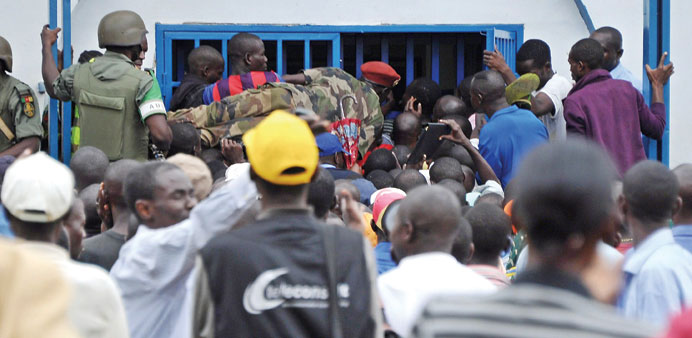
Civil servants wait in queue in front of a bank in Bangui yesterday.