


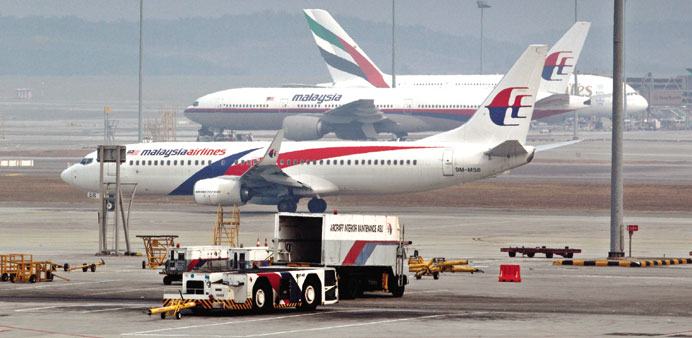
What the incident with flight MH307 now means for Malaysia Airlines safety rating can only be determined when the reason for the disappearance has been found.
By Arno Maierbrugger/Gulf Times Correspondent Bangkok
The disappearance of Malaysia Airlines flight MH370 on March 8 has again raised questions about airline safety in general and passenger control in particular. The fact that Malaysia Airlines was not aware that two passengers entered the aircraft on wrong identities is not very flattering neither for immigration nor the airline itself. Its long reaction time has also raised eyebrows among the families of the supposed victims, as well as aviation experts. However, Malaysia up to now has had a six-star rating out of seven issued by airline safety rating agency Airlineratings.com, indicating it is among the safest airlines worldwide. This will probably change now.
In fact, the safest airlines in the world can be found in the Middle East and in Asia-Pacific. Among the national carriers in the Middle East, Emirates, Etihad, Saudia, Kuwait Airways, Royal Jordanian and Egyptair all enjoy a seven-star rating. Qatar Airways and Oman Air still have six-stars - on par with Pakistan International Airlines and Air India -, and just Bahrain’s Gulf Air got five stars for its safety record.
In the Asia-Pacific, Qantas, Singapore Airlines, Air New Zealand, Cathay, Japan Airlines, Eva Air and Korean Air are the safest carriers.
Altogether, Airlineratings.com has assessed 425 airlines around the world, ranking them after a methodology that is based on a variety of official sources, including audits by government agencies and aviation bodies. That way, it found the carriers with the worst safety records – three stars or lower - in the world being Air India Express, Air Bagan, Air Mandalay Yangon Airways (all Myanmar), Ariana Afghan Airlines, Cebu Pacific (Philippines), Eritrean Airlines, Lion Air (Indonesia), Iraqi Airways, Lao Airlines, Yeti Airlines (Nepal) and some other small carriers of which some do not even undergo regular audits.
Altogether, some 50 airlines worldwide are not recommended to fly with due to fundamental safety concerns.
What the incident with flight MH307 now means for Malaysia Airlines safety rating can only be determined when the reason for the disappearance has been found. Malaysia Airlines’ last fatal incident was in 1995, when one of its planes crashed near the Malaysian city of Tawau, killing 34 people. The deadliest crash in its history occurred in 1977, when a domestic Malaysian flight crashed after being hijacked, killing 100.
According to Airlineratings.com, a carrier can receive only the highest rating if it has been fatality-free for the past ten years. Air France, whose flight AF 447 crashed in 2009 into the Atlantic Ocean with 228 people on board in an incident that resembles the vanishing of Malaysia Airline’s flight MH307, now has a six-star rating.
Malaysia Airlines has 15 Boeing 777-200s – the aircraft type involved in the MH307 incident - in its fleet of about 100 planes. The state-owned carrier last month reported its fourth straight quarterly loss due to strengthening competition and warned of tougher times ahead which in fact came quicker than anticipated, as it seems.