


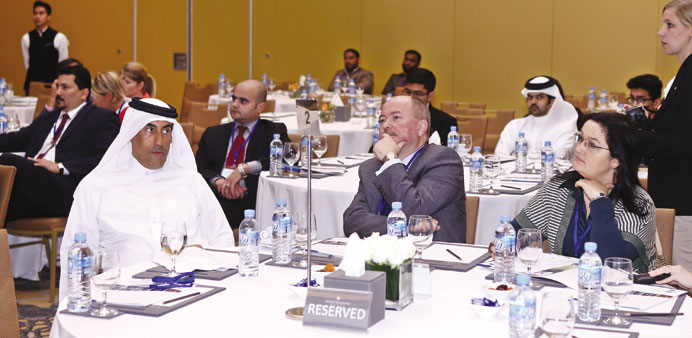
Al-Misnad (left) and Kulach listening to resource speakers. PICTURE: Shemeer Rasheed.
By Peter Alagos/Business Reporter
European Union ambassador to Saudi Arabia has underscored the importance of Small and Medium-scale Entrepreneurs (SMEs) and their role in creating “a powerful sector” that can advance the automotive industry towards “economic integration.”
Addressing participants of the “Symposium on SME in the automotive industry,” ambassador Adam Kulach noted that the industry has diverse sectors ranging from manufacturing and assembly plants to parts and service suppliers.
To achieve “economic integration,” the ambassador encouraged SMEs to identify comparative advantages the GCC area has over other countries and capitalise on their strengths. “Oil and plastic from this area are among the products that are essential in the automotive industry,” Kulach pointed out.
Kulach said the many sectors involved in the automotive industry co-exist in a systematic relationship that sets an example for other types of industries to emulate.
Citing the network of manufacturing plants and extensive chain of suppliers worldwide, Kulach said: “The automobile industry is a very good example [that shows] how a certain sector can become the source and the inspiration for co-operation.”
According to Kulach, there was a strong interest between Qatari businesses and their European counterparts in the industry. “We doubt whether there is enough interest in the European Union, Europeans, and the Gulf. Well, I can assure you that whenever I travel the region, I discover that there is not only potential but there is real interest.”
This was echoed by Ali Abdulatif al-Misnad, honorary treasurer and board member of the Qatar Chamber of Commerce & Industry, who said: “The automobile industry has the potential of becoming an investment sector in the Gulf region, if the right strategy and procedures are implemented.”
Al-Misnad, who discussed the “Role of Qatar Chamber in supporting the SMEs,” cited a recent study by the Gulf Organisation for Industrial Consulting (GOIC), which revealed that there is a 26,000-strong workforce employed in some 300 car assembly factories and other car-related industries in the Gulf with investments worth up to $1.1bn.
He added that Gulf countries import cars worth QR8bn annually in addition to billions of dollars worth of spare parts. “It is a market sector that is growing at 9% annually in the region,” al-Misnad said.
Al-Misnad said the GOIC report pointed out that “it would be easy for the Gulf countries to activate and expand their investments in the auto industry since they already produce some of the spare parts such as the brake linings, air and oil filters and batteries most of which are produced in Saudi Arabia, Oman and Kuwait.”
He noted that transmissions, radiators, windows, gaskets and seals are among the other products produced locally. “They do not, however, make the basic standard parts such as fuel injectors, small electric generators, distributors or safety equipment. From this, we can conclude that there are a lot of opportunities to establish Euro- GCC joint ventures in the automotive industry,” al-Misnad added.
Under the umbrella of the EU-GCC and the German Emirati Joint Council for Industry and Commerce, the German Industry and Commerce Office Qatar, in co-operation with the Qatari Businessmen Association, held the event to identify the mechanisms used in EU countries, which contributed to the success of their SMEs.
The event gathered experts in the field, namely German Emirati Joint Council for Industry and Commerce deputy CEO Dr Dalia Abu Samra Rohte and Enterprise Qatar manager (Learning development) Ibrahim al-Mannai, among others.
Resource persons, who shared their expertise, include Eurochambers director (International Affairs) Dirk Vantyghem, Antwerp Chamber of Commerce director of services and entrepreneurship Sven de Vocht, Torino Chambers of Commerce secretarygeneral Guido Bolatto, and Society of Automotive Engineers in Torino president Alberto Dal Poz.