


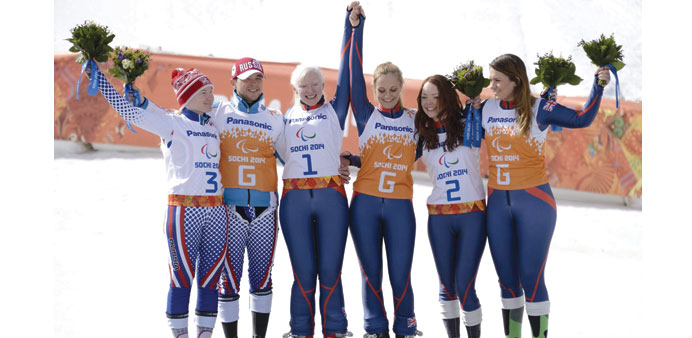
Great Britain’s gold medallists Kelly Gallagher and her guide Charlotte Evans (centre), bronze medallists Jade Etherington and guide Caroline Powell (right) of Great Britain and silver medallists Aleksandra Frantceva and guide Pavel Zabotin of Russia celebrate on the podium after the women’s Alpine Skiing Super G Visually Impaired race in the Rosa Khutor Alpine Center at the Sochi Paralympic Games, yesterday, (EPA)
AFP/Sochi
When Kelly Gallagher accepted her gold medal yesterday — a historic Winter Paralympic victory for Britain - she shared the podium with Charlotte Evans, her eyes on the slope while she flies down the alpine course.
Kelly, who hails from Northern Ireland, has congenital oculocutaneous albinism, a disorder which involves a lack of pigment in the skin, hair and eyes and which also causes vision problems like blurring. When she skis, she can’t see anything at the snow level, and the only way she can tell how fast she is moving is with the force of the wind in her face.
But Charlotte provides crucial instructions, hollering non-stop into the headset that acts as an invisible link between the two skiers, even when they travel at speeds of 100 kph. “She can be so mean to me on the course, but that means that I can ski better,” said Gallagher, after cinching the gold in the Super G in Sochi. “I couldn’t have done it without Charlotte’s constant determination and talent,” Gallagher said.
Skiers say that having a good guide is essential in succeeding as an athlete, but for guides, that often means saying goodbye to a career and depending on another person’s schedule. Not to mention the responsibility that comes with verbally directing a blind or partially-blind person down a slope at the speed of a car on a highway.
“Personalities have to match,” said Kim Seevers, who skis as a guide for American competitor Staci Manella. “If you don’t get along, it will spill over on to the race course. You have to implicitly trust each other.”
Endangering themselves
and the competitor
Before the advance of technology to wireless Bluetooth sets, guiding skiers had to constantly yell over their shoulders, endangering themselves and the competitor. Directions include the sequence of the gates that the skier needs to go around, whether the turn is fast or slow, left or right.
“Before we yelled at each other constantly, now it’s much easier,” said Seevers. The guide and the skier also have to be the same build, since weight effects velocity, and the distance between the two people has to stay constant. If the skier falls, the guide cannot help them.
‘Just follow the sound’-There are three categories of blindness in Paralympic skiing, and the amount of vision is taken into account for calculating the result. Most competitors on the slopes are either B2 or B3, meaning they have approximately 5 and 10 percent of vision, respectively. People in the B1 category are classified as legally blind.
Among them is Lindsay Ball, a 22-year-old American who skis with guide Diane Barras. When she races at her first ever Paralympics in Sochi later this week, Lindsay will be wearing opaque black goggles, through which no light can pass.
Meanwhile Diane will wear a special backpack with an audio that will tell Lindsay where she is. “I will just have to follow the sound when I ski,” Lindsay said. “If we are going fast, I usually stick to simple commands: go, go, left, go, go, right,” said Barras. “I am talking the entire time, and she has to be really focused on turning.”
Lindsay has skied since she was six, and said she has only heard of one more person skiing in her category in Sochi. For her the sport is definitely more dangerous than it is for people with even a little eyesight.
“I definitely hit more gates, have more crashes,” she said. “Other skiers see the gate just before they pass it, but I don’t, and Diane skis ahead so she can’t tell me about it.”
Lindsay’s parents introduced her to skiing and will be watching from the stands, she said. “They are definitely nervous parents, with me not seeing anything and going pretty fast,” she said. “But they are really supportive.”