


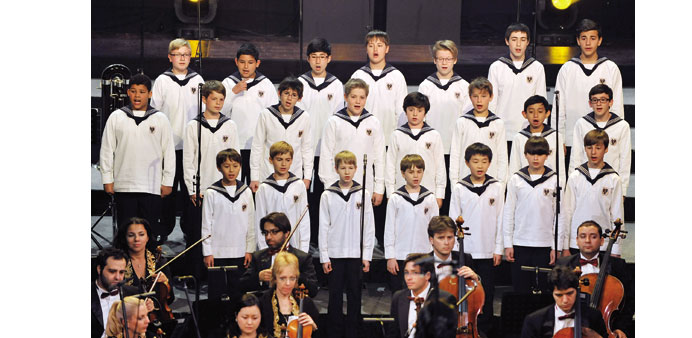
MAKING A STATEMENT: The Vienna Boys’ Choir performing at Katara Opera Theatre. Photos by Najeer Feroke
Together, they perform around 300 concerts every year to an audience of close to 500,000. Behind their endless quest for glory lies a great tradition, writes Anand Holla
Time changes everything, they say. What then can explain the spell of serenity that the Vienna Boys’ Choir can still cast on us, even 512 years after its birth?
At Katara’s stately Opera Theatre that throbs with a stillness reflective of an era gone by, time seemed to have moved back by a few decades for a while recently.
Arguably the most famous boys’ choir in the world teamed up with Qatar Philharmonic Orchestra to transpose more than 1,000 patrons to a time when music was all heart, all soul, and was best enjoyed with eyes closed.
Dressed in sailor suits and singing in voices that can only be called angelic, the 22 boys covered an impressive range of medieval to contemporary Western Classical compositions.
Be it traditional songs from Bulgaria, Ireland, Korea, China, Serbia and Africa, or a French ditty like Ballad of the Happy People; there was fine variety on display by this choir of trebles (boys who sing in sopranos) and altos (lower than sopranos and higher than tenors). The crowd spared no applause.
Soon after their performance, when one of the boys, Evan, was asked if any of them felt burdened by their rigorous schedules, he told Community in a flurry, “Oh no no… we join the Vienna Boys’ Choir only so that we get to sing. It’s such a wonderful opportunity for us to sing the music we do. I wouldn’t exchange it for anything else.”
Evan is young, like all his co-choristers who are between 10 and 14 years of age. Yet he and his friends are as thoroughly aware of their choir’s illustrious past as its ability to fight through the nastiest trends of throwaway pop music.
Known in German as Die Wiener Saengerknaeben, the choir has 100 children who are divided into four touring choirs, named after four legendary Austrian composers — Bruckner, Haydn, Mozart and Schubert.
The big names weren’t chosen randomly; they have all worked with the choir or were members themselves. Like the sub-group that performed at Katara was Mozart, and the legend was a composer to the Imperial Court in Vienna.
Each sub-group tours for around eleven weeks a year, and what they accomplish is staggering. Together, they perform around 300 concerts every year to an audience of close to 500,000.
Behind their endless quest for glory lies a great tradition. In 1498, when Roman Emperor Maximilian I moved his court and his court musicians to Vienna, he wanted his ensemble of musicians to include six singing boys. So that year, when the Vienna Chapel Imperial was founded, the Choir was born.
Until 1918, when monarchy ended with the collapse of the Habsburg Empire, the Choir sang exclusively for the imperial court. While the Austrian government took over the court opera, its orchestra, and the adult singers, the boys’ choir was left alone.
Three years later, Josef Schnitt, who became the Chapel’s Dean in 1921, classified the Choir as a private institution, and those children were now known as the Vienna Boys’ Choir.
This was also when the imperial uniform was replaced by the then-fashionable sailor suit — a style statement that now appears grossly out of style.
Lack of finances can rarely be a blessing, but in the case of the Choir, it compelled them to start performing outside of the chapel. The audience response was so encouraging that the Choir’s stature only grew. Since 1926, the Choir has wrapped up close to 1,000 tours in 100 different countries.
Their flawless performance in Doha, led for the most part by the Qatar Philharmonic Orchestra’s spirited music director Han-Na Chang, somewhat explains the success of “Austria’s young ambassadors.”
Backed by the rich strains of the Orchestra’s violins, cellos, brass sections, woodwinds and percussions, the children pulled off vocal harmonies that calmed our senses.
The only time the pitch silent hall heard anything except for the music or the words was when a boy in the Choir’s front row sneezed towards the end of a piece. And even that didn’t break the audience’s spell.
“The choir’s spirit lies in working together to attain a common goal. That’s why I love my job so much,” Bomi Kim, the group’s choirmaster said, bursting with excitement on the empty stage after wrapping up the show on Sunday night.
“I always say that I make the boys smile and they make me smile — with music. What’s amazing is that we get to share that feeling with people through music,” Kim said.
Like Chang, Kim, too, is from Korea.
“I was blown away by how beautifully Chang conducted the show. Also, the Siwar Choir (made of Qatari and Arab children who live in Qatar and are between 9-16 years) sang with their hearts. It’s been such an enriching experience for us,” she said.
Assimilating different styles of music and musical cultures — like joining the Siwar Choir in singing a couple of fantastic Arabic songs like Zourouni and Lamma Bada Yatathanna for their Doha show — is an integral part of the Choir’s evolution since the 1920s.
Joined by the members of the Vienna Philharmonic Orchestra and the men of the Vienna State Opera Chorus, the Choir even today adheres to the tradition of the imperial musicians — as Hofmusikkapelle, they sing for the Sunday Mass in Vienna’s Imperial Chapel, as they have done since 1498.
The tradition has been to select the boys by auditions, who sing with the choir until their voice breaks. Statistically, a quarter of the school’s alumni end up becoming professional musicians, conductors, singers or instrumentalists.
The Choir runs its own kindergarten and schools, offering wholesome musical and academic education. At the Augartenpalais, a baroque palace in Vienna, almost 400 children and teenagers between the ages of three and 18 study and practice.
The most promising talents are picked at age 10 to join the choir. Their school year is divided into three semesters; two in Vienna, and one touring the world. What defines their strength is their discipline.
Evan gave us a lowdown on a day in his boarding school life: “We wake up at 6.45am, get ready and be in school from 7.30 to 10. After two hours of choir practice, we get one-and-a-half hour of free time for lunch, and to play sports or study a little. It’s school again from 2.30pm to 6pm.”
After that, the kids get three hours of free time to practice instruments. “Then we have dinner and sleep off at 9.30pm,” said Evan, “But if you are a little quick with your lunch, then you get more free time for yourself.”
Kim has no complaints over dealing with them. “They know they need to take music seriously.” The uncompromising discipline reaps rich dividends in the form of many globe-trotting opportunities.
“We have a hectic schedule throughout the year. In January, we were in Korea. Now we are going from Qatar to Bahrain. Later it’s Israel, Jordan, Germany, and America,” she rattled off, referring to their gigs, children’s operas, ad jingle assignments and so much more.
The Choir, a private, not-for-profit organisation, has been financing itself mainly through concerts, recordings and royalties. And it’s having a ball while it’s at it.
After Walt Disney made Almost Angels, a 1961 fictional drama on the Choir, the next big film on the boys is now underway — Curt Faudon’s 90-minute docudrama that traces them through tours across continents, set to an eclectic, multi-cultural soundtrack in the Choir’s voice.
“Wherever we go and whatever new element we incorporate, the purity of tone remains a constant in our music,” Kim said, “I insist on the boys sticking to a pure, clear and warm sound.”
To ensure this on the day of the concert, Kim needs to keep the kids away from every child’s favourite — ice-creams. “The rule is absolutely no ice-creams or cold drinks on concert days,” Kim said, smiling and turning to another boy Philip.
“We don’t drink sugary, fizzy drinks anyway, so we are fine. Ice-creams can wait as well,” said Philip.
What he can’t wait to experience each time though is soaking in the applause. “That’s the best part, that’s our reward. To see how happy people get listening to us,” Philip said.
Evan feels likewise. “Some songs can touch people so much, that they start to cry. To get to do that is a most special opportunity for us,” he said.
And Evan too uses ‘we’ and ‘us’ as if to speak for the Choir collectively, rather than for himself. As Kim said, it’s all about the spirit of working together.
BELOW:
1) BLAST FROM THE PAST: The Vienna Boys’ Choir back in the Fifties.
2) THE STAGE: Doha’ites were enthralled by one masterpiece after another rendered by the Vienna Boys.