


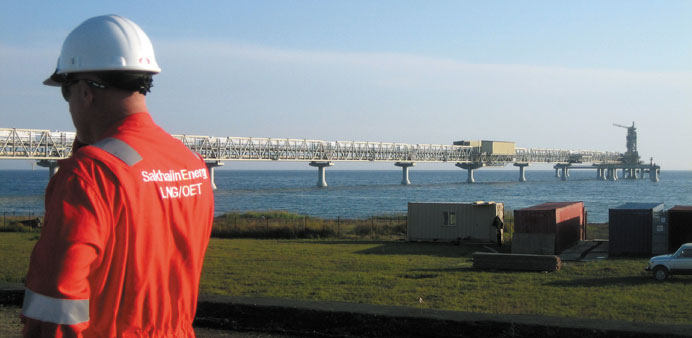
A worker stands near a liquefied-natural gas plant south of Korsakov, Sakhalin Island, Russia. A disruption of natural gas supplies to Europe by an escalation of Russia’s military action in Ukraine may boost LNG demand and prices in Asia and South America, according to Societe Generale and Morgan Stanley.
Bloomberg/Singapore
A disruption of natural gas supplies to Europe by an escalation of Russia’s military action in Ukraine may boost LNG demand and prices in Asia and South America, according to Societe Generale and Morgan Stanley.
Russia, which provides Europe with more than a quarter of its natural gas mainly though Ukraine, has cut supplies twice since 2006. While the current crisis hasn’t interrupted exports, liquefied natural gas prices will “move through the roof” if flows transiting Ukraine are stopped, said Thierry Bros, an analyst at Societe Generale in Paris.
The deployment of Russian troops into Crimea last weekend roiled energy markets, setting off the biggest rally in UK gas prices in 29 months and prompting Europe to import the most gas from Russia in almost a month. Any potential supply curbs may cause traders to stop selling LNG cargoes out of storage and instead hold them for domestic use, triggering competition for the fuel in South America and Asia, according to Holmwood Consulting, a Surrey, England-based energy consultant. “The only way South America can get them is to outbid Asia,” said Leigh Bolton, managing director at Holmwood.
Europe could see supply threatened by an escalating conflict or if Russia decides to punish Europe for supporting Ukraine, Shane Oliver, the chief economist of AMP Capital Investors in Sydney, said in a research note March 3.
Russia shipped 505mn cubic meters of gas to Europe, excluding Baltic countries, on March 4, the highest level since February 7, according to data from CDU-TEK, a unit of the country’s energy ministry.
Some LNG terminals in Europe can be used by traders to store and later reload cargoes of the gas chilled to minus 160 degrees Celsius (minus 256 degrees Fahrenheit) to meet spot demand from buyers globally.
The Netherlands’ Gate terminal will probably be the first to stop selling cargoes from storage as the country supplies gas to Germany and countries further east that could demand more if Russian supplies are cut, according to Bolton. Belgium’s Zeebrugge could also stop reselling cargoes, he said.
“Germany is a large user of Russian gas, but as you move further east into the Czech Republic that’s where the exposure to Russian gas increases,” Bolton said.
LNG terminals in the European Union had a total capacity of 18.5mn metric tons a year while only importing about 6mn tonnes in 2012, Adam Longson, an analyst at Morgan Stanley, said in a March 3 research note. “Import capacity should not be an issue,” Longson said. “However, the economic costs could be high.”
Rising demand and prices would put “greater strain on all LNG importing economies” in Asia, Western Europe and Latin America, Longson said.
UK gas for next month, the European benchmark, jumped as much as 2.7% to 60.15 pence per therm ($10 per million British thermal units) at 3:08 pm London time on ICE futures Europe.
LNG to be shipped over the next four to eight weeks to Northeast Asia dropped to $18.20 per million British thermal units in the seven days ended March 3, down 6% from $19.40, New York-based research company Energy Intelligence Group said this week on the website of its World Gas Intelligence publication.
Prices in North Asia are forecast to decline next week, according to nine of ten traders surveyed by Bloomberg News yesterday. Asian importers typically purchase fewer spot shipments in April and May on decreasing heating and power demand during spring in the northern hemisphere.
Japan and South Korea were the world’s two largest LNG importers in 2012, followed by Spain, India and China, according to BP’s Statistical Review of World Energy.
Brazil was the biggest buyer of spot LNG in the Americas in 2012, according to the International Group of Liquefied Natural Gas Importers. The country gets 81% of its power from hydroelectric plants and last year sought to increase the use of fossil fuels after the worst drought in 50 years depleted reservoirs.
Gazprom warns it could cut gas exports
Russian energy giant Gazprom yesterday warned Ukraine it could cut off gas exports if the new authorities in Kiev did not pay a bill for debt that now stands at $1.89bn.
“Ukraine has de-facto stopped paying for gas... We cannot deliver gas for free. Either Ukraine pays the debt and pays for current supplies or the risk appears of a return to the situation at the start of 2009,” said Gazprom chief executive Alexei Miller, quoted by Russian news agencies.
Gazprom in 2009 cut off gas to Ukraine in a move that also left much of the EU without supplies. Europe imports around a third of its total gas needs from Russia.
Miller said that yesterday was the final cut-off date for payments for February’s gas deliveries to Ukraine.
“Gazprom has not received the payment on its account. The debt due has increased and is now $1.89bn (€1.36bn),” he added.
Gazprom has already said it will end the substantial discount that Ukraine receives on market gas prices from April. But the European Union has said it will help Ukraine pay its bills. The 2009 dispute — which left homes in some European countries unheated in a freezing winter and also forced cuts in supplies to industrial customers — was brought to an end in a deal between Russian strongman Vladimir Putin and then Ukrainian premier Yulia Tymoshenko.
Tymoshenko was later jailed under Yanukovych’s rule for abuse of power because of her role overseeing the signing of the deal, which opponents said had been a bad one for Ukraine.
Gazprom’s threat caused an immediate selloff in Europe’s main stock markets which had briefly ticked into positive territory over positive US employment data.
Industry experts say thanks to the mild winter European countries have about six weeks of reserves and as warmer spring weather arrives demand should fall.
Nevertheless Bulgaria, one of the countries worst affected by the 2009 cuts as it is 90% dependent on gas shipped through Ukraine, announced earlier this week it is stockpiling supplies.