


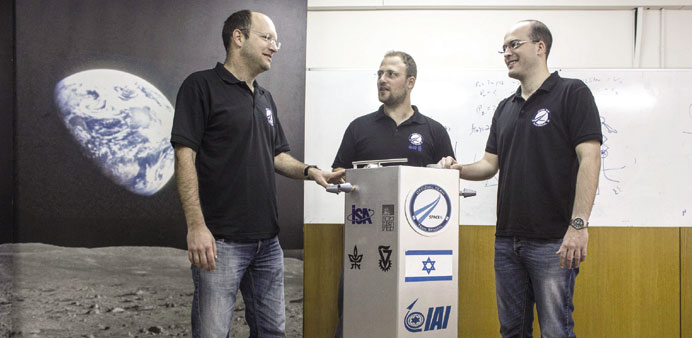
The co-founders of SpaceIL (from left) Yariv Bash, Kfir Damari and Yonatan Winetraub stand next to their company’s spacecraft process prototype at Bar-Ilan University, near Tel Aviv.
By Steven Scheer, Reuters/Tel Aviv
It’s only the size of a dishwasher and weighs as much as giant panda, but its inventors are hoping this spacecraft will go where no other Israeli vessel has gone before - to the moon.
Working on a shoestring budget, the Israeli scientists and engineers building the shuttle - temporarily named Sparrow - believe it will land on the moon by the end of 2015, a feat only the US, Russia and China have managed so far.
The landing will be the toughest task in the Sparrow’s mission, not least because of the moon’s many mountains and craters, said Yariv Bash, an electronics engineer and the founder of SpaceIL, the group building the spacecraft.
“(Landing) is going to be either 15 minutes of horror or 15 minutes of fame, depending on the outcome,” he told Reuters.
SpaceIL, which is backed mainly by philanthropists, was founded to compete for Google’s LunarX Prize, unveiled in 2007. The $20mn prize will go to the first team to land a spacecraft on the moon and transmit images and video back to earth.
Thirty-three teams started out in the running and they are now down to 18, including competitors from the US, Italy, Japan, Germany, Brazil, Canada, India and Chile.
SpaceIL believes it has an advantage because the unmanned craft is comparatively small - the size of a dishwasher with legs - and weighs just 140kg. Most of the craft’s weight is its fuel and propulsion system. By the time it lands on the moon, it will weigh a mere 40kg. “The smaller you are, the less it will cost to go to space,” Bash said.
The grey, six-sided shuttle will be fitted with nine computers and eight cameras, making it the smartest and smallest spacecraft to have landed on the moon, according to Bash.
At the moment there is just a prototype, with plans to start building the real machine later this year, a process that should take 12-18 months.
SpaceIL has raised $21mn in donations out of a total budget of $36mn it believes is needed to build and land the craft. It plans a crowd-funding event to secure the rest of the financing.
The group estimates other teams’ budgets at $50mn to $100mn.
Unlike some of the other competitors in the space race, SpaceIL - which has a team of 250 people of mainly volunteers - is a non-profit organisation and does not need to show investors a return.
Israel, which has experience in sending spy satellites to the lower orbit, does not have capabilities to launch into space, although the Israeli Space Agency is looking to develop a civilian space programme.